
This day in history: Undercover reporter who was ‘thirsty as a storage battery’ discovered free flowing booze

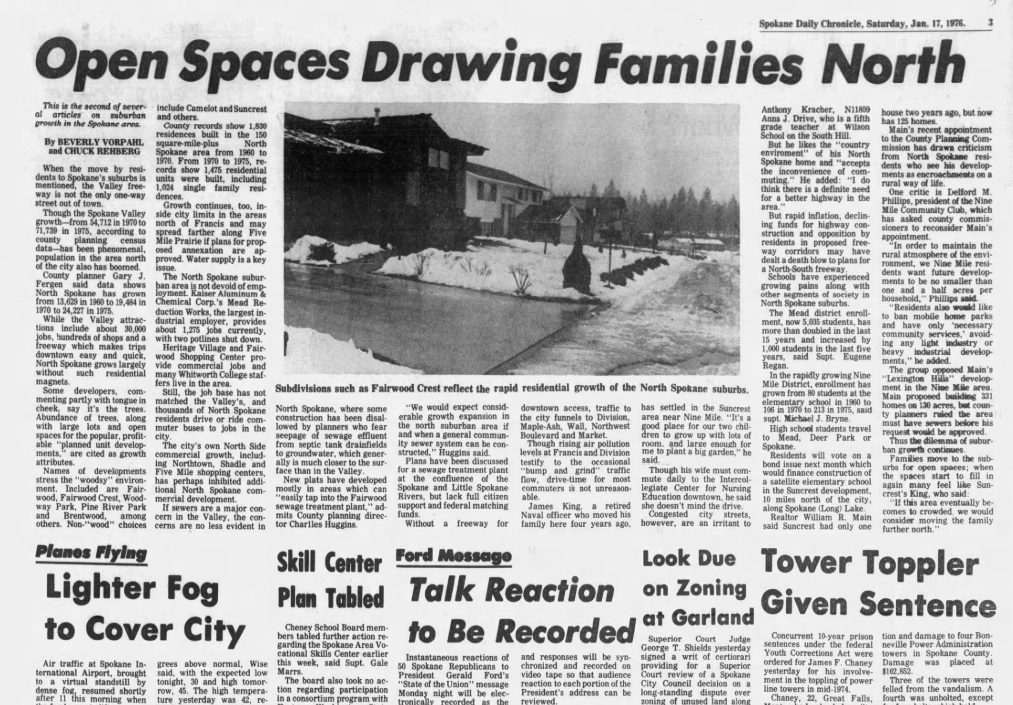
From 1976: The Spokane Daily Chronicle reported that the Spokane Valley area wasn’t the only suburb with a population boom – the area north of Spokane was increasingly popular.
The northern suburb population had jumped from 13,269 in 1960 to 24,227 in 1975.
“Some developers, commenting partly with tongue in cheek, say it’s the trees,” said the Chronicle.
The names of some of the developments had a decidedly woodsy sound: Fairwood, Pine River Park, Woodway Park, and Brentwood. In addition to the trees, the attractions included large lots and plenty of space for the increasingly popular “planned unit developments.”
Commercial development (meaning, shops and stores) were lagging as of 1976, as were job opportunities. Yet this had not discouraged growth, since there was reasonable access to stores and jobs on the city’s north half and downtown areas.
Despite the growth to the north, the Spokane Valley was still the most populous suburban area by far. It had almost three times as many residents as the northern suburbs.
From 1926: The Spokesman-Review sent an undercover reporter to the city’s seedier “resorts” and so-called “soft drink” bars to find out if the city was in fact a wide-open haven for illicit booze.
“He learned that the reports were founded entirely on fact,” said the SR. “He visited 12 resorts and in 11 of these he had not the slightest difficulty in buying moonshine over the bar by the glass.”
These visits came before federal Prohibition officers staged a mass raid downtown.
Here is how his encounter at the Utah Bar on Trent Avenue (now Spokane Falls Boulevard) was described:
I approached the bartender.
”Any booze?” I asked. “I’m as thirsty as a storage battery.”
”What say?” he asked, regarding me fixedly.
”I said, gotta drink?”
”Sure.”
He poured me out half a glass of whisky. Another customer sidled up and put in his order. We drank together, the “barkeep” rinsed our glasses and served chasers.
”Say, how is the burg? Wide open?” I queried.
The barkeep grinned. “Well, it ain’t closed. There’s plenty of booze.”
The undercover reporter then made second visits to the establishments after the raid, where he found “a much chastened bunch of foreigners, who told me they ‘weren’t handling it anymore – for a while.’”
At another place, he found a “huge padlock on the door – they had given up.”
At a third place, the bartender assured him that “liquor was still flowing in Spokane, but the boys were pretty careful.”