
Onboard system error appears to have routed double-decker bus driver to low bridge in downtown Spokane

Drivers for Spokane Transit Authority’s double-decker buses were rerouted by onboard navigation software onto Cedar Street before one of them crashed into an overhead viaduct downtown on Sunday, photos shared with The Spokesman-Review appear to show.
Roughly three and a half hours after the crash that sent seven to the hospital, the agency sent warning messages to other drivers not to take the detour from the usual route onto Jefferson, where the viaduct has high enough clearance for the double-decker buses.
“Starting immediately: DO NOT USE CAD maps for routing purposes until further notice,” the message warns, photos shared with The S-R show.
An hour later, agency officials decided to pull the double-decker buses out of service pending an investigation into the crash.
In interviews Tuesday, Spokane Transit officials said they were looking into possible technology issues Sunday but stopped short of acknowledging it may have contributed to the crash.
“I know for the integrity of the investigation, that’s not something I can speculate on,” said Chief Operating Officer Brandon Rapez-Betty.
Rapez-Betty also declined to state when STA first became aware of issues with their navigation system for the route, nor why it took over three hours to warn other drivers on the route not to rely on the software following the crash. Asked whether these types of navigation errors have been flagged in the past, Rapez-Betty suggested any issues Sunday were not unique and downplayed their seriousness, comparing any problems with the agency’s onboard system to errors an average driver might experience with Google Maps.
The navigation error and accident also coincided with a thrice-yearly service change, which STA officials characterized as relatively minor adjustments to the schedules of routes.
Though agency officials were quick to state Monday that the driver has worked with STA for four and a half years and is now on administrative leave, Rapez-Betty declined to say Tuesday whether the driver was new to the route.
“Operator experience is a subject of the investigation, so I can’t comment on that,” he said.
The driver, who would have driven past one low-clearance warning sign before smashing headlong into another, was cited for negligent driving and, as is standard protocol following any crash, tested for drugs and alcohol.
Chad Camandona, president of Amalgamated Transit Union Local 1015, the union representing Spokane Transit drivers, declined to comment on the pending investigation.
“We are aware of certain things, but at this point in time, we are just letting the investigation go through,” he said. “As a union we stand with our driver, and we’re hoping for the best for the people injured on the bus.”
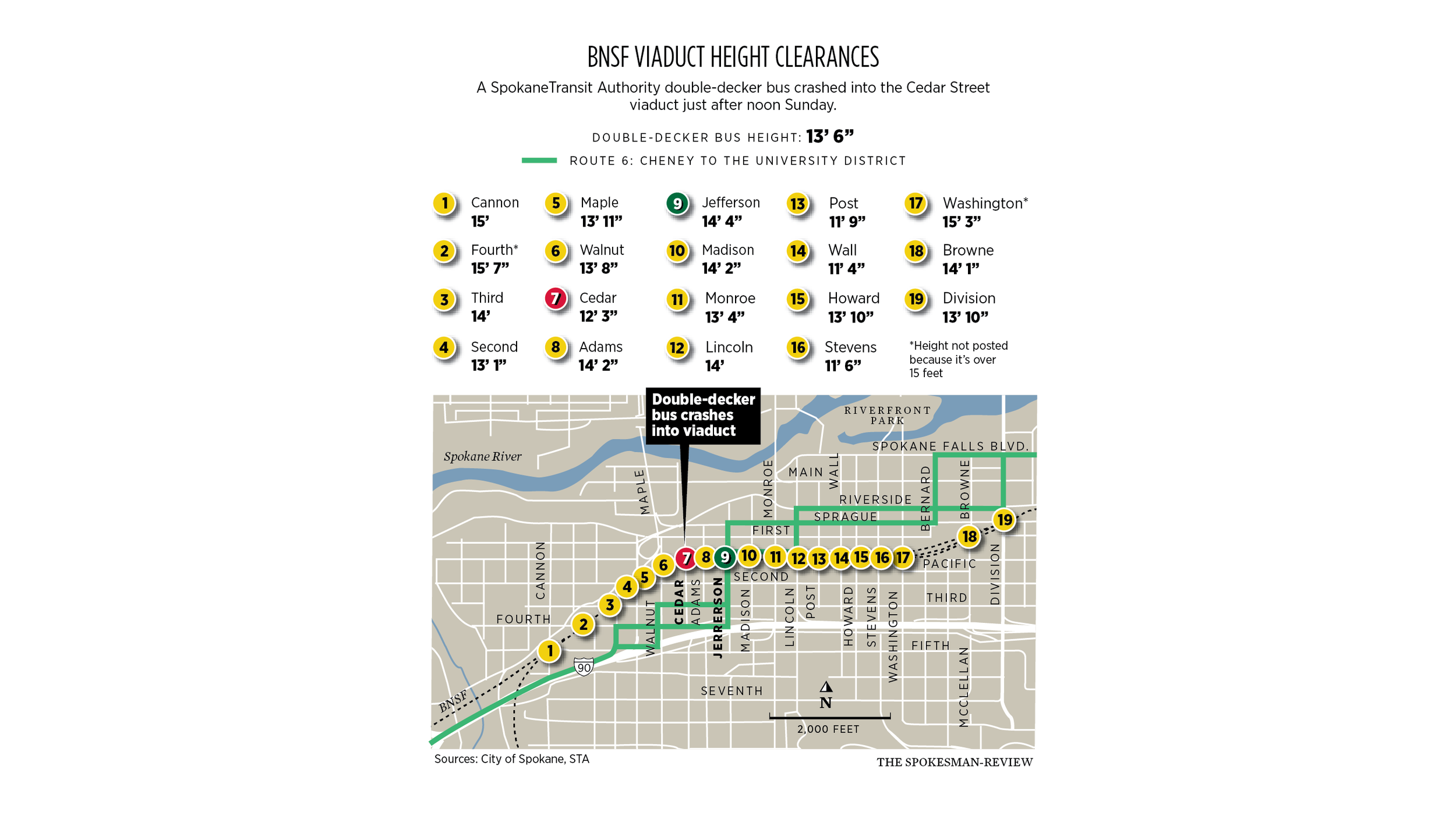
The roughly 37,000-pound, 13 ½-foot-tall vehicle traveling down a road with a 25 mph speed limit slammed into the roughly 12½-foot-tall railroad viaduct, shearing back the top foot of plexiglass, metal and plastic composite and continuing forward for another 6 or so feet before crunching to a halt. Of the 10 people on board – nine passengers and the as-yet unnamed driver – seven were hospitalized, though none suffered life-threatening injuries.
An Eastern Washington University student, Megan Hubbs, wrote on social media and told reporters that glass sprayed riders on the top level and she was hit in the face by a ceiling panel as the roof crumpled. Another, James McShane, was slammed forward during the crash into a plexiglass panel, knocking out a tooth that ripped through his lip and swelling his eye shut, his wife, Pam Davis, told KREM 2 News.
Photos of the crash appear to show the bus took more damage than the Cedar Street viaduct, though the warning sign and one flashing light was damaged. City officials quickly replaced the light, and officials with BNSF Railway, which manages the viaduct, did not respond to a request for comment.
Double, double
The Spokane Transit Authority raised a lot of eyebrows when the agency declared it planned to add seven double-decker buses to its fleet at roughly $1.4 million apiece, 75% of which was covered by state and federal grants.
There are few double-decker buses in Washington state. Sound Transit has 50 of them, all operating on the agency’s routes on Interstates 405 and 5. Community Transit in Snohomish County, a partner organization with Sound Transit, got into the double-decker business in 2011 and has 46 of the extra tall vehicles in its fleet, also chosen explicitly for express routes on freeways.
Spokespeople with both agencies reported zero crashes in that time with a low-clearance bridge.
Spokane Transit Authority is the only other agency in the state that uses double-decker buses. Sunday’s crash came just four months after the double-decker was introduced to the area on Sept. 20.
One of the most notable elements of downtown Spokane is the BNSF railroad viaduct that runs across the entire length of the city center just south of the downtown commercial hub. Depending on the particular cross street, the clearance can range from 11½ feet to over 15 feet.
It is not unusual for the roof of a tall vehicle to get peeled open like a tin can by one of those bridges. Between 2007 and 2017, 108 tall vehicles slammed into Spokane’s bridges, including 37 trucks that collided with the Stevens viaducts.
It happened again Tuesday when a moving truck managed to lodge itself completely underneath the Stevens Street viaduct, KXLY reported; crews reportedly had to let the air out of the truck’s tires in order to remove it.
Such accident frequency led to the double-decker buses having skeptics. Spokane Councilwoman Kitty Klitzke, who sits on the STA board, used to work inside the Community Building a few blocks north of the viaduct.
“An ordinary part of my work months was seeing someone get stuck under the overpass next to the Community Building,” she said. “I wasn’t involved in the decision to select these vehicles, but I had an immediate gut reaction after that decision was made.”
Spokane Transit was well aware of these concerns, and decided to only launch the double-deckers on Route 6 and 66 between Cheney and Spokane, primarily serving the very heavy traffic routes back and forth from Eastern Washington University. Compared to the 60-foot accordion -style buses in service elsewhere in the fleet, the double-deckers were noted for being more fuel efficient, able to seat roughly 20 more people, and were believed able to provide a “safer and more comfortable ride” for passengers, according to an agency analysis.
Rapez-Betty noted that the decision to add the double-decker buses was crosschecked and validated by WSDOT and approved by the state Legislature. The route had to be modified to go under Jefferson to accommodate the extra -tall bus, but the bus could detour safely through Adams, Madison or Washington if necessary.
The agency proved effective at turning skeptics into converts. Drivers praised the vehicle’s amenities and comfort, and several riders told The Spokesman-Review that they felt a sort of childlike wonder riding on the top floor.
About two weeks ago, De’Anthony Hamilton rode on a double-decker bus for the first time. The route wasn’t the direction he needed to go to get to his destination, but because his “inner child” was activated, he felt that he had to ride on the double-decker at least once.
“I went all the way up, and it was the coolest experience,” he said. “I just felt like a kid again.”
While peering through the big window on the upper level, Hamilton felt like he could see everything. Every person the bus passed seemed to be smiling and quite a bit smaller than usual, he said.
Vera Grey used to ride the double-decker every Tuesday. She felt uneasy when the bus had to take a turn, but her son was thrilled riding on top, and the cars on the street below looked like Matchbox toy cars from their vantage from the front.
“It’s really fun to ride up there, because it feels like you’re taller than everyone else and can see into buildings, especially here (downtown Spokane),” said Hudson McArthur, a student at Cheney High School who regularly commutes on the bus to and from school and work.
Still, when Hudson sat on the top floor, he avoided the front – partially because the bus gets too close to the overhead bridges for his comfort.
“When I heard about the story, I was very devastated, because I realized that could have been me (injured),” McArthur said. “And imagine my mom getting that call.”
The Spokane Transit Authority was so confident in its new route that it poked fun at the holdouts still paranoid about the viaducts with a “Jaws”-themed commercial ahead of the buses’ launch last summer, depicting a panicked passerby who was certain the bus would crash into the railroad viaduct. After the bus clears the Jefferson bridge, the digital reader board states: “Told you so.”
That advertisement was taken down over the weekend amid internet mockery, done out of sensitivity to the crash victims, said agency spokesperson Carly Cortright.
“I understand that the agency is the butt (of the joke), but … safety is our No. 1 organizational priority, and in hindsight, it appears we are discounting that safety,” Cortright said. “And we didn’t want people making fun of the victims. The internet could be cruel. I know some people would use it for nefarious purposes.”
Upon hearing about the Sunday crash, Hamilton said he was devastated. His thoughts and prayers go towards those who were injured, but he hoped the double-deckers wouldn’t be phased out because of one accident.
He also believed the mistake, though significant, shouldn’t draw too much away from the wonderful things STA has done and continues to do.
“I don’t think that bus driver knew that was gonna happen like that. I know they’re probably distraught right now. But I know that the City of Spokane will prevail.”
Rapez-Betty said the transit agency is committed to eventually returning its double-decker buses to service. In the meantime, the crowded route to and from Eastern Washington University will be served by other buses in the agency’s fleet.
Spokesman-Review reporter Mathew Callaghan contributed to this story.