
‘He was killed standing up for people like me’: Dozens show to Spokane vigil for Minnesota man shot dead by Border Patrol
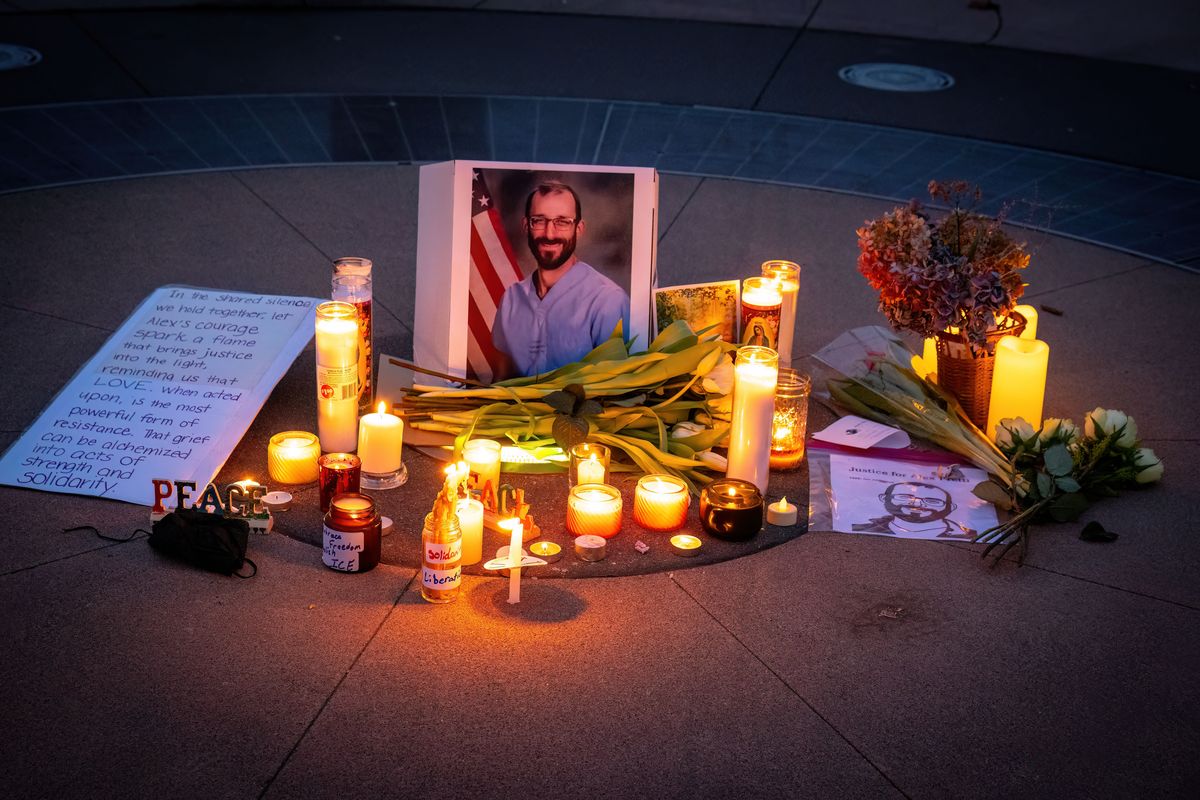
Nearly a hundred people gathered at Riverfront Park’s Rotary Fountain Monday evening, most standing silent, holding a candle and looking toward a photograph in the center of the fountain.
The photo, surrounded by candles of its own, was of Alex Pretti, a 37-year-old intensive care nurse for the Department of Veterans Affairs who was shot and killed by a Border Patrol agent in Minneapolis over the weekend.
“I saw the news on Saturday and I immediately just was filled with anger,” attendee Logan Taylor said. “It’s just one thing after another with this administration, and it’s – it’s so sad to see another dead person.”
Pretti was a U.S. citizen, and his death is the second in the past month to spark national outcry over the actions of Department of Homeland Security officers in Minnesota, coming just weeks after the Jan. 7 killing of Renée Good.
Taylor, 24, said he was in mourning Monday, noting that Pretti’s death was particularly upsetting because he was apparently trying to help a woman during a confrontation with Border Patrol agents.
“Nobody should be taken off the streets, especially by federal officers,” Taylor said. “That’s like the government’s whole job is to protect its people, but they’re actively killing us.”
The killings of Good and Pretti have been defended by elected officials, including President Donald Trump, Vice President JD Vance and Homeland Security secretary Kristi Noem – in some cases, recounting events differently from video evidence of each encounter.
Christi Malsam, 66, echoed Taylor’s concern over the Department of Homeland Security’s actions .
“I’m a registered nurse. I’m a Latina. I’m afraid of immigration,” Malsam said.
She remembers that her mother used to carry a laminated copy of her own birth certificate in case she was stopped by immigration enforcement in Texas, where she lived. Back then, proof of citizenship would be enough to end any confrontation, she said.
Now, Malsam carries copies of her birth certificate, marriage certificate and passport everywhere.
“You have to have those, and that’s if they take the time to look at it and not just take you,” she said. “So many people are being grabbed, and they’re telling (federal agents) ‘I’m a U.S. citizen,’ and they’re not listening.
“And then eventually they’ll figure it out, but in the meantime you’re roughed up, you’re shackled, you’re in a van with terrified people, and you’re in terrible conditions.”
When it came to Pretti, Malsam choked up.
“It’s so sad that he was killed standing up for people like me,” she said. “He cared enough to go up there and record what was happening and suffered the ultimate sacrifice.”
Malsam’s husband, Mike Malsam, 71, compared immigration officers pulling people off of the streets to conditions in 1930s Germany.
“I think it’s the tragedy, of course, of the death, but it’s just kind of also a tragedy of our humanity, what’s going on in this country,” he said. “This is more than just immigration. This is – I mean, you’re seeing innocent people, civilians being yanked out of cars … this is cruelty on top of all that.”
Acknowledging the vigil turnout was small, Christi Malsam said people may not have known it was happening. She and her husband were hopeful to see the community come together.
“I think it means a lot, because some of the people don’t see it. They don’t know anybody in the predominantly white city, so they don’t know that these things have been happening,” Christi Malsam said. “Now, they’re seeing it with their own eyes and hearing about it. So it’s making them much more aware, and those with a human heart are feeling compelled to be here.”
Community was a primary motivation for organizing the event. Alihna Grandos, 23, advertised the vigil with her brother on Facebook. An Eastern Washington University student, she said that she wanted to show Minneapolis support.
“Everyone’s kind of angry and sad and needs a community to just grieve together about it,” she said.