
New Washington Supreme Court Justice Colleen Melody, a Ferris High School grad, reflects on career, road to the court
OLYMPIA – While the U.S. Supreme Court often garners the most media attention, the vast majority of cases are determined in state courts, newly appointed state Supreme Court Justice Colleen Melody noted in an interview last week.
Disagreements between neighbors, parenting plans, divorces, contract disputes, criminal cases and workers’ rights cases are just a few of the areas of law that regularly find themselves in the state court system.
Around 95% of cases are filed in state, not federal, courts.
“The reason I bring that up is that, like I said, federal courts are in the news all of the time,” Melody said. “But also because it shows how important state courts are. That’s where almost all of our legal disputes are resolved. So they’re really, really important.”
It’s a system Melody is working to get accustomed to seeing from a new perspective.
At the start of the new year, Melody assumed the seat of former Justice Mary Yu on the state’s top court, a role for which she was nominated late last year.
The nine-member court on which Melody now sits is tasked with interpreting laws adopted by the Legislature, hearing appeals from lower courts and upholding the state and federal constitutions. The court also oversees the operations of lower courts and administers discipline to attorneys. Members serve six-year terms, and once on the court, typically enjoy strong records of re-election.
A Spokane native and graduate of Ferris High School, Melody attended the University of Washington, where she was a Gates Public Service Scholar.
While working on her undergraduate degree, Melody took a course called “Women and the Law” taught by Patricia Novotny, a lecturer she said served as an example of how to use the law to expand the rights of LGBTQ parents and litigating cases in the public interest.
The course, she said, prompted her to consider attending law school.
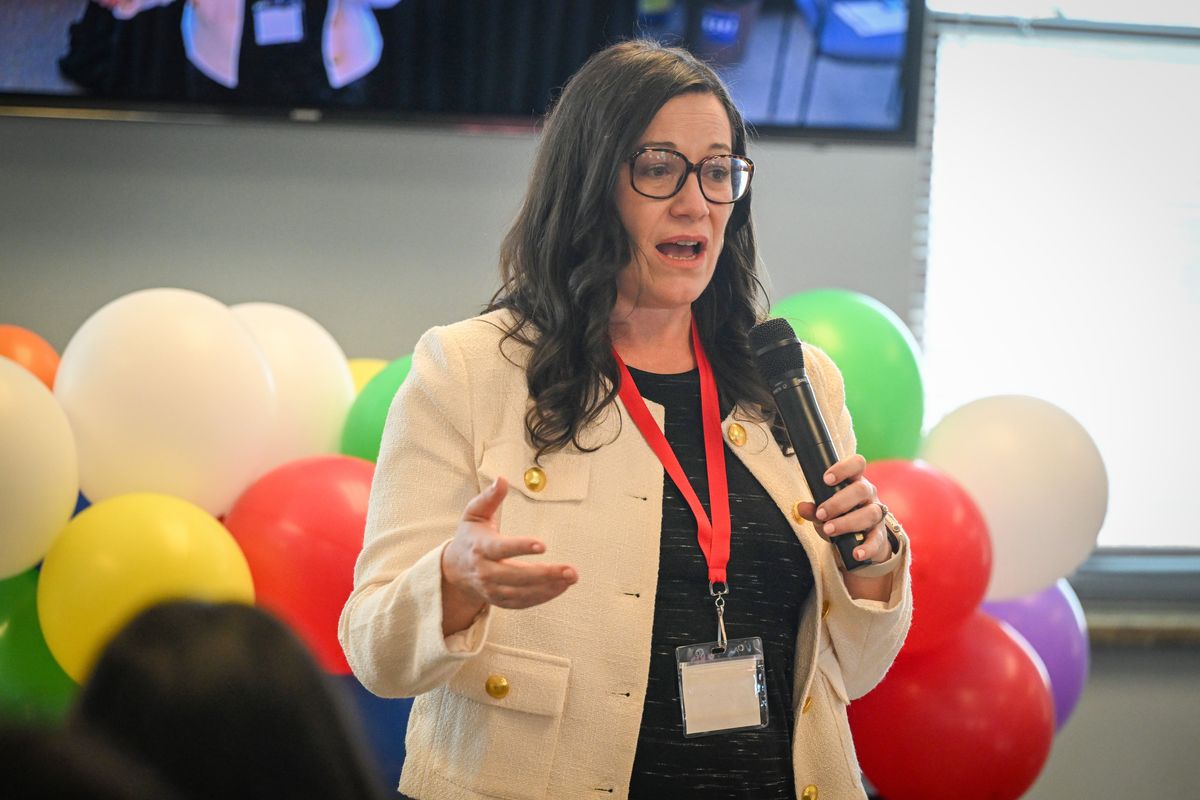
She made her first public appearance back in Spokane as a justice on Friday at the Color of Justice student outreach program at the Spokane County Courthouse. Students from the Spokane Public Schools and Cusick School District listened to attorneys and judges about how they began their careers in the law.
Melody, who appeared along with fellow state Supreme Court Justice Sal Mungia, told students to not shy from asking people questions about their careers.
“The only way I figured out what it means to be a lawyer was because people were willing to talk to me and I asked a lot of questions,” Melody said.
Her legal career spans courtrooms around the state and country.
Early in her career, Melody served with the U.S. Department of Justice civil rights division in Washington, D.C., where she earned the U.S. Attorney General’s Award for Outstanding New Employee and the Assistant Attorney General for Civil Rights’ Special Commendation for Outstanding Service.
After four years of working exclusively in the federal court system, then-Attorney General Bob Ferguson persuaded Melody to return to Washington to serve as the division chief for the Wing Luke Civil Rights Division in the Office of the Attorney General.
Melody’s appointment to the state Supreme Court is the first time she’s served on a bench, though she had a previous opportunity. Attorney General Nick Brown said Wednesday that while leading the judicial selection committee to recommend candidates to serve as federal judges in Western Washington, he tried to persuade Melody to consider the role.
“I tried to steal her from you, Gov. Ferguson,” Brown said. “I was just not successful.”
While in the attorney general’s office, Melody led many of the state’s most high-profile challenges to both Trump administrations. During the first Trump administration, Melody led the state’s efforts in 2017 against the first travel ban President Donald Trump issued. Last year, Melody secured a restraining order against the Trump administration after the president attempted to end birthright citizenship through an executive order.
Melody’s work, Ferguson said Wednesday, was on “some of the most consequential cases in our state’s history.”
But for 11 years, the role also took her to dozens of county court houses in “quite literally every corner of the state.”
It’s this work, she said, that spurred her deep appreciation of the state court system.
“I just developed this deep appreciation for the role of independent, excellent, state court judges interpreting Washington’s constitution, Washington’s laws, independently from whatever is happening at the federal level, and understanding that Washington is a sovereign state in our republican system of government,” Melody said. “I came to really value the special role that state court judges play.”
After serving in the attorney general’s office for more than a decade, Melody said her new role is a “huge change,” something she was aware of when she applied.
When leading the civil rights division, Melody’s responsibility was to “prosecute to the full extent” the cases her office thought presented civil rights violations and “achieve all appropriate remedies that we could.”
“That’s not the job now. The job now is to impartially and fairly assess the facts and the law of each case individually, and to determine them on their merits,” Melody said. “Regardless of if I would have brought the case, whether I like the outcome, how I sort of personally view the policy implications of any decision.”
While she formally took the oath of office during a ceremony inside the Temple of Justice last week, Melody has officially served in the role for the past three weeks.
On New Year’s Day, Melody was sworn in as the 100th member of the Washington state Supreme Court to ensure that the court’s bench was full.
Her first weeks on the court have been spent learning the court’s functions, deciding which cases the court will hear, hiring and onboarding law clerks and getting to know the eight new colleagues she now serves alongside. Earlier this month, Melody sat in on her first oral arguments on her first two cases as the court began its winter term.
The work, she said, comes as public trust in the legal system is teetering.
“At a time when there are questions about the stability, the durability of institutions and when we see the credibility of courts starting to slide in national polling, I think there’s an opportunity for state courts to set themselves apart and make more clear that they have an independent and separate role from the courts in the federal system,” Melody said.
It’s work that Melody has always felt called to.
Her dad served as a Spokane Public Schools elementary school teacher and principal while her mom worked for the state Department of Health and her sister works for the state Department of Financial Institutions.
“My whole family is composed of public servants, and I think my parents taught me that you measure your worth and your work by how much you’ve given back,” Melody said. “And so, as a lawyer, I’ve never really considered doing anything other than public service.”
Spokesman-Review reported Emily White contributed to this report.