
FAA ignored warnings before DCA crash, federal investigators say
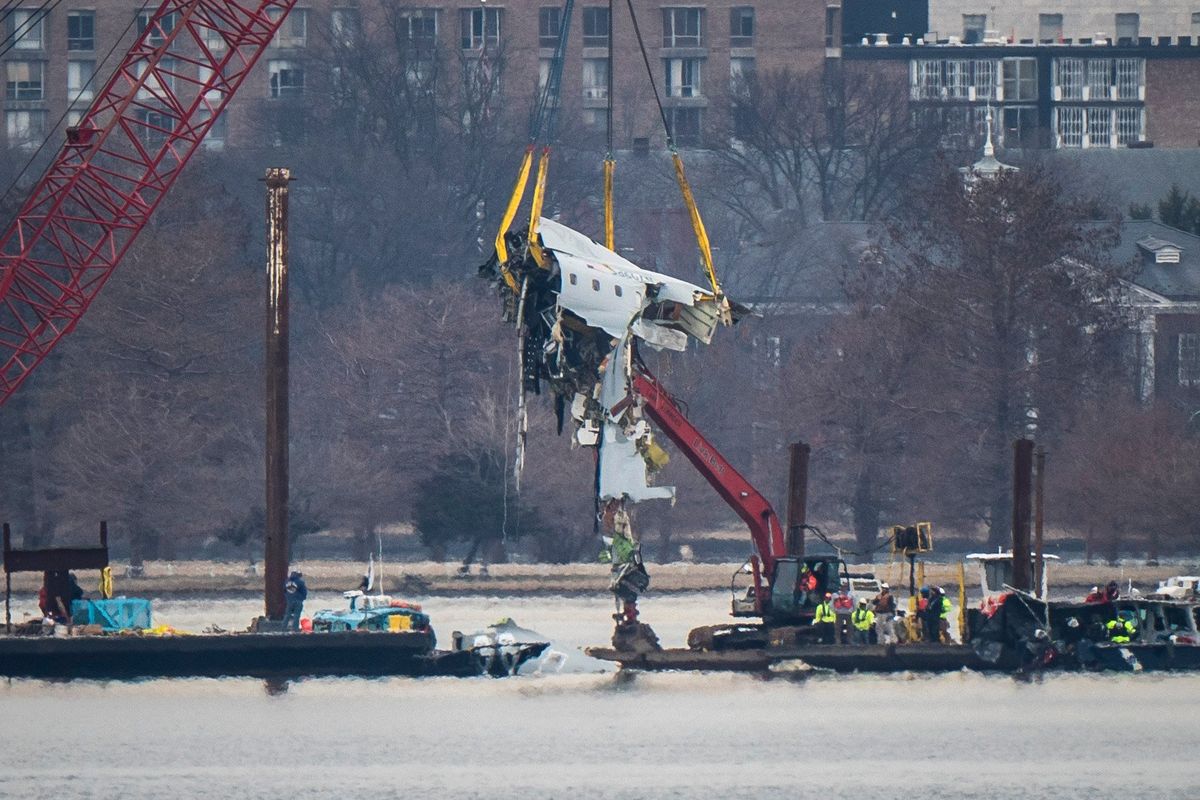
The Federal Aviation Administration is continuing to ignore warnings about close calls between aircraft a year after a deadly collision above Reagan National Airport between a commercial jet and a U.S. Army helicopter, the head of the National Transportation Safety Board said Tuesday.
“Are there other hot spots? And am I concerned that the FAA is not paying attention to those other hot spots? The answer to that is yes,” Jennifer Homendy told reporters during a break in a hearing on the crash that killed 67 people.
Investigators found in their nearly year-long review of the tragedy that it was “100% preventable,” Homendy said. Air traffic controllers were routinely overwhelmed and probably desensitized to the number of near misses at the airport, investigators concluded, while pilots were left to manage visual separation from other aircraft on their own, without being told how narrow their flight paths were. And controllers and pilots who flagged the situation as dangerous went unheeded, they said.
“We have an entire tower who took it upon themselves to try to raise concerns over and over, and over and over again, only to get squashed, by management and everybody above them within FAA,” Homendy said. “For years, no one listened.”
Within the FAA, she noted, people did not want to be interviewed on the record “because they are afraid of retaliation.” Employees said that management discouraged them from reporting some issues because doing so made the facility “look bad.”
In its conclusion, the board found that the largest factor in the crash was the FAA’s placement of Route 4 directly in the path of Runway 33. “This helicopter route should not have been there in the first place,” Homendy said.
“The FAA values and appreciates the NTSB’s expertise and input,” the agency said in a statement. “We will carefully consider the additional recommendations the NTSB made today.”
The investigation also faulted the U.S. Army, finding that it failed to warn pilots that their altitude readings might be inaccurate, while not logging close calls with other aircraft around National. Overall, the Army did not adequately train its pilots on the specific dangers of the airport’s congested airspace, the NTSB said.
The helicopter crew members, with limited visibility and unclear transmissions, probably confused a more distant plane for the commercial jet they were supposed to avoid, investigators found. The plane crew received no warnings about the helicopter from air traffic controllers.
Safety could be improved massively if all aircraft were required to both broadcast their locations and receive location reports from others in the sky, Homendy said.
The hearing, held at NTSB headquarters in D.C., comes two days before the one-year mark of the crash between an Army Black Hawk helicopter and an American Airlines regional jet. It provided the most detailed re-creation of the crash to date and, for the first time, offered specifics on the collision, as the Black Hawk’s rotors hit under the jet, severing a wing and causing both aircraft to immediately drop into the Potomac River.
The Trump administration has focused closely on the failures of the Black Hawk crew. In response to a lawsuit filed by family members of the victims, it said both the crew and air traffic controllers contributed to the crash. The NTSB, however, emphasized that the causes were systemic failures that went far beyond individuals.
“I want to make it crystal clear any individual shortcomings were set up for failure by the systems around them,” member Michael Graham said.
Investigators also said that FAA maps gave no clear guidance on the exact parameters of the fatal helicopter route, and that the agency did not conduct required annual reviews of helicopter paths that gave little room for error, despite years of warnings from pilots flying the routes.
“How is it that no one, absolutely no one in the FAA did the work to figure out there was only 75 feet – at best – 75 feet of vertical separation between a helicopter on Route 4 and an airplane landing on Runway 33?” Homendy asked.
Congestion crisis
Investigators showed that in the minutes before the crash, the airspace into National was extremely congested. The controller was managing five helicopters and six aircraft – after more than five hours in the seat without additional help, the NTSB said. Nine times in the 18 minutes before the crash, approaching collision alerts can be heard in the background of tower transmissions.
To support that finding, investigators created a simulation of the crash, synchronizing recorded audio from the air traffic controller and transcripts from the cockpit with their re-creation of the minutes leading up to the collision. They also conducted a visibility study to simulate what both pilots might have seen while flying. In December, The Washington Post published an investigation that examined the bright skyline around Reagan National Airport and whether city lights in the area, especially as viewed through night-vision goggles, may have played a role in the crash.
Investigators said there was no evidence that any of the pilots or controllers involved were unqualified, impaired or sleep-deprived. But the FAA did not do timely drug and alcohol testing of controllers in the tower that night, they noted.
There were 60 passengers and four crew members aboard Flight 5342, which began its journey in Wichita and was on final approach to National when it collided with the Black Hawk helicopter, on a training mission and carrying three crew members. Among the passengers on the regional jet were young figure skaters and coaches returning from a special development camp.
Calls for action
In the wake of the crash, both the Army and the FAA have made changes. The Army has since recalibrated altimeters across its fleet and prohibited missions from the Pentagon’s helipad after an incident in May in which radar at the Pentagon lost visibility of an approaching Black Hawk.
The FAA, for its part, has banned nonessential helicopter traffic near National and permanently closed the helicopter route the Black Hawk took on the night of the crash. It also has slowed arrival rates for planes at the airport – a change that air traffic controllers had lobbied for unsuccessfully in the years before the Jan. 29 crash.
Ben Shtuhl, whose partner, Melissa Nicandri, was among the passengers aboard Flight 5342, said the changes were necessary but don’t go far enough. “The NTSB report is another step in getting real accountability from agencies and others,” he said.
Sens. Mark R. Warner and Tim Kaine, both Democrats from Virginia who have long opposed efforts to add flights at National and vowed to push for change, said in a statement that the board’s conclusions underscore how preventable the collision was.
“An overstretched system, overwhelmed air traffic controllers, an overreliance on pilots to maintain separation … and the Federal Aviation Administration’s failure to act on safety recommendations all contributed to a disaster that should never have occurred,” they said.
In their opening statements, board members somberly acknowledged the human cost to the family and friends of those who died.
“I’m sorry on behalf of all of us at the NTSB,” board member Todd Inman told the audience. “We should not be here. I told you yesterday none of us should be here. But unfortunately from tragedy, we draw knowledge to improve the safety for us all. It will not be an easy day.”
“I imagine every day since Jan. 29 has been incredibly difficult, and I imagine today is even more difficult,” Homendy said. “And Thursday, as we mark one year since this tragedy occurred, since you lost your loved ones. As a mom, I can only imagine what you’ve been through.”
On Wednesday, family members will gather at an event to honor those who died and the first responders who helped with the recovery efforts. They have already witnessed how quickly the changes they have spent months lobbying for can be undone, Shtuhl noted.
In December, for example, a provision in a Pentagon funding bill raised concerns among family members and drew a harsh rebuke from Homendy after it appeared to undercut a postcrash change from the FAA requiring that aircraft be equipped with technology that transmits their position to others operating in the same airspace. The Black Hawk helicopter was equipped with the technology but had a waiver that allowed it to operate without it switched on.
Shtuhl said he hopes the NTSB’s findings will bolster congressional efforts to repeal that provision by passing a bipartisan measure known as the Rotorcraft Operations Transparency and Oversight Reform Act (ROTOR).
“While the board meeting may end today, it’s not over,” Inman said. “Tomorrow begins the advocacy. It’s the time to actually really start the hard work for a lot of people.”