
How NBA big men evolved from post players to shooters and playmakers beyond the paint

When the Oklahoma City Thunder and San Antonio Spurs met in Game 1 of the Western Conference finals, one of the biggest stories was a classic battle between two elite big men in the Thunder’s Chet Holmgren and the Spurs’ Victor Wembanyama.
Both made the All-Star team this season, and they were the top two finishers in the voting for Defensive Player of the Year.
But here’s the plot twist: Shockingly little of the battle between those two giants took place in the paint. In Game 1, four of Holmgren’s seven shot attempts were 3-pointers. Wembanyama tried only two 3s, an unusually low total for him, but one of them was an audacious 27-foot pull-up to tie the game at the end of the first overtime.
This is a feature, not a bug. Chet Holmgren is 7-foot-1 and shot 243 3-pointers this past regular season. Victor Wembanyama is 7-4 (at least) and shot 350 3s. Their ability to play away from the basket at their size is the exact thing that makes them threatening: two dribbling, shooting, ballhandling giants executing moves that were until recently only performed by much smaller men.
And in their case, Holmgren and Wembanyama grew up playing that way.
“Yeah, the game is changing in front of our eyes,” said Spurs coach Mitch Johnson between Games 1 and 2, drawing on his own experience coaching youths before he got into the pros. “Those guys are probably at the forefront of that evolution of the game.
“You’d get a tall kid and tell him you’re supposed to screen and then play underneath the basket. And now they get to watch those guys, and who’s to say that’s where you should play, put them in a box. So, it’s pretty cool to see those guys play fundamentally, see them also modernizing the game in that regard.”
We’ll get more of that in the NBA Finals when the Knicks’ Karl-Anthony Towns — arguably the best-shooting big man ever — faces off against Wemby.
No generation of players has seen the game change on them quite like the big men who came into the league in the late 2000s. That contingent — which includes Al Horford, Brook Lopez, Kevin Love, Marc Gasol, Chris Bosh and LaMarcus Aldridge — was forced into one of the most radical adapt-or-die shifts that any position in the league has ever seen.
That evolution, like many, started slowly, and then accelerated suddenly. In Horford’s rookie year, only one center, Utah’s Mehmet Okur, made more than 100 3-pointers in the season; 36 centers played at least 1,000 minutes without a single make, including Horford.
This past season, 12 centers made at least 100 3s, including stars such as Nikola Jokić, Wembanyama and Towns … and also bench players such as Jay Huff and Sandro Mamukelashvili. (Holmgren finished just short, with 88.)
Conversely, only 13 centers in the entire league played at least 1,000 minutes without making a 3-pointer.
What we’re seeing in the playoffs is the culmination of a years-long drift of big men away from the low block to spotting up 23 feet from the basket. It has accelerated rapidly in the last dozen years, but this is a revolution half a century in the making.
We had many intermediate steps on the way to the modern game, from late-’80s and early-’90s with players such as Bill Laimbeer, Brad Lohaus and Manute Bol who occasionally camped out at the 3-point line, to early-stage “stretch fives” such as Okur and Sam Perkins.
But one player in particular got the transition rolling.
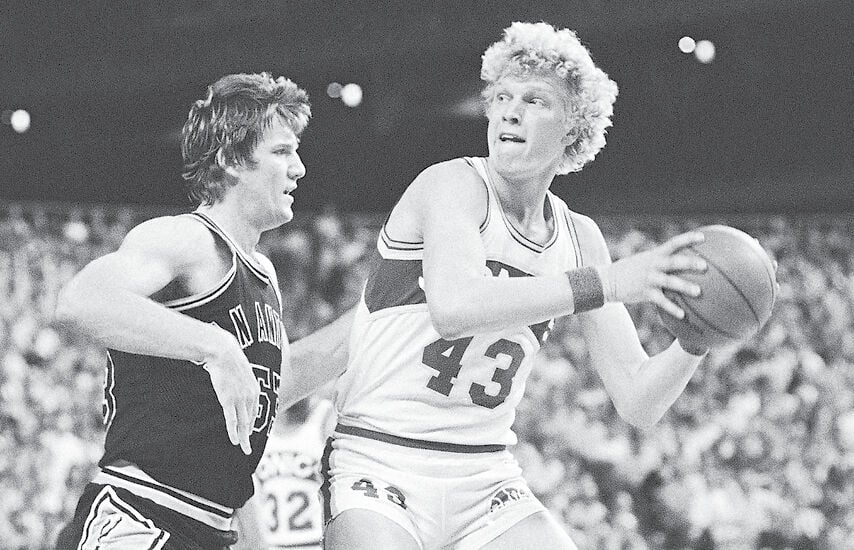
Jack Sikma wasn’t the first center to shoot a jump shot, but he might have been the first one to realize he could be a more effective player going backward than forward.
A progenitor of all the stepbacks you see from the likes of Steph Curry and James Harden and, yes, Wembanyama, was a much simpler move Sikma developed to neutralize his strength disadvantage and take advantage of his shooting ability.
In an era when big guys were told to get in the paint and mix it up, he wasn’t given the luxury of hanging out at the 3-point line. The line didn’t even exist in his first two NBA seasons. Sikma, who played his first nine seasons in Seattle and last five in Milwaukee, had only seven career 3s to his name until his 12th season in the league, when Bucks coach Del Harris realized how much space it could open for his other post players.
Instead, the 6-11 Sikma developed a pivot move with the ball kept high over his head. From that position, without dribbling, he could launch immediately into a nearly unblockable stepback jumper.
Sikma, who was a guard until a late growth spurt, could always shoot and was comfortable facing the basket. His inside pivot was how he could face the rim as a center. After his freshman year at Illinois Wesleyan, he and his college coach, Dennis Bridges, developed the move.
“My whole post game, with my inside pivot, was all based on the fact that my strength wasn’t a power move. It was to create a little space and use the shooting as the weapon,” Sikma told The Athletic. “I was a late bloomer, really skinny, grew late.”
His late-career evolution to the 3-point line somewhat mirrored that of Marc Gasol when I worked for Memphis. (Full disclosure: I was the Grizzlies vice president for basketball operations from 2012 to 2019.)
Sikma, like Gasol, was winning all the team’s shooting games in practice (Sikma was a career 84.9 percent foul shooter and led the league at 92.2 percent in 1987-88), so they finally realized he should shoot some of them in a game. He went from making three 3s in 1987-88 to 82 in 1988-89. The league’s other players listed as centers by Basketball-Reference that season made 88 3s … combined.
“When Del implemented it, where I was outside, basically pick-and-roll and pick-and-pop, it opened up the post,” said Sikma, for teammates such as Terry Cummings and Ricky Pierce. “It has transcended into keeping the middle open, attack off the dribble, and the spacing is so big.”
Sikma pointed out one less-discussed advantage of having bigs at the 3-point line — namely, that they’re big. “We don’t have to leave the floor to shoot it,” he said, and can easily launch it over a closeout.
Sikma also noted two big changes in the game since he played that made it more of a skill game than a power game.
“Attacks off the dribble started to be more effective when they changed the hand-checking rules,” Sikma said. “That was brought on by Jordan. They wanted more space.
”And then the post play changed when Shaq got in the league and they changed how you could guard the post with one hand on the back and the other elbow bent. That made it harder to score in the post. Those two changes made it evident that we should get the court spaced out. And if you had a big who could shoot, that’s a big benefit.”
Kevin Love can show you how the NBA has changed, 90 minutes before the game starts.
“You watch guys warm up before the game, there’s nobody in the paint!” the veteran big man said when I caught up with him in Utah this January. “We have 10 guys on the perimeter shooting 3s now.
“The only guys in the paint are rookies getting rebounds for the veterans.”
Of the players in this generation, none mastered the dark arts of jousting for position around the basket quite like Love.
Yet he, too, was one of the early practitioners of the big-man spacing game. Like Sikma, he realized he could go backward instead of forward, patenting one move in particular that befuddled opposing big men of that era: catching on the elbow near the free-throw line and then taking one dribble back to the 3-point line and launching.
“It came out of the flow of the offense,” Love said. “Rick Adelman, who is a genius, in his corner offense. He just opened up a whole different world for me offensively. I loved that shot. I still love that shot. And I was hitting stepback 3s and pick-and-pops, transition 3s.
“So it was something that I was looking for. But again, in today’s game, I think I would have probably have three or four more attempts per game.”
Love’s 505 attempts in 2013-14 ranked seventh in the NBA — nearly as many as his former Little League teammate Klay Thompson.
Love had some resources he could lean on for that move and others — one of Minnesota’s assistant coaches was a former player named Jack Sikma.
“Kevin was always a great shooter,” Sikma said. “It was a real weapon and had such a solid base, (he) could make some movement and still get under control and shoot it.”
Of course, Love needed to have a reliable 3-point shot to make that work. He could always shoot, but he was so effective on the glass that Minnesota didn’t want him far from the basket.
“When I came into the league (Wolves coach) Randy Wittman was like, ‘I just don’t see you shooting 3s right now,” Love said. “Maybe at some point you’ll step out and take a couple, but that’s not why we brought you here.’ It wasn’t really until Kurt Rambis, my third year, really pushed me into shooting 3s and kind of saw where the game was evolving and leading to.”
“And for me, it started off by being trail 3s. I eventually got into the pick-and-pop. And that’s where, like, outside of Dirk, I would like to think I was one of those first guys that ended up stretching the floor in a major way.
Unlike many of his contemporaries, Horford wasn’t a natural shooter. While for others it was simply a matter of taking shots in games that they were always able to make in practice, Horford’s pathway to the 3-point line was a more torturous matter of existential survival.
It’s mid-February in San Francisco, and Horford has just finished a game against Wembanyama where the two players combined to take 13 3-point attempts. This is the same guy whose entire offensive game consisted of left block post-ups when he came to the Hawks nearly two decades ago in 2007.
“I could have never imagined even shooting 3s, to be honest,” Horford said. “I always tell this story, but I used to see Joe Johnson practice with the Hawks in my first few years, and I would just see him shooting 3s, and I’m like, ‘Man, that’s such a deep shot.’
“I never imagined that I was going to be taking it.”
Which takes us to the half of this that people don’t really talk about: The big man 3-point revolution also changed entire lives on defense, rendering the plodding big men of yore virtually unplayable. Now, big men had to slide their feet at the 3-point line.
“You were taught your entire life to run back to the rim,” Love said. “You have to load up for guys like Giannis (Antetokounmpo) all the way to (Jalen) Brunson. So you have a guy that’s 6-11, putting pressure downhill, or Brunson who’s always trying to get into the paint and play off two (feet). And you find yourself looking, trying to help, and he’s pivoting and kicking out for a 3 for Towns. You kind of have to pick your poison. That’s why it’s such a luxury having a big that’s able to shoot.”
Talking to the veteran players, there was a certain wistfulness in how the game has evolved. It was clear that Lopez, Love and Horford all still relish their rare chances to mash in the paint. Pulling big men out from the middle opens the floor for everyone else, but it also takes away a lot of what they do best.
“I played my whole life establishing myself in the post and then working my way out,” Love said, but that abruptly changed when he joined up with LeBron James and Cleveland.
“That adjustment was hard.”
Those chances are fewer and farther between now, though.
There’s a flip side to that, too. These same bigs relish the bygone days of banging in the post — each of these players evinced clear pride in his ability as a post player — but they also wonder what a problem they would have been if they had come into the league in 2025 and let their perimeter games flourish.
“If I was shooting eight 3s a game,” Love said, “and the ball was in my hands and the game was played like this? Yeah, I think with my skill set, I could have done a lot of damage.”
And if Sikma played today, nearly half a century since his rookie season?
“I think I would have to really work on my mobility,” he said. “I would fit as a four as well or not better than a five in this day and age. It’s amazing … the bigs grow up learning how to handle. Two dribbles was about my limit.
“The whole approach has changed as far as skill development. I was a farm boy that played Friday night for the high school team. Now the amount of time that’s spent, it’s so organized. It’s creating more skilled basketball players.”
Giant skilled basketball players such as Wembanyama and Holmgren. And, like Sikma, they’re continuing to change the big man’s role in the game.
“You’ve gotta be athletic, you’ve gotta be able to move now,” Sikma said.
“But being 7-5 helps.”