
The write stuff: Spokane Calligraphy Guild celebrates the art of lettering
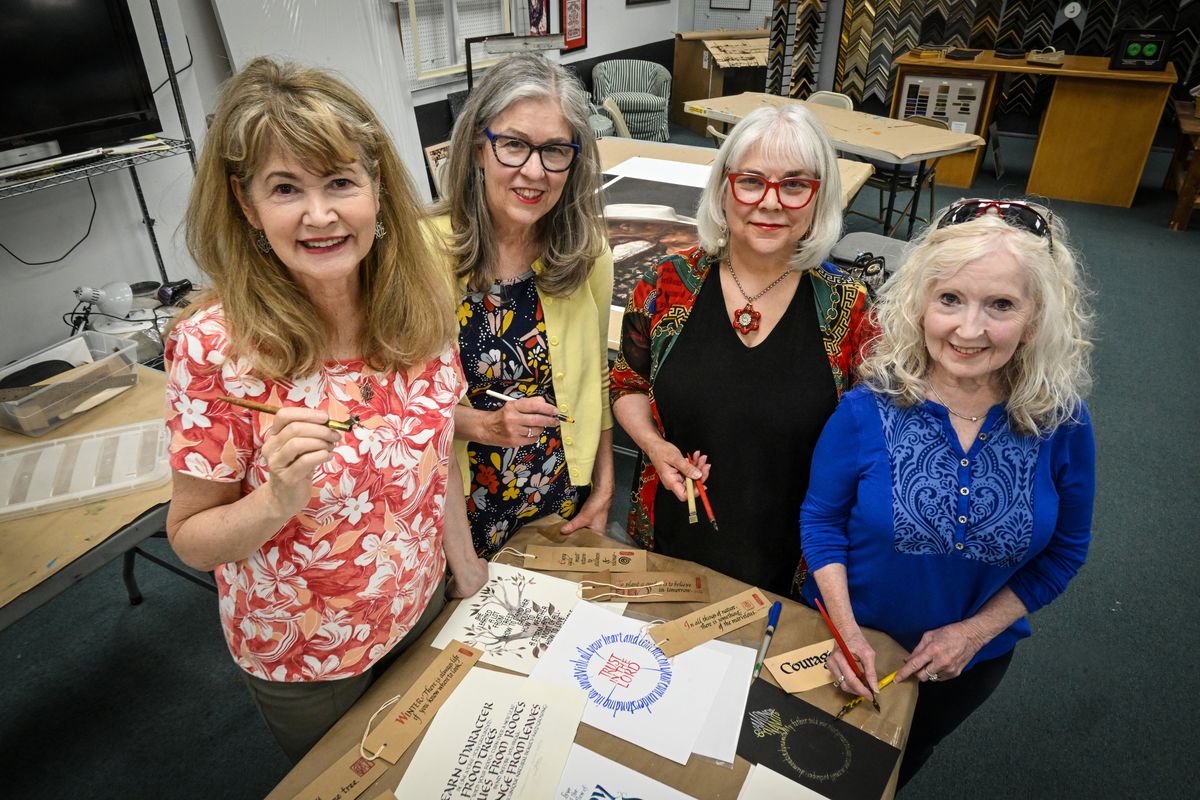
Text messages now dominate our written communication, and cursive instruction has disappeared from many schools. Yet, in Spokane, a small group is dedicated to preserving and sharing the art of beautiful writing.
Founded in 1982, the Spokane Calligraphy Guild meets monthly, September through June, at Spokane Art Supply.
They celebrate the art found in every letter.
A high school lettering class introduced Vicki Hall to the ancient craft.
“I liked art,” she said. “I thought I would draw or paint.”
But later, a calligraphy class inspired her, and she founded the guild with fellow enthusiasts, including Lars Neises.
At Spokane Art Supply, Hall picked up a calligraphy pen and soon stunning script looped and whorled across a piece of cardstock.
“It takes practice,” she said.
The art of calligraphy is no longer confined to luxury invitations. Artisans apply lettering techniques to everyday materials, from canvas hats or shoes to glassware. Tools include brush pens (flexible markers) or pointed pens with nibs that you dip into ink.
Shelby Barrentine, guild president, caught the calligraphy bug in 1978.
“I took a class, smelled the ink and was hooked,” she said. “It’s perfect for me because I collect quotes and lyrics in notebooks – it felt like a natural connection.
She’s been a member of guilds across the country.
“It’s like we’ve found our tribe,” Barrentine said.
The Spokane Calligraphy Guild is a 20-member group that includes newcomer Elisabeth Ramon.
A friend invited her to join.
“I like writing pretty words,” Ramon said. “I’ve learned a lot in just the few months I’ve been coming.”
Cynthia Moore echoed the sentiment.
“I was an elementary art specialist for Spokane Schools,” she said. “I happened to be at a presentation by Shelby. She taught us about the tools and had us practice.”
After she retired, Moore joined the guild.
At their meetings, members share techniques or tools, or they invite a guest expert to teach.
“I was the art teacher, and now I get to be the student,” Moore said.
Artist Linda Schneider said her parents had a copy of the “Speedball Textbook” and she got lost within its pages as a child.
Speedball is an American company that manufactures art and calligraphy supplies.
In a full-circle moment, a few years ago, the company commissioned her to create an ornate pictorial for one of its publications.
“It’s a very relaxing thing to do,” she said of calligraphy. “To me, it’s like doing a dance.”
She’s spent the bulk of her adult life creating this art.
“I did lettering for billboards in college,” Schneider said.
In addition to her professional work, she does “lettering on the go.”
When dining out, or in a doctor’s waiting room, or at an airport, she’ll ask a stranger for their name. She then transforms their name into a small piece of art, using the pens and paper she always carries.
“It often makes people cry,” she said.
Hall began doing this, too. Giving their gifts to strangers keeps the art of calligraphy alive.
“That’s why Vicki and I write in public,” Schneider said.
This summer, the Spokane Calligraphy Guild will showcase the timeless art of beautiful handwriting in a special exhibit at the Central Library, hosted in partnership with Spokane Public Library.
“We’re making lots and lots of weathergrams,” Moore said.
Weathergrams are brief, seasonal observations written on compostable paper and offered to the elements. Usually, they’re hung outdoors where they weather, fade and eventually return to the earth. At the library, they’ll be displayed on faux tree branches.
People frequently ask calligraphers about their favorite project, and Schneider’s answer never varies.
“My favorite project is always the next one,” she said. “No matter how long you’ve done it, there’s always something new to learn.”