
Getting cold feet at Dry Falls Lake | Michael Wright
Sitting in a float tube on Dry Falls Lake didn’t exactly make my toes go numb, but it was close.
It was Monday morning. Day two of the lake’s 2026 fishing season. About a half-dozen anglers were rowing one-person prams around the lake. They stayed dry and comfortable while I wore waders and fins and kicked my tube around, being careful not to venture too far from the truck.
My thermometer was at home, which was fine. I knew the water temperature without it: warm enough to prevent ice, but cold enough to raise questions about the wisdom of using a vessel that requires dangling your legs in the water at all times.
That’s pretty much the expectation for the second day of March at this lake near Coulee City, where it sits beneath steep rock walls at the head of a series of cataracts.
Cold water, lethargic fish and scant-to-nonexistent bug hatches are the norm for early spring lake fishing. In the waning days of a wimpy winter, however, it seemed possible that things would be different for the first week of fishing at Dry Falls. There was at least a chance the water would be warmer than usual, that insects would be hatching and that the fishing would already be incredible.
Even Darc Knobel, owner of the Desert Fly Angler in Ephrata, thought so.
“I’m shocked that our water temperatures have stayed cold like they have,” said Darc Knobel, owner of the Desert Fly Angler in Ephrata. “I really thought we’d have a jump start on the season but I guess the cold nights are just keeping us at normal temperatures.”
When reached on Thursday, Knobel said he’d heard reports of water temperatures at Dry Falls ranging anywhere from 38 degrees to 41.5. He’s heard that Lenice Lake, near Vantage, has had 48-degree water and better fishing.
Somewhere between 50 and 60 degrees is the sweet spot for trout. Much warmer than than that and lake-dwelling fish retreat to deeper water, where they’re harder to catch. Temperatures in the high 60s and low 70s are dangerous for trout, and in some cases deadly.
Anglers are already anxious about what’s to come this summer. Low snowpack levels might mean the low streamflows and high water temperatures might arrive sooner than in years past.
Those problems are still off in the future, though. It’s barely spring. Stillwater trout are still in the shallows. The water is still cold. It only gets warmer throughout the day, and the fishing only gets better.
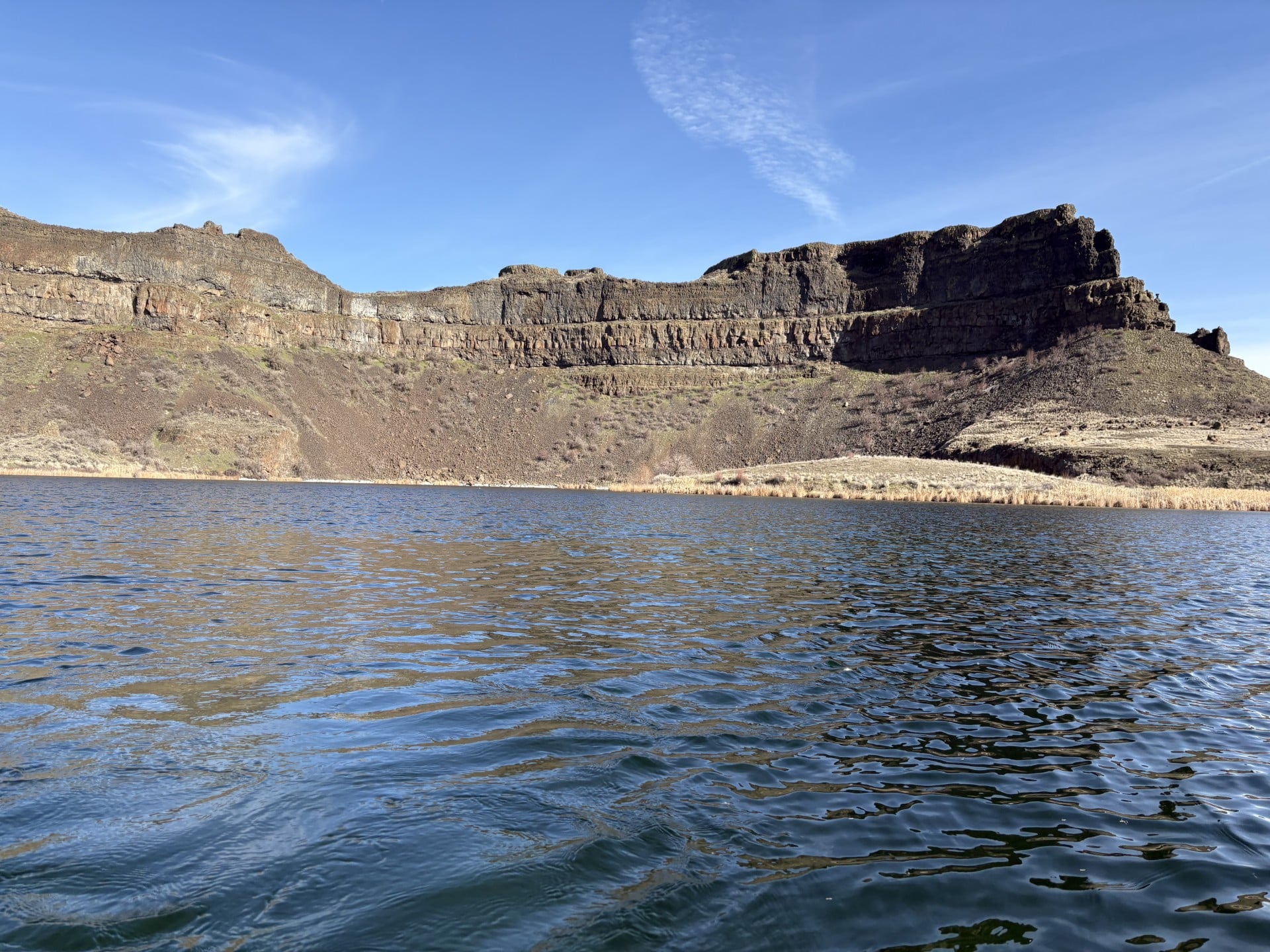
Dry Falls Lake is one of more than two dozen lakes that opened for the season last Sunday. Part of Sun Lakes-Dry Falls State Park, the lake itself is a geologic marvel. About two hours west of Spokane, the lake sits in a canyon carved by Ice Age floods, at the head of what was once a massive waterfall.
Now it’s a dry, desert landscape with a string of groundwater-fed lakes. Dry Falls Lake is the first in a chain that stretches south to Soap Lake.
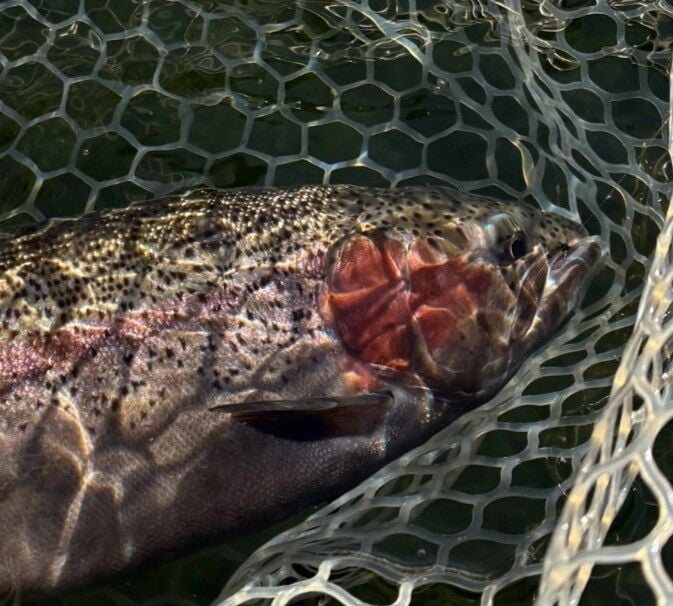
The Washington Department of Fish and Wildlife stocks Dry Falls with fry. The fish grow big, fat and feisty, which makes them a draw for anglers from around the state.
On Monday morning, as I worked the east side of a bay close to the parking lot, two anglers worked a rocky point on the other side. They each hooked fish, though not many of them.
Nothing of the sort happened to me. Around noon, I returned to the boat ramp for a lunch break and to warm my legs back up. An hour or so later, I headed back out.
Eventually, the two anglers in prams left the spot where they’d been catching fish and rowed back to the boat ramp. Not wanting to be too obvious, I waited until they were out of the water and then kicked across the bay.
The water was somewhat deeper there and had more obvious structure. Before the other anglers had driven away, my bobber went down. A 20-inch rainbow had eaten a chironomid pattern.
Not long after, a fish whose stomach was an inch wider than my palm ate a balanced leech. Less than five minutes after I released that one, another fish ate the leech.
It went on like that for another half-hour. Then the action stopped completely. I noticed my feet were cold again. It was time to go home.