
How a lone Montana bison bull has linked people, art and history across 140 years
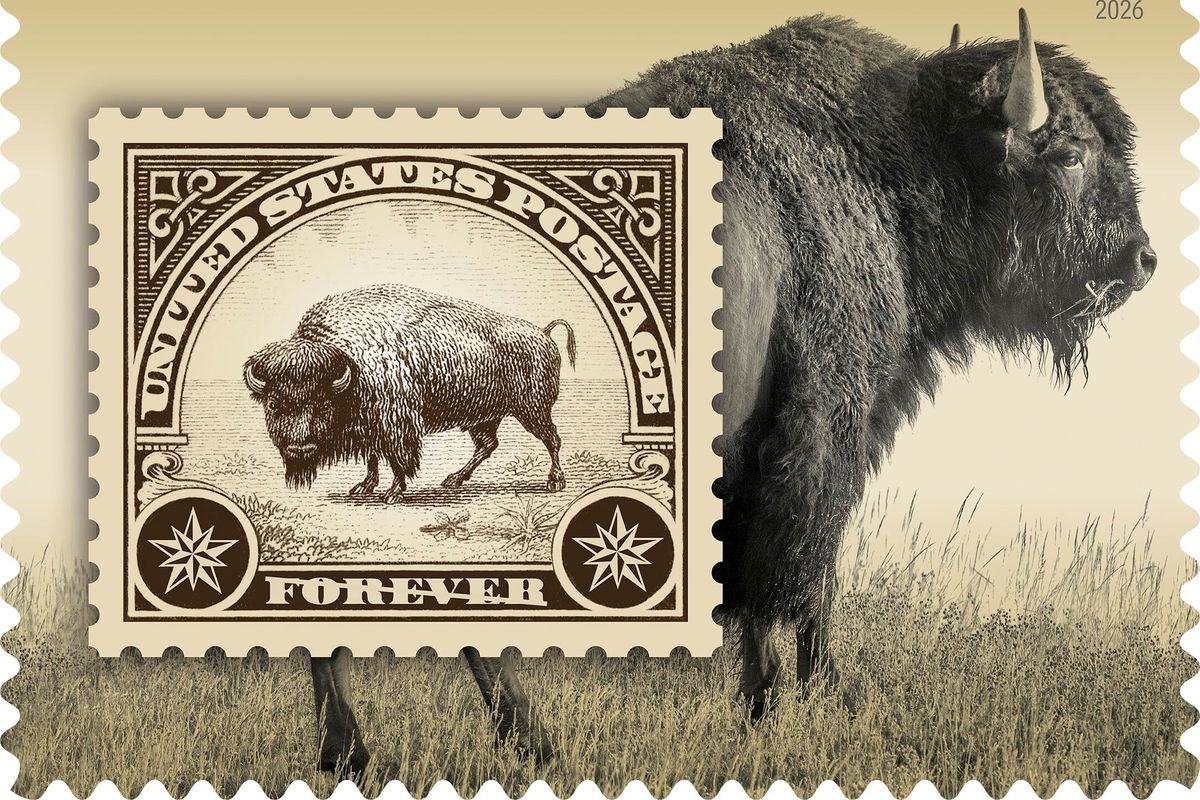
This circuitous tale, that connects a massive bison bull across 140 years of American history begins in 1886, when getting a message across Montana was a life-threatening task.
“My lost courier turned up alive after six days and nights out in the blizzard with only a raw sage hen for food, and although he came very near perishing he is now all right.”
This was how William T. Hornaday began his letter, dated Dec. 21, 1886, to the secretary of the Smithsonian Institution. He wrote the letter while still in Miles City, the location from which he had set out in mid-October in search of the last remaining bison reportedly roaming Eastern Montana’s bluffs and coulees between the Missouri and Yellowstone rivers.
The letter goes on to report how Hornaday, the Smithsonian’s chief taxidermist, had successfully killed 23 bison with the help of his four-man crew. The animals were located south of what is now Sand Springs, in Garfield County.
“We killed very nearly all we saw and I am confident there are not over thirty-head remaining in Montana, all told,” Hornaday wrote. “By this time next year the cowboys will have destroyed about all of this remnant.”
Bison connections
One of the eight mature bulls the hunting party killed, and Hornaday mounted for museum display, has linked the taxidermist and the animal to interesting people and events for more than a century, including: a famous Bronx artist known for his life-like depictions of dinosaurs; a 1901 $10 bill; a 1923 postage stamp; Fort Benton’s museum; a Livingston wildlife photographer; a 2026 U.S. postage stamp; and events planned at the Smithsonian National Museum of Natural History this spring.
The massive Montana bull was killed by Hornaday on Nov. 22, 1886.
He would later recount, “With the greatest reluctance I ever felt about taking the life of an animal I shot the great beast through the lungs, and he fell down and died.”
The bison measured 8-feet-4-inches around the chest and was estimated to weigh close to 1,600 pounds. When Hornaday skinned the animal he found four bullets buried in its body, shots fired by previous unsuccessful hunters.
The hide was later used to create a display of a family of six bison that were on exhibit for about 70 years, first at the Smithsonian Arts and Industry Building in Washington, D.C., from 1888 until 1910, and then at the National Museum of Natural History until 1957.
Famed dinosaur artist
Paleoartist Charles R. Knight made a full-sized drawing of a bison bull that was used for the ten-dollar bill issued in 1901. The bison, standing in profile but looking straight out with its tail raised as if ready to charge, was flanked on the currency by the profiles of the Corps of Discovery explorers Meriwether Lewis and William Clark.
“Greengrocers, housewives, gamblers, shopkeepers, and petty criminals all made contact, however fleetingly, with the great bull who went down in the Montana snow that long-ago afternoon,” wrote author Stefan Bechtel in his book “Mr. Hornaday’s War.”
Knight completed his drawing by observing a bison at Washington, D.C.’s Zoological Park where four captive bison were kept, according to the Postal Museum’s website.
“It is quite likely that Charles R. Knight saw both the mounted Hornaday Bull and the bison at the nearby zoo,” said Kirk Johnson, Sant Director at the National Museum Natural History. “Both the 1923 stamp and the Hornaday mount have the bulls head turned hard to the left.”
Calling him a “finicky artist,” writer Riley Black wrote for a 2012 National Geographic article that Knight “refused to work from photographs or films. Everything he needed to interpret organisms could be found through observation.”
Yet as Johnson observed, Knight’s bison drawing closely resembles the taxidermy bull Hornaday created for the museum exhibit.
From $10 to 30 cents
Knight’s bison drawing was so popular it was repurposed for a 30-cent stamp issued in 1923. Nearly 300 million were printed. It was unusual, according to stamp collectors, because it didn’t have a ribbon banner and description below the image of the bison like others of that era. It was also one of the first stamps printed on a rotary press, rather than a flat plate press.
Author Richard Milner, who wrote a book about Knight titled “The Artist Who Saw Through Time,” said Knight, much like Hornaday, “became haunted by the realization that all his beloved animal species were ultimately doomed and that humans were now greatly accelerating the process.”
The two men would meet when Hornaday became director of the Bronx Zoo in 1896 where Knight was hired to sculpt animals, such as an elephant, for the zoo’s buildings.
Hornaday’s exhibition of six bison was celebrated at the time for depicting animals in a natural setting and in a group, rather than solitary. After the display was dismantled, the animals were returned to Montana and placed in storage.
In 1996, after the aged animals’ hides were restored, the once-neglected mounts were again put on display in the Museum of the Northern Great Plans in Fort Benton, not far from where they had lived 100 years earlier.
A new bison stamp
This year, in honor of the 250th anniversary of the signing of the Declaration of Independence, the U.S. Postal Service will be issuing a series of historical stamps. Among them is one that imposes the 1923 engraving of Knight’s bison drawing over an image of a Yellowstone National Park bison taken by Livingston photographer Tom Murphy.
“You usually have to die before you get your picture on a stamp,” the 75-year-old Murphy joked.
He got the job on a referral from Glenn Plumb, the former Yellowstone chief of Natural Resources.
“I owe him,” Murphy said. “I bought him lunch.”
Fifteen million of the stamps will be printed, along with T-shirts and coffee mugs. A ceremonial release of the stamps is planned in Boston sometime in May.
Bronze bison
Murphy said it was Kirk Johnson who told him of the original bison stamp’s connection to Hornaday and the bison he killed in Montana.
“So Kirk is pretty excited about this,” Murphy said.
The Smithsonian, thanks to the support of donors, is having two bronze bison sculptures created by sculptor Gary Staab that will be 125% the size of the original, taxidermy bison.
The bull sculpture will be a representation of the one Hornaday shot in Montana in 1886. The second will be a cow and a calf. Together they will be installed on the upper plinths of the mall side entrance of the Smithsonian museum.
A foundry in Loveland, Colorado, will create the statues. In March, they will be trucked to Washington, D.C., making stops along the way in Denver, Lincoln, Nebraska, and Chicago.
On March 18, the bronzes will be installed followed by an April 2 dedication ceremony featuring tribal communities, government, museum and nonprofit partners, according to Johnson. In May and into June other Smithsonian exhibitions dedicated to bison, the national mammal, will be opened to the public.
Lifelong love of bison
A South Dakota native who grew up on a cattle ranch, one of the bison skulls Murphy pulled from the soil of his family’s land was dated to about 200 years ago.
“It wasn’t really old, which means it was probably one of the last wild bison in South Dakota,” Murphy said. “In the grass, when I was a kid, I used to find just the horn shells laying in the grass. The bones would rot away, disappear, but these horn shells lasted. So I’ve been intrigued by these bison since I was a little kid.
“I tried to talk my dad into selling his cows and raising bison instead, but he wasn’t interested.”
In addition to being a symbol of the West and the national mammal, Murphy is impressed that bison are the only large mammals to have survived the last Ice Age.
“Mammoths and mastodons, giant sloths, short-faced bears and dire wolves, all these huge, huge Ice Age mammals, and it’s the only one that’s left,” he said.
“They’re wild and ancient.”
Although nearly exterminated in the 1800s by hide hunters, sport hunting and a U.S. Army campaign, the largest land mammal in North America was saved in part by the actions of people like Hornaday, who formed the American Bison Society in 1905 along with President Theodore Roosevelt.
In an 1887 letter to the director of the National Museum Hornaday wrote, “It now seems necessary for us to assume the responsibility of forming and preserving a herd of live buffaloes which may, in a small measure, atone for the national disgrace that attaches to the heartless and senseless extermination of the species in a wild state.”