
The Spokane Civic Theatre has postponed its ‘Hunchback of Notre Dame’ musical amid concerns over cast diversity and threats to a performer
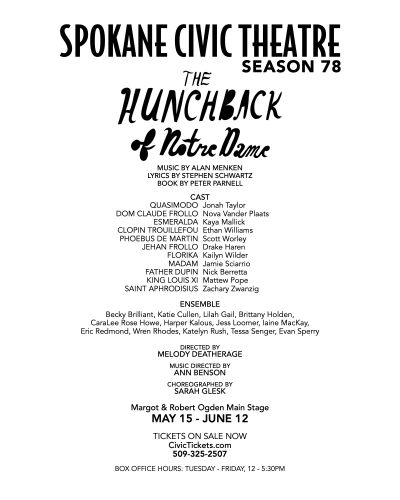

In “The Hunchback of Notre Dame,” Esmeralda and the Romani of Paris risk being driven out of the city because they are “Gypsies.”
So when a predominantly white cast was selected for Spokane Civic Theatre’s upcoming production of the Disney musical, actors and community members were quick to point out the irony.
“In the story, Esmeralda and her people, the Romanis, are the outcasts. They’re thought of as less than – they’re excluded. And then for the director to exclude all of the actors who fit the qualifications for those characters, it’s just such an obvious parallel to the story,” said Dana Sammond, a veteran performer at Civic and a part-time employee there.
Performers of color like Sammond, who is Chinese American, have spoken out since a cast list for the community theater production was announced Monday. The cast of 24 is largely white, the primary exception being the South Asian actress cast in the lead role of Esmeralda.
Several people of color say they were shut out of the production as Romani roles were given to white actors. They argue that oversight is the latest evidence of unconscious but systemic bias against Black and Brown performers in Spokane theater.
“We need some more color in the casting room so that this ‘unconscious’ bias don’t go unnoticed,” said Black performer Ijah Moore, who auditioned but was not cast in “Hunchback.” “If we look at the history of Civic and look at the shows that they have prioritized, why would people of color show up?
“They didn’t prioritize people of color for ‘Hunchback,’ so why would we show up?”
Bee Aaron, who was among the women of color who auditioned, said there should be more diversity among those who cast Civic productions.
“This was negligence on the part of Leadership for not taking the sensitivity of the material into consideration before assigning production roles and moving forward with casting,” she said in a statement.
As a person of color who has been in Civic shows before, Aaron said this was just the latest instance of bias at Civic.
“This particular director has a long history of casting ‘white’ actors in roles written for and intended to be played by people of color. This is not lost on the community, and we have taken notice of this pattern of behavior and refusal to take accountability for their internal biases. Malicious or not, there are visible internal biases at play here—whether it be racial or by association—There has been a blatant pattern of ‘othering’ practices that have been allowed to take place under current Civic leadership, and I fear this is a much deeper systemic problem than anyone realizes,” Aaron said.
The production is set to be directed by Melody Deatherage.
The theater announced Friday a “temporary pause” would be placed on the production in light of the controversy.
“The production of ‘The Hunchback of Notre Dame’ is currently on pause as we are listening…” reads a statement on Facebook. “This decision was not made lightly, but we feel it is the only way to authentically integrate potential action steps and learnings that arise in the coming weeks.”
Civic will host an open forum on Saturday, March 21, at noon. Taking place at the theater’s main stage, the forum will be moderated by former NAACP Spokane president Kiantha Duncan. Decisions about the future of “Hunchback” at Civic will be made following the forum, according to the statement. An “equity leadership consultant” will also be hired as an “advocate for inclusion” for future Civic auditions.
Inclusion in the theater is something taken “very seriously,” said Civic’s Executive Director Jake Schaefer.
“We’re working as hard as we can in real time. But this is demonstrated by effort, and we don’t want to miss that this is institutional,” he said. “The board and staff have met several times. We are having those conversations with people who have reached out directly or otherwise.”
They also are bringing a dramaturg, a literary adviser to a theater production, to ensure the cast and production understand the historical context of Romani and disability discrimination central to the plot of “Hunchback.”
One white performer cast in a Romani role has dropped out of the production amid what she has described as “death threats” against her.
Kailyn Wilder, who declined to speak with The Spokesman-Review, recently graduated high school. She was cast as Florika, a minor Romani character who has few lines and dies minutes into the play. Despite the role’s modest impact, the character has an outsized role in the plot as the mother of Quasimodo, the disabled protagonist of the piece.
Florika is also the first Romani character introduced in the story. She is betrayed by antagonist Claude Frollo minutes after he labeled all Romani as “criminals, foreigners and gypsies.”
Florika dies off stage after giving birth to Quasimodo, whom Frollo raises out of duty.
In a Facebook post, Wilder wrote she dropped out of the show because she did not want to “support anything that might be seen as discriminatory” after realizing the part in which she was cast was Romani.
“As of right now I want to make it VERY clear that I in NO WAY meant to cause any harm to ANYONE. My goal in life is to spread light, love and joy – so you can imagine my genuine horror when I saw all of this after doing more research,” she wrote.
Near the end of her post, the actress wrote that her mental health had been impacted from “receiving death threats from someone anonymous.”
Schaefer said he was “shocked” by threats sent to actors in the play, and he had urged the performer to report any threatening messages to the police.
Sammond said any criticism directed to the actors cast in the play is wrong.
“This is absolutely not her fault. She was put into this position, and she should not have been. None of us were asking her to quit. She is talented and deserved to be cast,” Sammond said. “Ultimately, I’m really proud of her for making the decision, because that’s a really hard decision to make. I can’t imagine how scared she must be after being threatened.”
What is ‘The Hunchback of Notre Dame’?
Based on the 1832 novel by Victor Hugo, “The Hunchback of Notre Dame” is a musical with many potential pitfalls for a local theater.
The central character, Quasimodo, asks the actor to portray a physically disabled and deaf young man. Much of the plot involves the discrimination of Romani peasants in France. While the 1996 adaptation retains many of the original themes and is widely considered one of Disney’s darkest movies, it also introduced comic relief in the form of a cartoon gargoyle singing an upbeat love song at a baby grand piano.
The juxtaposition of the zany antics of a ’90s Disney renaissance musical and the plot of a 19th-century novel about the corruption and racism of the Catholic Church can be difficult to meld.
When the writers of the Disney movie adapted their work to the stage, they returned the piece to a much darker tone.
The version of “Hunchback” to be performed by Civic has removed the dancing gargoyles and placed much more focus on Esmeralda, the erotic dancer and “gypsy girl” on which the plot hinges. In the play and novel, Esmeralda’s foreign beauty attracts a wide range of white suitors in Paris. When she rebuffs the sexual advances of antagonist Frollo, the powerful Notre Dame archdeacon burns Paris to the ground to capture and execute Esmeralda.
Performers ‘shocked’ by largely white cast list
Sammond was excited to audition and possibly perform in “Hunchback.” She wanted to be in the ensemble and had no conflicts.
“I didn’t want to be a lead. I auditioned for the show specifically to be in the ensemble because I love the music and I really like the choreography in the show,” she said.
Sammond has performed in at least seven Civic productions since 2017 and numerous other theater and burlesque shows across the city. She is also a part-time employee at Civic as a coordinator within their education department. She sometimes teaches young theater students at Civic as well.
At callbacks, Sammond said both white and nonwhite actresses were asked to audition for Esmeralda. She found that strange, but expected the lead, supporting and ensemble Romani characters would be cast from the more than eight performers of color she recognized from the audition.
But when she saw the cast list, only one of the performers of color she knew was cast.
“I felt a mix of surprise and disbelief. It took me a little while to let myself feel angry about it, because I choose, perhaps naively, to see the bright side,” she said.
To not have diversity in the cast when the piece calls for it and many people of color auditioned felt like a slap in the face. She also worries that the casting may discourage people from auditioning for Civic in the future.
“If this continues, it will just push POC actors away. And that’s harmful to the community, and it’s harmful to the theater,” she said.
Sammond also worries having so few performers of color on stage may make those who were cast feel tokenized by the production.
“If it were me being in the room and noticing that I was the only POC person, I would feel very uncomfortable and singled out and tokenized,” she said.
Kaya Mallick, who was cast as Esmerelda, does not feel that way.
“I didn’t feel tokenized until I heard what the community was saying. Esmeralda should be performed by a woman of color, and I’m honored I get to be that performer. Also, I would hope that the community trusts female artists of color to speak up and make such decisions for themselves,” she said.
Mallick said lack of diversity in local theater is a problem that needs to be addressed.
“I understand the frustration that many people have expressed about the cast list,” she wrote in a statement. “That said, I also feel very supported by Civic leadership. They were intentional about casting performers from a diverse array of ability levels, cultural & linguistic backgrounds, and genders & sexual orientations. While their oversight on racial diversity was disappointing, I do not believe it was malicious. I am optimistic that this conversation has compelled them to make some necessary changes.”
Who are the Romani?
The movie musical is among the most prominent depictions of the Romani people in American media, and the 1990s film has largely shaped the public’s understanding of the Romani and their culture, said Gonzaga history professor Ann Ostendorf.
“One of the problems with older depictions of Romani is that they have the stereotypes baked into it,” she said.
The Romani people are a nomadic ethnic group originating from northern India who later migrated throughout Europe. Subject to much prejudice and discrimination, the Romani have been commonly known as “Gypsies.” Significant populations of the Romani remain in Europe and continue to face discrimination today.
Used both as a slur and a term of self-identification, modern day usage of “gypsy” is complicated, Ostendorf said.
“It depends who you ask, and it depends on the context. In England, members of Romani communities refer to themselves as Gypsies. In America, it is often not seen as a slur, but it has been used as one historically,” she said.
Some younger Romani activists have pushed toward using more inclusive terms like Romani and phasing out Gypsy because of the “baggage” associated with the term.
Modern adaptations of “Hunchback” portray the Romani as a put-upon minority facing unfair discrimination. But the depiction relies heavily on stereotypes.
“Many minorities like Romani or like Native Americans can be stereotyped very romantically – as very strong or valiant,” Ostendorf said. “But often these depictions can still be considered problematic by some within the group.”
In “Hunchback,” Esmeralda fits the stereotype of a poor Romani woman who is sexualized. Much of the plot involves her helping white characters overcome their prejudice toward the Romani.
Though all sharing an ethnicity and culture, the nomadic Romani have a wide range of phenotypic features based on where their specific Romani community settled. Many Romani in northern Europe share many features of their white neighbors, while Romani communities in eastern and southern Europe appear much different.
“How Romani are racialized depends upon the context, the place and the time period. But apart from race, Romani are still very stereotyped as outsiders, as foreigners. Regardless of how their racial identity was categorized, these stereotypes compound across the centuries in Europe – that Romani are thieves or child stealers or of loose morals,” Ostendorf said.
Romani in the United States immigrated here largely to escape discrimination in Europe. It is unclear how large the population is because many Romani hide their ethnic identity to fit into American society, Ostendorf said. But because they remain largely invisible, most Americans’ only conception of the “gypsy” is through highly stereotyped depictions in media.
Most of these depictions on the stage and screen have been portrayed by white actors. Performers wore a specific shade of makeup known as “gypsy” to portray Romani. This kind of “gypsyface” was common throughout the United States and even included Girl Scouts- sponsored “gypsy camps” where white girls would dress up and perform as Romani for their parents, according to Ostendorf.
“Hunchback” itself has contributed to white performance as Romani. Since its 1996 premiere, the highly stereotyped outfit of a tambourine-playing belly dancer has been a staple of Halloween costumes.
This history may complicate the portrayal of white actors in Romani roles. Frequent Civic performer Nicholas Roy Morgan said he was concerned when Civic announced Hunchback at the outset.
“It’s always so controversial, because theaters pass a tan white woman as Esmeralda, put her in a curly-headed wig, call it a day,” he said. “That’s what happened in my hometown in 2018. It is a show where you always expect it to not be handled correctly.”
Despite not being Romani herself, Sammond believes strongly that the Romani characters in Hunchback should be played by people of color.
“I am not Romani, but I am the daughter of an immigrant. And I know the history of persecution,” she said.
“When white people in an audience see white people on stage experiencing persecution, it’s so much easier for them to sit through it. But when they see Black people, Brown people, Yellow people, queer people experiencing harsh realities on stage, that makes them uncomfortable. And maybe we need a little of that uncomfortability in the theater,” Sammond said.