
This day in history: CdA Tribe said state should turn back land. Spokane museum about to open in mansion

From 1976: The Coeur d’Alene Tribe was “pleased” – in part – with the Department of Interior’s ruling on the Heyburn State Park case.
The department ruled that Idaho had violated the 1911 agreement in which the tribe granted the land to the state under the express condition that the land “be used only for public recreation.”
The state had since violated the agreement by granting more than 200 leases for cabins and cottages in the park.
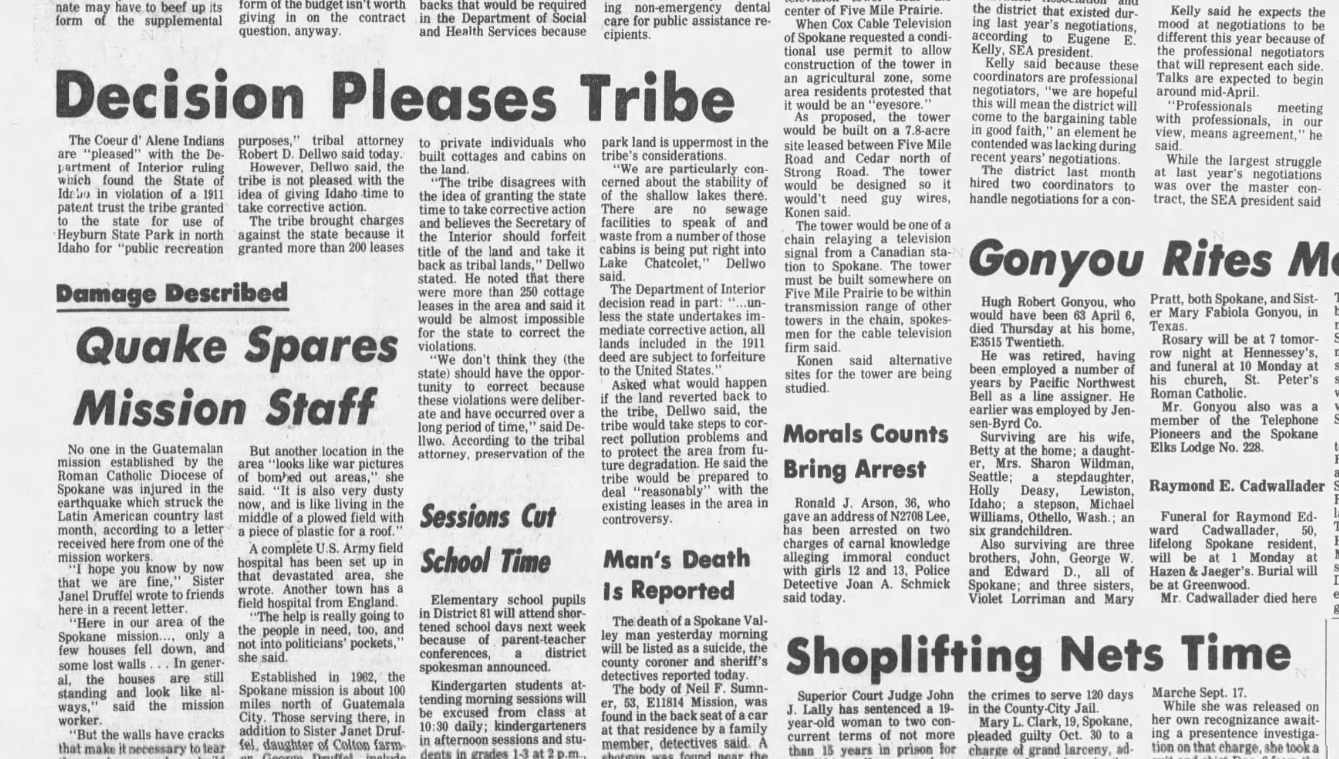
Yet the tribe was not pleased “with the idea of giving Idaho time to take corrective action.”
Robert Dellwo, the tribe’s attorney, said the tribe “believes the Secretary of Interior should forfeit title to the land and take it back as tribal lands.”
With more than 200 cottages, Dellwo said it would be impossible for the state to correct the violations,” and furthermore, Idaho shouldn’t even have the opportunity to do so,” because the violations were deliberate and have occurred over a long period of time.
More legal battles would ensue.
From 1926: Final preparations were being made on Spokane’s new “historical and art museum,” at its stately quarters at 2316 W. First.
This was the “old A.B. Campbell estate,” or, the Campbell House, as it’s known today to thousands of visitors to the Northwest Museum of Arts and Culture (MAC).
Campbell’s daughter had bequeathed the Kirtland Cutter-designed mansion to the public with the intent of turning it into an art museum named the Grace Campbell Memorial Museum, in honor of her late mother. The city’s historical and art associations subsequently merged under the name the Eastern Washington State Historical and Art Museum Association, “under whose auspices the new quarters are being prepared.”
The city’s fledgling historical museum had been housed for years in a succession of cramped spots best described as office space. Now, its artifacts were being moved into the Campbell House alongside the artworks.
The grand opening would take place on April 16, 1926.