
Book review: ‘North of Ordinary’ shows a survivor who lives on her own terms

A couple of weeks ago, we began an office pool.
Normally reserved for twice-a-year sporting events, the Super Bowl and March Madness. But this was for a randomly selected contestant of “Survivor,” the CBS reality TV show entering its 50th season.
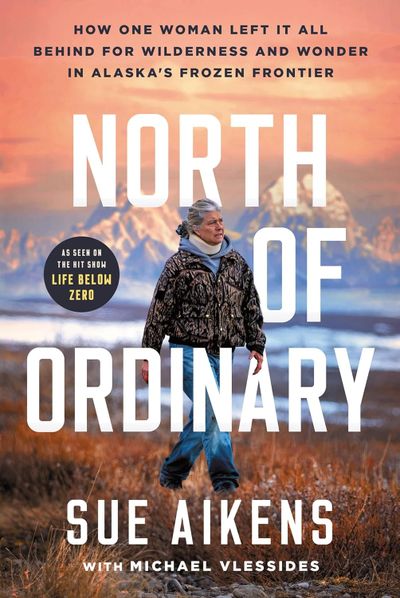
I jumped into the office pool but have had a difficult time getting into the show because I have been reading “North of Ordinary” by Sue Aikens.
Aikens, whose life has had its own reality show, “Life Below Zero,” is a true survivor in every sense of the word, and her new memoir would shame the scantily clad competitors on tropical islands. Aikens survived more difficulties before age 16 than other “Survivors” have had to in 25 years.
After a short life in a blended family and revolving door of toxic masculinity in her mother’s house, the other siblings grew up and moved out. Aikens’ mother decided to move with her 12-year-old daughter to Alaska, living in a tent in the wilderness some 40 miles away from Fairbanks. Soon after, Aikens’ mom went to the grocery store in Fairbanks and never returned.
She never knew who her father was, and Aikens had often been left alone to fend for herself since she was a toddler in the mid-1960s. The little girl learned to appreciate solitude and nature and quiet moments amid chaos, whether in Mundelein, Illinois, Las Vegas or Chicago. Trees became forests with a fairytale-like magic able to transport her out of the sometimes violent realities of her real life.
“The oak tree at the edge of my street, its trunk split open by lightning long before I was born, became a hidden fortress, a space where I could simply sit and listen to the rush of the leaves,” Aikens tells her co-author Michael Vlessides, who’s credited on the book cover. “The creek that ran behind the rows of houses, largely ignored by the other kids in the neighborhood, was more like a kingdom to me than a narrow tickle of water choked with weeds and lined with old stones. Even the abandoned, filled wedge of town became a place where I could lie down in peace and watch the clouds pass overhead.
“These were the places where I didn’t need to explain myself, where my existence was celebrated, not just tolerated. The wind and the water and the grass didn’t care who I was. They accepted me as me, and that was enough.”
The neglect was actually a warmup for what she would need to survive the Alaska wilderness as a preteen. She would learn self-sufficiency from her tough-as-nails great-grandmother, how to forage berries from a Native elder during a summer in North Dakota and learn to hunt meat from a school bus driver in Alaska.
Yes, she would go to school. A family befriends the young girl to babysit for them, and the mother helps enroll her in school, where her intelligence soars her to grades beyond her age, and she befriends the bus driver who would help change her life. She eventually finds a cabin that will shelter her better than the tent she had used, and she finds jobs waiting tables in grills and taverns, as her physical maturity means she can pass for a woman of working age. In Alaska, people don’t ask a lot of questions. “Alaska easy” is what they call it, including the process of enrolling a young girl with no family in school.
Life continues, but through marriages, family and raising children, Aikens finds the song of the wilderness calling her back. She loves the solitude. She loves the adventure.
She moved her father away from civilization, to Kavik, a camp on Alaska’s North Shore.
She moved closer to bears. Grizzly bears. Bears looking for food. Including her.
“But I remember having a moment of clarity as the bear clamped down on my skull,” Aikens writes. “If that was going to be my end, I was OK with it. I’d had a good run and had lived most of my life on my own terms, surrounded by the beauty I’d chosen to be my personal backdrop. I’d been the best mother and wife that I could. I was ready to die.”
Aikens has to fight bears (plural) and barely escapes death. But she landed a spot in “Life Below Zero,” a National Geographic production, that documented her life at Kavik.
While some might think someone like Aikens, who lives an isolated life, might balk at having cameras follow her, she did. But she became close to the directors and camera operators who visited and followed her. The pay from being a reality TV star also helped her survive the constant flights of fuel being flown in to keep her from freezing to death.
“North of Ordinary” is beautiful in its description of far-flung places on Earth most of us will never see. But its real value is reminding us that we don’t need to live in fear. And we should not fear living life on our own terms.
As Aikens tells us, life is about taking that next step. One step at a time.
That’s how you become a true survivor.
If You Go Sue Aikens What: The author will talk about her new book with Ammi Midstokke on the Northwest Passages stage. When: 7 p.m. March 11 Where: The Bing Crosby Theater, 901 W. Sprague Ave. Info: $10 general admission; VIP and book bundle packages SOLD OUT; students of all ages receive tickets free. Please email kristib@spokesman.com to claim. Auntie’s Bookstore will be on site to handle book sales at the event. Spokane-based sister duo Ivy and Neilia Eyer, known for playing folk, blues, and fiddle tunes, will perform.