
Baumgartner makes the case for attacking Iran, citing 47 years of violence. Crocker has seen that first-hand but fears the war’s consequences
WASHINGTON – On the morning of April 18, 1983, a young diplomat named Ryan Crocker had a meeting at the U.S. Embassy in Lebanon with Bob Ames, the CIA’s chief Middle East analyst.
“I don’t remember what we talked about that morning,” Crocker said in an interview Thursday, “but I sure as hell know it wasn’t about the certainty of a truck laden with explosives coming to kill him and blow up the embassy.”
Crocker, who grew up in Spokane Valley and returned after a four-decade career in the Foreign Service, was at his fourth-floor desk that afternoon in Beirut when a suicide bomber drove to the front of the building and detonated nearly 2,000 pounds of explosives, shearing off the wing of the building across a corridor from his office and killing 63 people. Crocker said he found Ames’ body in the rubble that night and he knew all 17 Americans killed in the attack, which the U.S. government later attributed to the Iran-backed Lebanese group Hezbollah.
“I’ve seen an awful lot of the bloodshed that Iran has wrought on Americans, not just in Lebanon but certainly in Iraq as well,” he said. “So a part of me – the visceral part of me – is pretty pleased that they are finally getting the blood and fury that they deserve. But the other part of me, the rational part of me, says, ‘OK, what does this set as a precedent? Where do we go from here? What are the consequences?’ And we’re not having that discussion.”
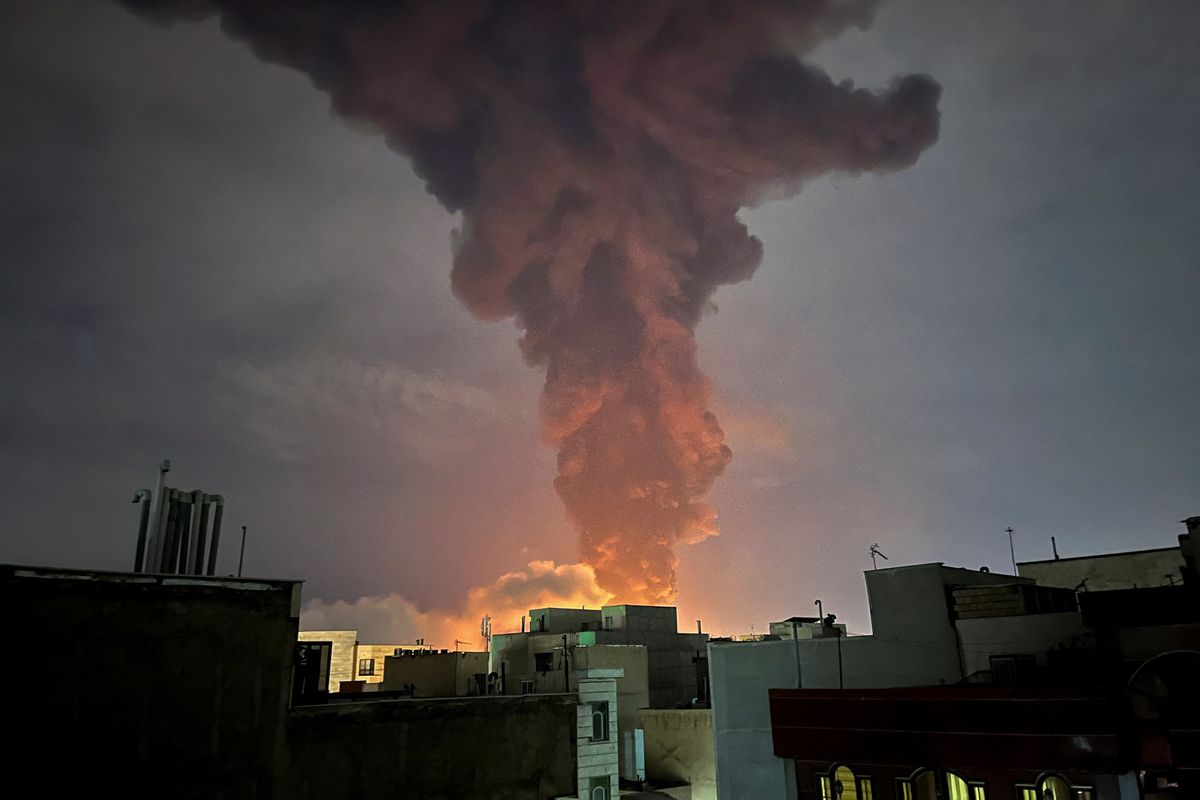
Rep. Michael Baumgartner, who worked at the U.S. embassy in Baghdad from 2007 to 2008 when Crocker was ambassador to Iraq, wants to have that discussion. On Wednesday, five days into an aerial assault on Iran the Trump administration dubbed “Operation Epic Fury,” the Spokane Republican took to the House floor and listed more than two dozen episodes in “the Iranian regime’s ongoing and bloody campaign against the American people.”
“No other terrorist regime has claimed more American lives,” Baumgartner said, since Muslim clerics took over Iran’s government in the Islamic Revolution of 1979. “When the ayatollahs of Iran chant ‘death to America,’ they mean it.”
Baumgartner recalled a day near the end of his time in Iraq, where he served as a State Department economics officer charged with countering Iranian influence in the neighboring country. As he rode in an armored vehicle through the Sadr City district of Baghdad, the congressman said he watched a roadside bomb made with especially destructive components from Iran tear through the vehicle ahead of his.
“There were a lot of those that were directly attributable to the Iranian regime,” Baumgartner said, recalling how he spent time tracking monthly U.S. casualties in Iraq after then-President George W. Bush ordered an American troop surge in 2007.
The Pentagon said in 2019 that Iran-backed militants were responsible for the deaths of at least 603 Americans in Iraq between 2003 and 2011, roughly 1 in 6 U.S. fatalities in the Iraq War.
In the early days of the joint U.S.-Israeli assault, polls showed Americans broadly opposed attacking Iran. In a Reuters/Ipsos poll conducted just after the strikes began, only 27% of Americans approved of the U.S. attacking Iran, while 43% disapproved and 29% said they were unsure. A poll by CNN and SSRS that didn’t include a “not sure” option found 41% support with 59% of those surveyed saying they opposed the war.
“It’s been going on so long that Americans, I think, have gone numb to the threat posed by the Iranian regime,” Baumgartner said in an interview Thursday. “Americans tend to have short-term memories, and because a lot – but not all – of this killing has taken place far from our shores, people have grown immune or forgetful or blasé about it.”
Baumgartner said he decided to make the floor speech because he felt President Donald Trump and his administration hadn’t effectively made the case to Americans for attacking Iran. The congressman elaborated on his own case for the war, and the risks it presents, in an article published by National Review on Friday.
“If I had any critique about the administration, it’s that I don’t think they’ve done a great job of explaining the threat to the American people,” he said in the interview, adding that while Trump may have understandably wanted to maintain the element of surprise, the president could have used his State of the Union address less than a week before the strikes began to “build a public case” for going to war.
Trump and senior administration officials have offered varying and sometimes contradictory rationales for the war, which they have described as unprecedented in its scale and intensity even while House Speaker Mike Johnson, R-La., claimed on Thursday, “We are not at war.” The GOP-led Senate and House rejected Democratic resolutions Wednesday and Thursday that sought to halt the strikes until Congress authorizes a war.
Trump has declined to rule out putting American boots on the ground in Iran, and six U.S. service members were killed when an Iranian drone strike hit a command center in Kuwait on March 1. U.S. Central Command spokespeople declined to confirm whether KC-135 tankers from Fairchild Air Force Base have been deployed to support the operation, but images on social media and public flight-tracking data indicate that U.S. KC-135s are operating from Ben Gurion Airport in Israel, which Iran targeted with missiles on Thursday, the Times of Israel reported.
Secretary of State Marco Rubio told reporters at the Capitol on Monday that the operation’s “very clear goal” is to eliminate the threat posed by Iran’s navy and its non-nuclear ballistic missile program, which he said Iran’s government was using to create “a shield where they can hide behind.” Then Rubio, who is also Trump’s national security adviser, said the United States attacked on Feb. 28 because “we knew that there was going to be an Israeli action.”
“We knew that that would precipitate an attack against American forces, and we knew that if we didn’t pre-emptively go after them before they launched those attacks, we would suffer higher casualties,” Rubio said.
The next day, Trump denied that Israel had forced his hand. The president has claimed that Iran was developing missiles that could soon hit the United States, despite a Defense Intelligence Agency report in May that said Iran’s leaders hadn’t decided to pursue such missiles and estimated it would take the country a decade to develop them.
Trump has said attacking Iran was necessary to stop its effort to develop nuclear weapons, despite previously claiming that U.S. strikes on Iranian nuclear sites in June had “completely and totally obliterated” Iran’s key nuclear sites. At the White House on Wednesday, press secretary Karoline Leavitt laid out a broader set of goals, adding that U.S. strikes were aimed at destroying not only Iran’s navy and ballistic missiles, but also its nuclear program and ability to support proxy groups like Hezbollah.
The administration’s messaging on the war has struck a belligerent and sometimes blithe tone, with Defense Secretary Pete Hegseth scolding journalists who reported on the Americans killed in the war for trying to “make the president look bad.” Leavitt told reporters at the White House on Wednesday they should be “grateful” to Trump for attacking Iran, because if the Iranian regime had its way, it would kill every one of them.
The White House has posted videos on X that splice clips from movies and video games with footage from the war, which had killed more than 1,300 people in Iran as of Friday, according to Iranian state media and the country’s health ministry. Hegseth said Wednesday the Pentagon is investigating but not yet taking responsibility for a strike on a girls school that killed at least 150 people on Feb. 28.
In his National Review article, Baumgartner said congressional colleagues he respects were “sounding the alarm” about the risk of attacking Iran turning into “Iraq 2.0.”
“They see airstrikes in the Middle East, hear talk of regime change, and conclude we are sleepwalking toward another 2003,” Baumgartner wrote, but he argued the Trump administration is applying the lessons of the Iraq War. “Don’t confuse battlefield success with political outcomes. Don’t dismantle institutions you can’t replace. Don’t invade without a plan for the insurgency that follows. And never enter a conflict the American people cannot clearly understand.”
If the airstrikes produce “verifiable restraint from Iran’s current leaders” or accelerate internal fractures that lead to new leadership willing to accept those limits, the congressman wrote, that would be a success. The U.S. government shouldn’t promise regime change like it did in Iraq, he said, “but neither should it close off outcomes created by pressure.”
Democrats have been quick to accuse Trump of breaking a campaign promise to avoid wars and focus on improving the lives of Americans. In his campaign to return to the White House, Trump didn’t say specifically that he wouldn’t go to war with Iran, but the president has defined his “America first” ethos in opposition to foreign entanglements and he told supporters at an October 2024 rally, “You’re not going to have a war with me.”
In a hearing on Thursday, Rep. Adam Smith of Bellevue, the top Democrat on the House Armed Services Committee, asked the Pentagon’s policy chief, “How did the ‘America first’ agenda fail in Iran?”
“We’re at war with Iran and 14 other countries have been dragged into it,” Smith said to Elbridge Colby, the undersecretary of defense for policy. “Look, anyone can come in and blow stuff up. I mean, that option’s been on the table and that’s the option we’ve been taking a long time. And that was sort of the president’s argument: ‘I’m different. I’m so strong that this isn’t going to happen on my watch.’ And he was wrong. It did.”
Tensions between the United States and Iran began well before 1979. When Crocker began his Foreign Service career in Iran in 1972 after graduating from Whitman College, the country was less than two decades removed from a 1953 coup d’état orchestrated by the U.S and British governments that overthrew Iran’s elected prime minister, Mohammad Mosaddegh, after he nationalized the country’s British-owned oil industry.
Iranian military officers staged the coup after Kermit Roosevelt Jr., a CIA agent and grandson of President Theodore Roosevelt, deployed propaganda that accused Mosaddegh of being secretly Jewish and paid Islamic leaders and military brass to oppose the prime minister, according to documents the CIA declassified in 2013. The coup returned Shah Mohammad Reza Pahlavi to power, but it also empowered the Muslim clerics who would overthrow the shah in the 1979 revolution.
For many Iranians, Crocker said, 1953 still feels like “the day before yesterday,” and Iran’s government invoked that collective memory to rally popular support during the 12-day war with Israel in June, which concluded with the U.S. bombing of Iran’s nuclear sites. Mass protests that began in 2022 and have been violently suppressed by the regime have shown that many Iranians want change, but Crocker said the fact that Khamenei’s death came at the hands of Israel and the United States could “color Iranian reaction for some time to come.”
“If 1953 planted the seeds, ultimately, of 1979,” he said, “God knows what seeds we’re planting now.”
In his speech on the House floor, Baumgartner began his history in November 1979, when students who followed Ayatollah Ruhollah Khomeini stormed the U.S. embassy in Tehran and took 66 Americans hostage, 52 of whom were held until minutes after President Ronald Reagan was inaugurated in January 1981.
Soon after overthrowing the monarchy, the new Islamic Republic of Iran began supporting the Islamic Jihad Organization, a precursor to Hezbollah led by their fellow Shia Muslims in Lebanon. After taking credit for the U.S. embassy bombing in 1983, the group bombed a barracks that housed U.S. and French troops who were part of an international peacekeeping mission during the ongoing Lebanese Civil War. That attack killed 241 American troops, 58 French troops and six civilians.
In March 1984, Hezbollah kidnapped William Buckley, the CIA station chief in Beirut, who died in captivity the following year. In September 1984, Islamic Jihad claimed credit for bombing a U.S. embassy annex where American diplomats were working after the first embassy bombing, killing 23 more people.
Attacks targeting Americans by Hezbollah and other Iranian proxies continued from the 1980s through 2024, when a Pakistani man was charged with plotting to kill Trump and former President Joe Biden at the behest of Iran’s government. That man, Asif Merchant, was convicted on Friday in a federal court in New York City, after he claimed the Iranian regime had forced him into the plot by threatening his family in Iran.
After Hezbollah fired missiles from Lebanon into neighboring Israel in response to the attacks on Iran, Israel ordered a mass evacuation and began bombing southern Beirut on Thursday. Crocker said the broadening of the conflict into a wide regional war – as far away as the coast of Sri Lanka, where a U.S. submarine sank an Iranian ship on Wednesday – demands a more “robust congressional debate” about where the conflict is headed.
“I’m not a fan of trying to stop military actions in midstrike, but clearly I think the American people and the Congress need to have a better handle on where this is going,” he said, adding that U.S. support for Kurdish or other militias inside Iran could lead to a civil war with effects throughout the region.
Baumgartner said he told Treasury Secretary Scott Bessent on Wednesday, “You should be planning for a messy civil war, and then hope it doesn’t happen.”
Crocker said he is glad Trump so far hasn’t put American troops on the ground in the country, but he said the administration’s approach of using airstrikes to pressure Iran’s existing regime to choose a leader Trump likes is unprecedented and seems unlikely to succeed. After Supreme Leader Ali Khamenei was killed in an airstrike when the war began, Trump said he wouldn’t accept the late ayatollah’s son as a successor, and the president told Politico on Thursday he wants to help choose Iran’s new leader.
“I guess you can keep killing leaders you don’t like, but it’s pretty hard to see how you eventually translate that into getting one you do like again,” Crocker said. “We have no idea what comes next in Iran.”