
Then and Now: Sprague Way cutoff
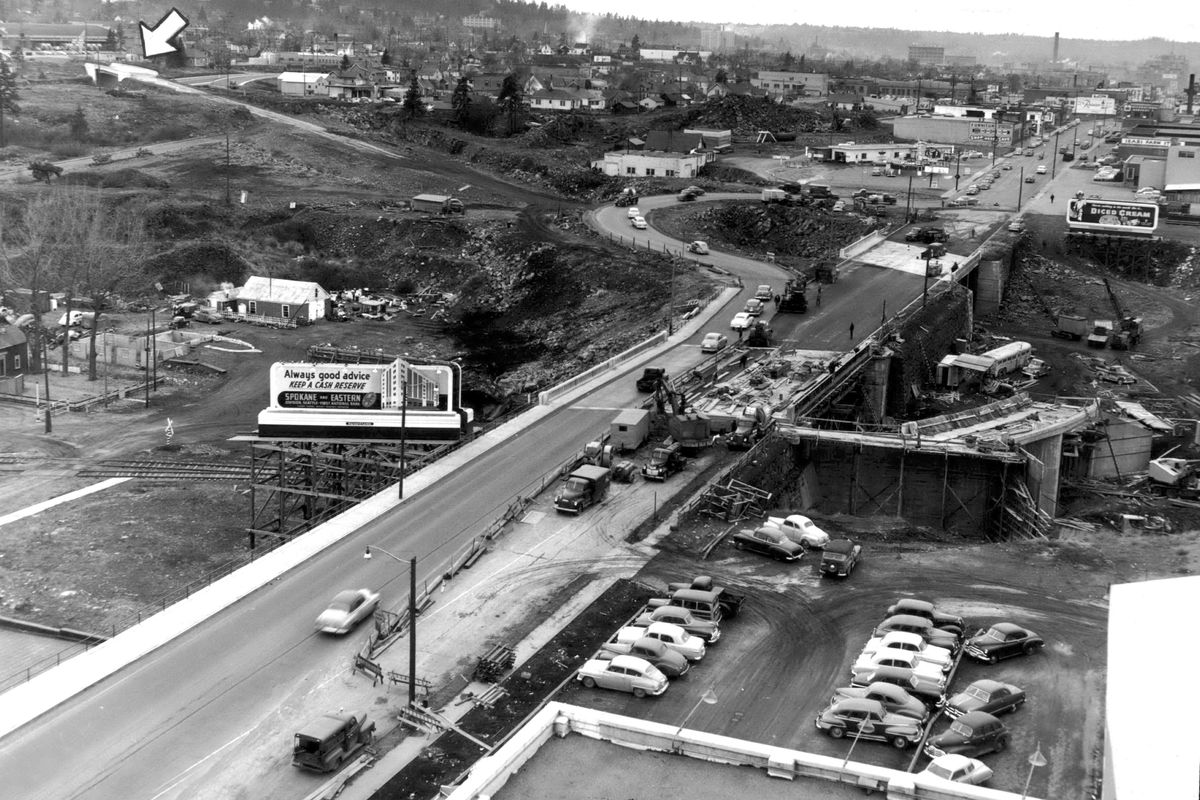
The number of automobiles and commercial trucks in the United States almost doubled in the decade after World War II and Spokane saw its share of daily traffic jams in the postwar years. Eastbound traffic entered Spokane from the west on the Sunset Highway and flowed east onto Third Avenue. Eastbound traffic from the Spokane Valley came mostly on Sprague Avenue, which slowed in the business districts.
East of Division Street, resourceful drivers had to find their way from the Second Avenue and Third Avenue couplet to Sprague to keep moving.
The city’s rocky landscape and crisscrossing railroads made it challenging to design new ways to move cars quickly through downtown.
One solution was a couplet of cutoff roads, called North and South Sprague Way, completed in 1954 to connect with East Third and East Second avenues, at South Scott Street, and down to Sprague Avenue near the Sperry Flour Mill.
The final plan, paid for with state highway and city street funds, called for two-lane roads down from Third to Sprague and another one ascending from Sprague to Second. Construction began in 1952 and the cost was estimated at $1.25 million.
The complex two-year project required at least three bridges: one to take the eastbound offramp from Sprague over Erie Street; one for Sprague Avenue to go over North Sprague Way; and one to carry South Spokane Way above Second Avenue.
The East Side Commercial Club, longtime proponents of the connector roads, held a parade to celebrate the new route in June 1954. Traffic engineers acknowledged that the cutoff was a temporary measure until a new interstate freeway that would bypass city streets altogether.
When Interstate 90 finally connected through downtown Spokane in the early 1970s, traffic slacked off on the Sprague Way cutoff and Third and Second avenues were quiet.
Early drawings and models of Interstate 90, laid out in the 1950s, showed the Hamilton Street off -ramps marked as “North-South Freeway” but that idea was never completed. It was 1984 when the Hamilton Street Bridge, officially named the James E. Keefe Bridge, was completed with an overpass over Sprague Avenue, leading to the complex interchange distributing traffic in several directions.