
Remote Alaska’s ‘queen of badassery,’ Sue Aikens, shares life lessons and tales from the frontier
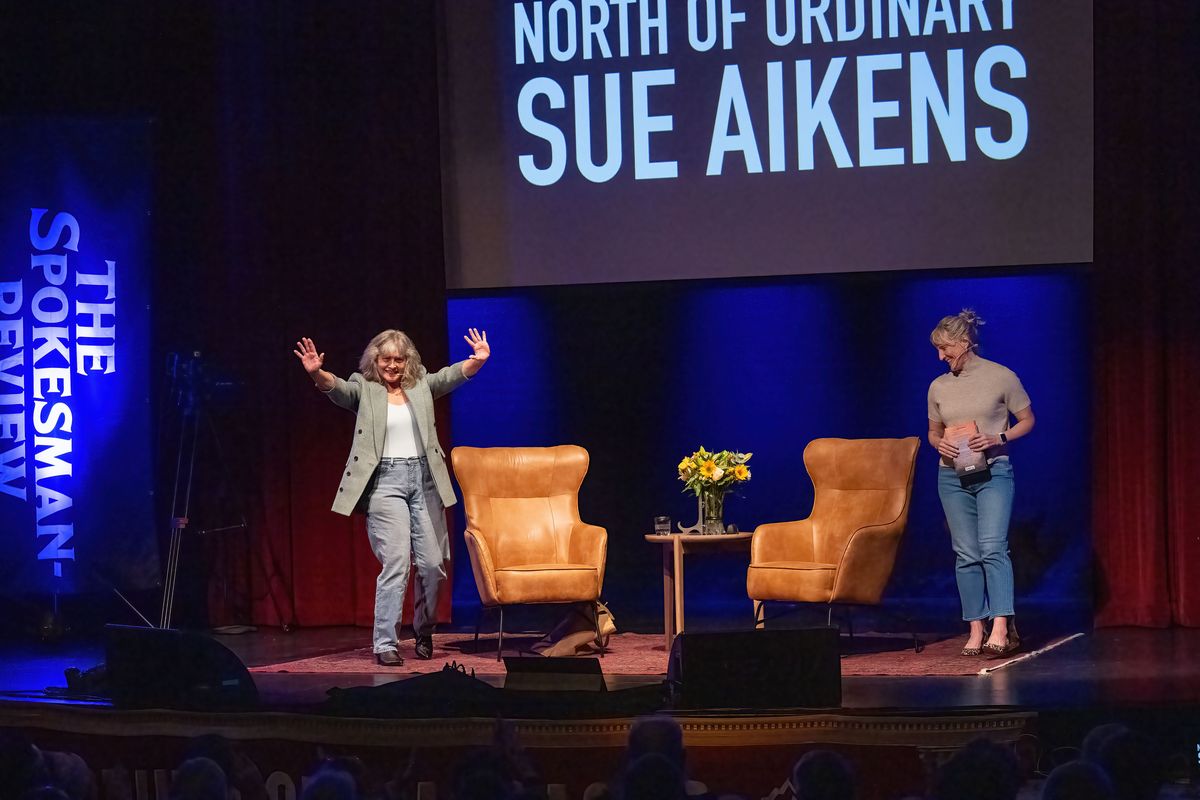
Few may be as comfortable off the grid as Ammi Midstokke, who pens The Spokesman-Review Outdoors column of the same name.
Even fewer find comfort on the extreme far reaches to the extent of Sue Aikens, who has spent much of her existence braving day-to-day life in the Alaskan wilderness.
The pair of outdoorswomen exchanged quips and tales from the frontier in a raucous Northwest Passages event at the Bing Theater Wednesday in which Aikens, star of the National Geographic series “Life Below Zero” that documents her life in the barren wild, discussed her memoir “North of Ordinary,” written in partnership with Michael Vlessides.
Aikens said when her publishers discussed a book tour to promote the memoir, she knew she wanted to stop by Spokane.
“I may be the queen of badassery up where I’m at in Alaska, but you guys are pretty cool down here too,” Aikens said.
Aikens’ life is, and has been, north of a lot of things. At a soiree with Northwest Passages donors ahead of the event at the Bing, Aikens laughed as she shared that her GPS coordinates are her literal, federal address.
Most are familiar with the first-time author from the past 12 years when a camera crew followed her as the sole resident of the Kavik River Camp in northern Alaska, nearly 200 miles north of the Arctic Circle. Viewers watched her maintain one of the last fuel stops for pilots as they approach the Arctic Ocean, forage and hunt for sustenance, and prepare tirelessly for predators also in search of a meal.
As Aikens shares in “North of Ordinary,” she’s come very close to becoming a meal. A grizzly bear attacked Aikens in 2007, “clamped down on my skull,” she writes, and severely injured her legs. She laid alone for 10 days, “urinating and defecating on myself,” before help arrived by plane.
Aikens referenced the harrowing experience briefly Wednesday, as she told the crowd her constant preparation is not paranoia, as some former viewers may believe.
“You better be highly situationally aware,” she said.
At 12, Aikens’ mother moved the pair from Chicago to a vacant property 50 miles from Fairbanks, Alaska. She abandoned her on the property soon after. Aikens took the frosty gauntlet ahead of her head on, enrolling in school, sheltering in a creekside cabin and finding solace in the natural world around her.
“My life was full of pain, full of abuse,” she said. “And here we are in Alaska, alone.”
The solitude turned into a sense of relief, Aikens said. She no longer had to worry about the trauma inflicted by her mother. She said she does not hold her mother’s actions against her. Aikens focused on her own life, and she still speaks of her with love and a frankness that her mother was intelligent, but cruel.
Five decades later, Aikens shows the same grit, and still holds the same penchant for vast open spaces, towering timbers and the critters scuttling amongst them. She told Midstokke she views herself as a protector of flora, fauna and disadvantaged children like she once was.
At one point, Midstokke asked her to elaborate on mistakes alluded to in her writing. After a lighthearted reference to past marriages, Aikens pointed to not being true to herself, and what it took to relearn her truths, stand up for herself and learn to trust her gut.
“People ask, ‘If you could change anything about your past, what would it be?’ ” Aikens said. “It took every single thing I’ve been through to make me who I am today, and I’m looking great. I love myself.”
Aikens said she enjoys the isolation her lifestyle brings, and is more comfortable with the dangers of the wild than what can come from urban life and other human beings. Loneliness is as foreign of a concept to her as a Chipotle opening up at the Kavik River Camp, which she said is around 100 miles from the closest road.
She hasn’t spent her entire life in Alaska, but pretty close. She told Midstokke she was away with a past husband at one point when she knew she had to return after she “got this scent, and it was the scent of Alaska: the high bush, cranberries, mulch.”
“I don’t know where the danger comes from with humans; that’s where the solitude really makes a difference,” Aikens said. “… If you’re going to spend that much time alone, make sure you are somebody you can handle.”
Midstokke said Aikens writes about Alaska as its own living character, and in true Aikens fashion, she jumped in to add “it’s an entity, it has a personality.” Aikens calls foxes her friends, and waxed poetically about a long relationship she had with a female grizzly bear who cared more for procreating than raising her cubs.
“It’s a life that I understood, and it’s a land that I blossomed in,” Aikens said. “… Alaska put its arms around me and accepted me. I can be one goofy bastard, but it likes that.”