
The Dirt: Tiny home village slated for Spokane
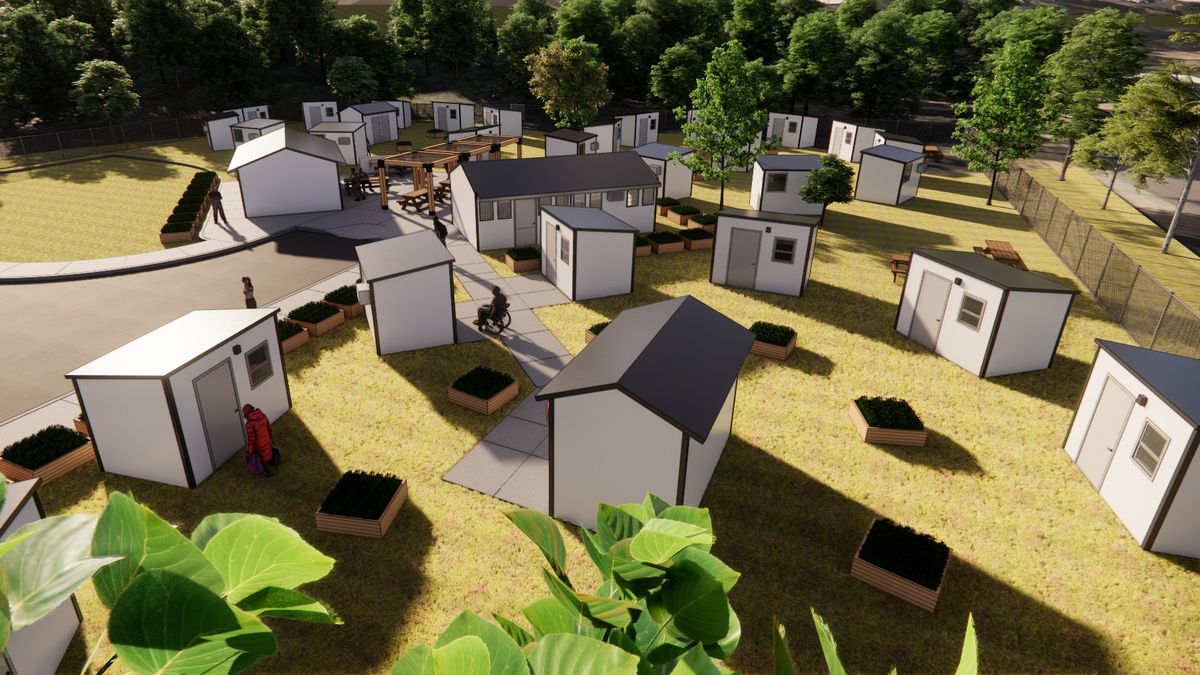
First pitched in November, a new 30-unit low income housing development is being developed by Waters Meet Foundation, a nonprofit formally known as Empire Health Foundation.
The foundation submitted a construction permit application to the city of Spokane that outlines the $2.2 million project named New Roots Tiny Home Village.
Its mission is to provide temporary shelter for unhoused residents as they transition into longer-term housing and to help facilitate that transition, according to its website.
“The idea is, let’s figure out how we can really do this well in our community and show that it’s a part of the continuum of homeless services that we need if we really want to address homelessness in meaningful and sustainable ways,” Waters Meet President Zeke Smith said in November, according to Spokesman-Review reports.
Located at 768 S. Audubon St., the site is located just west of the intersection of Sunset Boulevard and Government Way.
The project is accompanied by other nearby housing initiatives including the AscendA House immediately to the south, which supports those recovering from substance abuse. To the east is St. Agnes Haven, which is an affordable-housing building operated by Catholic Charities of Eastern Washington.
Leroy Eadie, vice president of programs for the foundation, said his team worked closely with Low Income Housing Institute, a Seattle-based nonprofit that has helped develop 18 similar projects in Seattle, Tacoma, Olympia, Skyway and Tukwila, according to its website.
Tiny homes in these villages look similar to a backyard shed but with doors and windows. Each home will be outfitted with air conditioning and heating, Eadie said. Homes will be spread out across the 2.2 acre site, plans show.
Eadie said the foundation purchased 15 tiny homes from the Institute and 15 from Pallet Shelter, an Everett-based public benefit corporation. Each home will be about 90 square feet, application documents show.
Additionally, New Roots will consist of three “hygiene” units that offer showers and restrooms for tenants and two community buildings for tenants to do laundry, eat and meet with service providers, Eadie said.
Two small offices will also be developed for on-site counselors, application documents show.
Eadie said the development will be operated by Community, Advocacy and Treatment, a Spokane-based provider, under a contract with the city of Spokane.
Other aspects of the project include improvements to landscaping, paving a small parking lot and constructing garden beds throughout the site, Eadie said.
Spokane based ZBA Architecture designed the project, and Spokane-based Cornerstone Construction and Development, Inc. will build it.
Fred Hutch is on the move
Cancer treatment provider, Fred Hutch Cancer Center, has submitted a remodel application to the city of Spokane for its new location in the Catalyst Building, located at 601 E. Riverside Ave.
Fred Hutch was previously located at the SIERR building, which is on the northern banks of the Spokane River just south of the University of Washington School of Medicine.
The Seattle-based cancer treatment nonprofit will relocate just across the river inside the Catalyst Building, which opened in 2020 as “one of the largest zero-carbon, zero-energy buildings in North America,” according to its website.
At the southern base of the University District Gateway Bridge, Fred Hutch will renovate a portion of the building’s fifth floor, application documents show.
The $400,000 effort will be the home of the provider’s Office of Community Outreach and Engagement. According to Jeff West, vice president of facilities for the nonprofit, the project will be completed next month.
Spokane-Valley based Lydig Construction will remodel the space, which was designed by the Spokane office of Seattle-based CollinsWoerman.
Six-unit buildings planned for South Hill
A 1904 home will be scrapped to make way for two sixplexes, according to plans submitted to the city of Spokane.
Just northeast of where Maple and Walnut Streets meet to form Cedar Street, a developer is planning to build two, three-story residential buildings.
Developer Kenny Ho purchased the property, located at 1611 W. 9th Ave., in February for $490,000, Spokane County property records show.
The estimated $3.6 million project includes splitting the properties into two, each with a six-unit building on it. Each building will be offered four parking spaces, documents show.
Plans were submitted as part of the pre-development process, which gives developers the opportunity to obtain feedback from city building officials before construction permits are sought.
Plans were submitted by Matt Hutchins, a principal at CAST Architecture, a Seattle-based firm.
Hutchins said the project will resemble another Spokane project the firm designed at 1517 S. Grand Blvd.
“Our brand of small-scale developments illustrates how we can make room for new affordable, equitable and sustainable housing options within existing neighborhoods,” he said. “We are designing these two buildings to feel friendly and familiar, borrowing heavily from the neighborhood context in form and detail, so as to minimize the disruption to the street.”
Currently on the site is a 2,400-square-foot home that was converted into a three-unit apartment building. Hutchins said the building will not go to waste.
“We plan on salvaging much of the quality details and components and hope to reuse some in the new development,” he said.
Hutchins believes the project will achieve the allure of a high-end apartment while also offering affordable units.
“Small apartment buildings that fit on formerly single-family parcels are desirable because not only can we leverage excellent neighborhood locations, each unit can have windows on three sides, minimal attached neighboring units and all the amenities and benefits of new construction,” he said. “About a third of the units will be available at reduced rent via the Multifamily Tax Exemption program.”
Construction should be completed by in early 2028, Hutchins said.