
Eye of the grizzly: Collar cameras let Washington State University scientists see the Arctic from a bear’s point of view
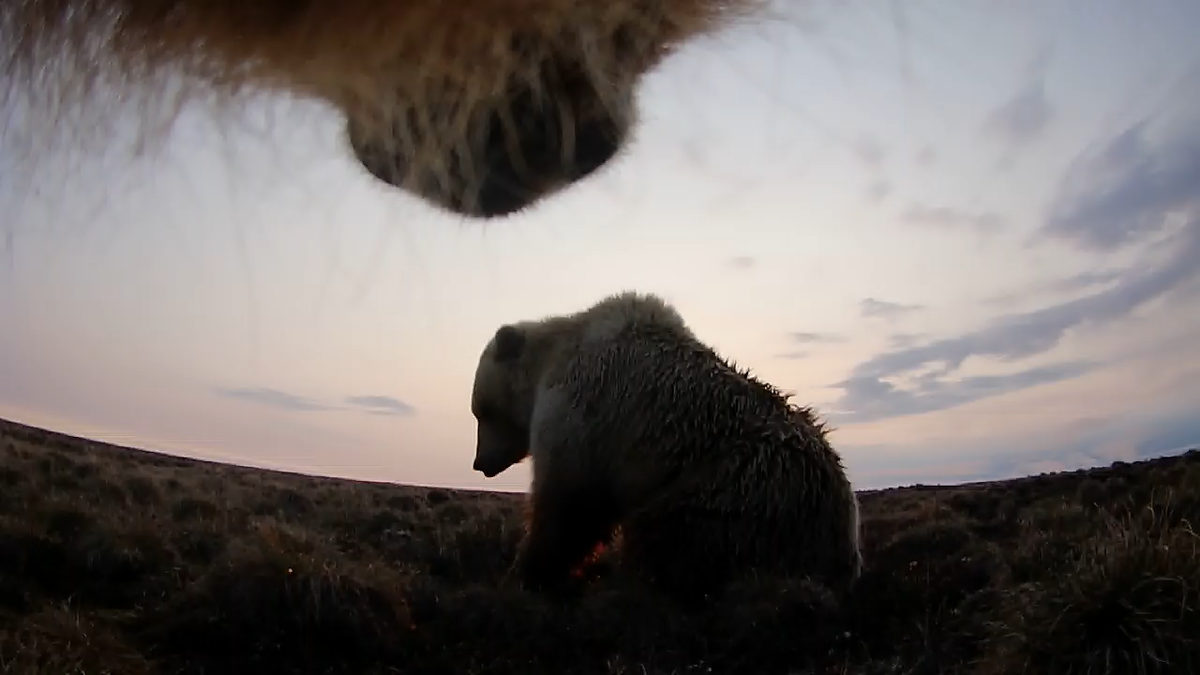
The clip with the wolves made Ellery Vincent jump out of her chair.
It begins in the dark. Then the grizzly bear lifts its head. Light streams into the camera attached to the bear’s neck with a bright flash and then settles, and the scene comes into focus.
At the top of the screen is the grizzly’s muzzle, pointed toward a mountain in the distance.
In the foreground, not more than 30 feet away, are four wolves.
They’re just standing there, unconcerned with the bear. They’re not trying to steal a carcass, not gearing up for a fight and certainly not aware that they’re on video.
The clip is one of thousands captured by collar cameras attached to 12 bears in the Arctic last year for a Washington State Unveristy project led by Vincent.
From May to October, the cameras gathered five seconds of video every five or 10 minutes, allowing Vincent and her team to eavesdrop on the diurnal minutiae of grizzly life in Alaska’s North Slope.
In all, there’s more than 400 hours of footage. Vincent, a doctoral student at WSU, and a team of undergrads have been combing through every second of it.
Tedious work – at least until a group of wolves enters the frame.
“That was I think one of the first bears I started watching,” Vincent said. “That set the bar very high.”
The footage is meant to help Vincent and her collaborators at the Alaska Department of Fish and Game study how grizzlies make a living in the North Slope, a massive and largely unpopulatd area in the Arctic. They’re scanning for specific details like what bears are eating and how their food choices shift throughout the year.
Vincent went there to collar the bears in May, not long after they left their dens. She returned in August – a time when food sources are shifting – to replace the cameras. In October, she came back to collect them before the bears went into hibernation.
Last year was the first of three planned field seasons. Vincent expects to return in May to collar the next group and start collecting a fresh batch of videos.
That means final results are still a few years away. But the project is already getting attention because the cameras themselves offer something rare: a bear’s eye view of a remote corner of the Earth.
WSU posted a compilation of some of the clips to its website earlier this week, beginning with the wolf scene. In other clips, viewers see a bear’s muzzle bobbing as it goes for a walk or crosses a river. There are shots of bears wrestling, hanging out and eating together.
“We’re actually able to get a window into their daily life,” Vincent said.
Charles Robbins, a WSU professor and the founder of WSU’s Bear Research, Education and Conservation Center, said the cameras represent just one way technology has transformed wildlife biology since he started working on bears 40 years ago.
“I’m from an age where we used to go out and wave antennaes around,” Robbins said.
Now DNA analysis allows scientists to learn an animal’s family history. Blood and hair samples can show them what a bear ate last month. GPS collars can beam an animal’s location data to a computer miles away.
“We can just look in great detail at the life of wild animals now,” Robbins said. “When I went through school, we weren’t even thinking of those possibilities. It’s been a true revolution.”
The idea of following grizzlies in the Arctic for a full season grew out of discussions about polar bears. They spend much of the year on sea ice and hunt seals, but Robbins said scientists were concerned about how polar bears will do as climate change melts ice and forces them to spend more time on land.
Robbins said some feel that since grizzly bears survive on terrestrial foods in the Arctic, polar bears should be able to make do for part of the year. A short study of the how the two species fared in late August and early September – a time when polar bears are forced onto land – found that polar bears lost weight while grizzlies either maintained or gained small amounts of weight.
That led to the idea of following grizzlies from May to October, the full range of time they’re out hunting and foraging. Scientists want to know how the bears are using their habitat and how the omnivores shift between their varied food sources – meat, berries, roots.
Using cameras eliminates some of the guesswork, Vincent said.
“In the past, where we’re just relying on GPS locations, we’re really having to infer what’s happening. These video collars allow us to see what they’re eating, what they’re doing,” she said.
Researchers have attached cameras to bears in the past, including to polar bears in the Arctic, but there have been issues with battery life and a lack of memory, Vincent said.
Her cameras came from Germany, and they were made to withstand the sort of abuse you’d expect from the wilds of Alaska.
“They have to stand up to the hard knock life of a bear,” Vincent said. “They’re fighting, going through water. They’re pretty durable. One of them was actually shot by a hunter this year and the camera still worked.”
Each camera had space for up to 17 hours of footage, which translates to an astounding number of 5-second clips.
They aren’t all winners. Whiskers have a way of obscuring the lens. So does mud. There’s no way to tell a bear to make sure the lens stays clean.
The good clips surely make up for the bad. Vincent likes the surprises, and she likes seeing how bears interact. She recalled seeing one male and female pair that hung out for nearly two months, hunting and eating together.
She said they’re “still in the quite early stages of getting through the video,” but some findings already jump out. They have started mapping where bears are eating caribou and moose carcasses. She thinks it’s possible people in the past have overlooked just how many carcasses the bruins are eating, in part because they gobble them up quickly.
“These bears are able to consume a carcass in a pretty short amount of time,” she said.
Roots are a major part of their diet. Vincent said the video showed the bears ate roots throughout the year. But they didn’t always come by them honestly.
Instead of finding roots on their own, some bears have learned to let smaller mammals do the legwork for them.
“They were raiding vole caches,” Vincent said. “The voles had stored up roots and the bears were smart enough to not have to look for them themselves.”