
‘No one has ever regretted doing music. Many people regret quitting’: Jerilynn Harris honored as best school orchestra director of the year
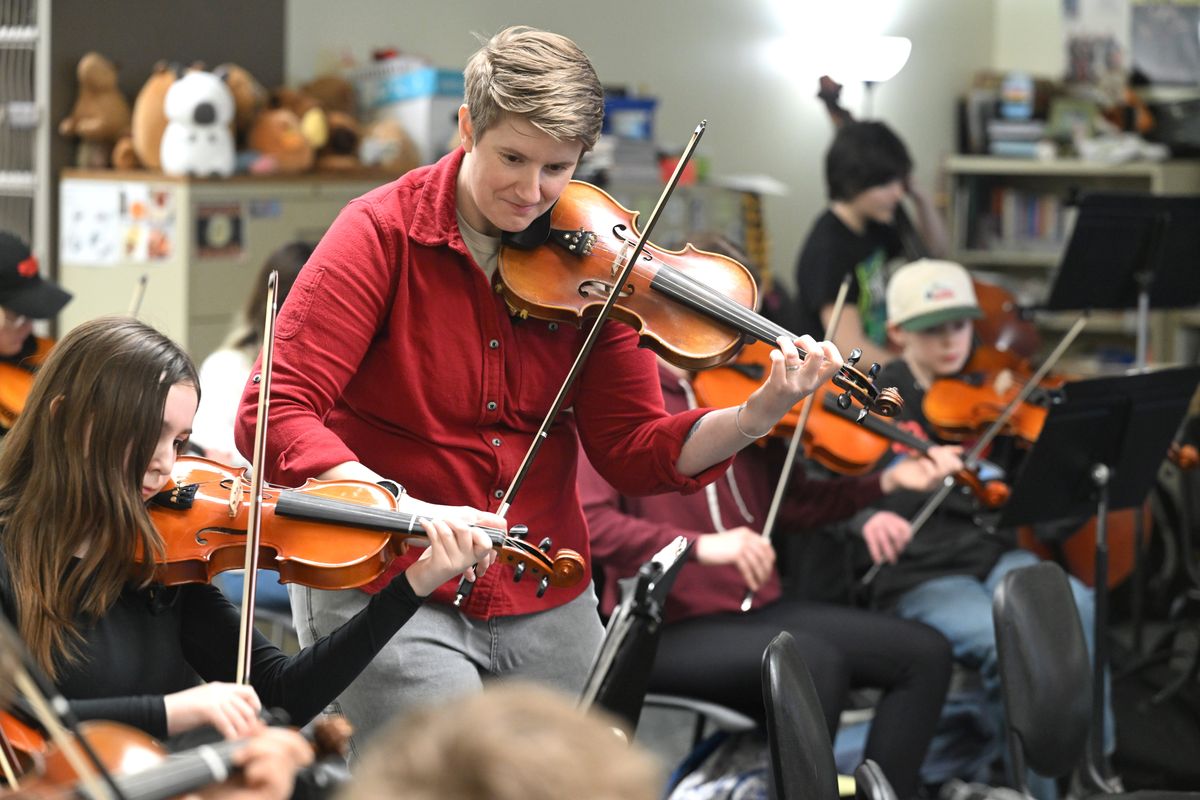
The seventh-graders walked into Jerilynn Harris’ orchestra class just before 9:25 a.m. Kids set up cellos bigger than their bodies, gingerly took violins out from cases and set up their music stands to be at eye level when they sit down.
Shrill, discordant notes echoed through the classroom in the beginning – evidence of young musicians tuning their instruments to sound just the way they want. The cacophonous string-plucking ceased when Harris stepped in front of the class of 45.
Music stands readjusted once more, kids fixed their posture and eyes turned toward Harris as the instruction begins. Soon, music filled the room – orderly, harmonious, in-tune and far from the dissonant warmup noises heard just moments before. To an ear untrained in classical music, their music sounds like it belongs in a movie about swashbuckling pirates or in the climax of an epic battle scene from Star Wars. But to Harris, they still sound erratic.
Early on in the lesson, Harris, who uses they/them pronouns, asked the class to be more controlled.
“What’s a word for the opposite of frantic?” they asked the class.
A kid toward the front raised his hand.
“Unfrantic?” he said cautiously.
Harris took a moment to absorb that answer before asking the rest of the class to shuffle their feet, which is the equivalent of clapping politely.
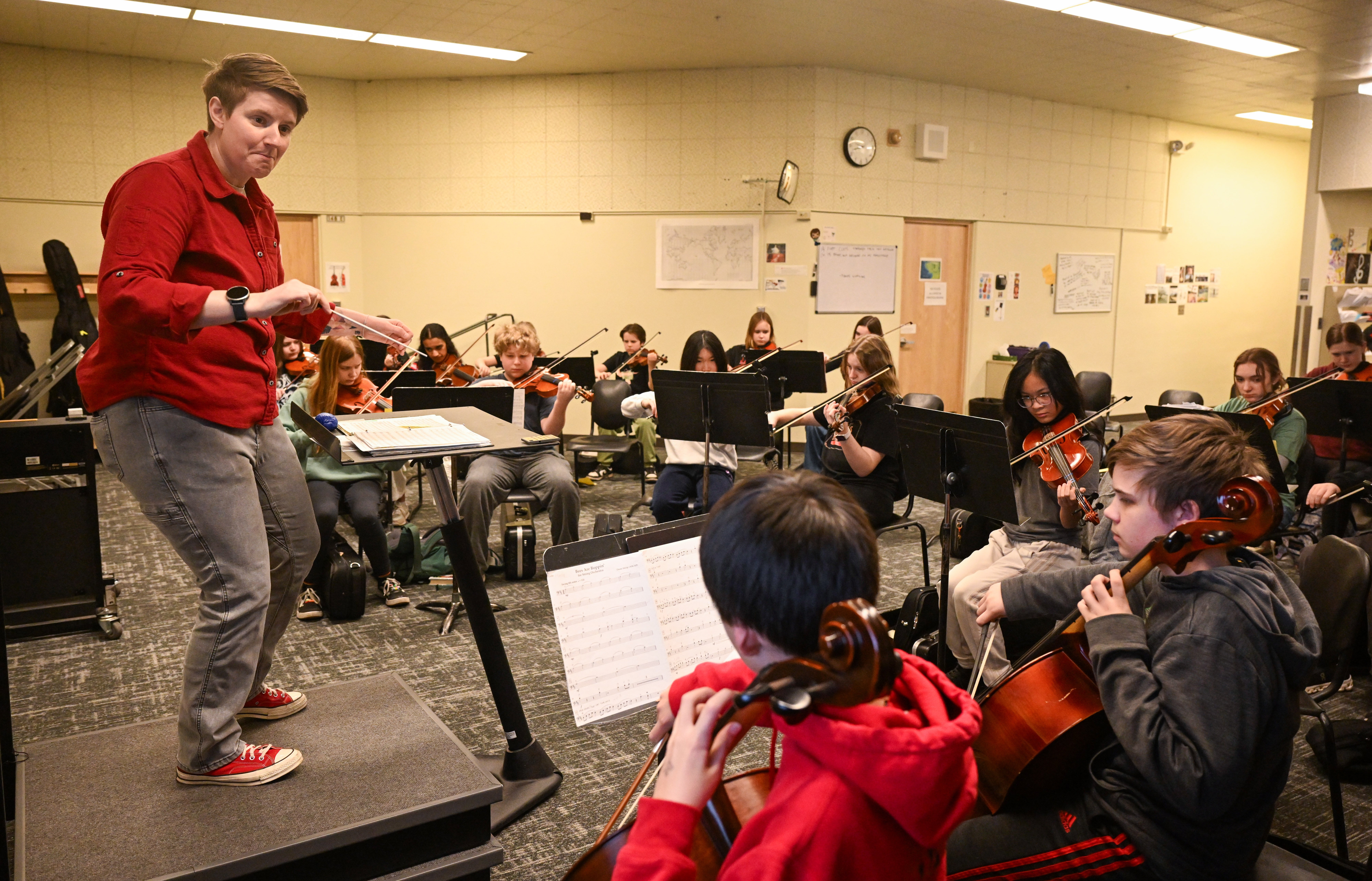
Harris has been the director of orchestras at Libby School for the past 10 years. Many of the seventh-graders in that first-period class have known Harris for a long time.
Theo Bagwell, a seventh-grade cello player, said he has known Harris since he was in kindergarten. Harris was his second music teacher, but the one he will probably remember the best when he is older.
“They’re always so positive and encouraging, and whenever I get something wrong, they help me until I get it,” Bagwell said.
Outside of class, Harris stays busy. They started the Odyssey Community Music Club, where approximately 40 students gather once a week after school to create music. They also conduct the Spokane Youth Symphony Sinfonietta. This year, Harris was awarded the best School Orchestra Director of the year by the Washington Chapter of the American String Teachers Association in late February for their commitment to fostering classical music education.
“By the time I was 15 or 16, I wanted to be an orchestra teacher,” Harris said. “An orchestra is just a really special kind of class, a really special kind of community, where you have to participate as yourself to create something bigger than yourself.”
Harris said music is at the core of their life and sense of self. Whether teaching, listening or playing, they feel most like themselves when engulfed in the music.
They play in the three-part string, three-part harmony band Betsy Rogue, along with two other educators. Harris describes the band as having a feminist rage, Americana kind of sound that doesn’t necessarily fit into any single genre.

The Spokane teacher trio of Harris, Eastern Washington University English lecturer Liz Rognes and Sacajawea Middle school orchestra teacher Heather Montgomery have played for years across numerous Spokane venues, including the Chameleon and the Big Dipper. Harris plays cello and guitar in the band.
Harris said their love for music began with piano. In fifth grade, they learned to play cello. Next came guitar, violin and viola. During the COVID-19 pandemic, they switched it up and took to the drums.
“Music was the place where I really, truly got to be myself,” Harris said. “That opportunity for authentic self-integration that comes through music, when music is right and when music is good.”
Music is wrong and bad, according to Harris, when there’s an obvious power dynamic and hierarchy where the conductor is “the end-all, be-all.” Harris said they prefer to think of themselves as a guide or mentor who’s able to show students the variety of pathways available to them. Whether that journey ends with a cello student performing at Carnegie Hall or a violin player fiddling around in a dreary dorm room with friends should be up to the individual.
“The classical music world has for a long time been this conveyor belt,” Harris said. “You join the orchestra, you take lessons, you do the Youth Symphony, you do a conservatory, you become a professional musician. And there’s so little room for personality and for authenticity within that. So my whole approach is music is so big, and there’s so many ways to make music and to interact with music, and I wanted to learn about the student and for them to learn about themselves, to see how music is going to be the most real for me in my life.”
Toward the end of first period, after wrapping up their final song, Harris asks the class how they’re feeling ahead of the next week’s concert. They ask the class to specifically use the words “I feel” and not “I think,” as one expresses passion and the latter delves into the realm of opinion.
Excitement, anxiety, hopeful, and scared are all words the Odyssey kids chose to use. Harris circled back to anxiety and told the class that feeling anxious is unavoidable, but those feelings can be eased with practice and dedication.
As the students funneled out the door, some stopped to chat briefly with Harris. One read Harris a poem they wrote, another complained about how sore they were from gym class, but almost all of them say “Thank you, Harris.”
Harris said working at Odyssey has far outlived their expectations. Prior to working there, Harris taught in the Bethel School District as an itinerant teacher, meaning they had to bounce between several schools in a single day.
Today, Harris is happy with where they are. Between the Spokane Youth Symphony gig, teaching classes at Odyssey and the afterschool club, and playing in a band, Harris is fully immersed in the thing that makes them feel the most complete. They credit a “great” orchestra teacher they had from fifth grade until their senior year with pushing them into leadership opportunities with the local youth symphony in Harris’ hometown of Longview, Washington.
“My perceived success as a teacher has come when I lean into just being truly myself,” they said. “And no one has ever regretted doing music. Many people regret quitting.”
In an era of education that seems to increasingly put more importance on math and science than it does on the humanities, Harris said they’re happy to work at a school that considers band and orchestra to be essential to the student experience.
“From birth, we’re dancing, we’re singing, we’re creating, we’re drawing,” Harris said. “And that’s so innate to human nature. To practically remove that and to be creating things without aesthetics, without beauty, without elements of color, and sound and all that, STEM would be really boring without the influence of art.”