
Yellowstone wolf’s skeleton testifies to the strains of a wild life
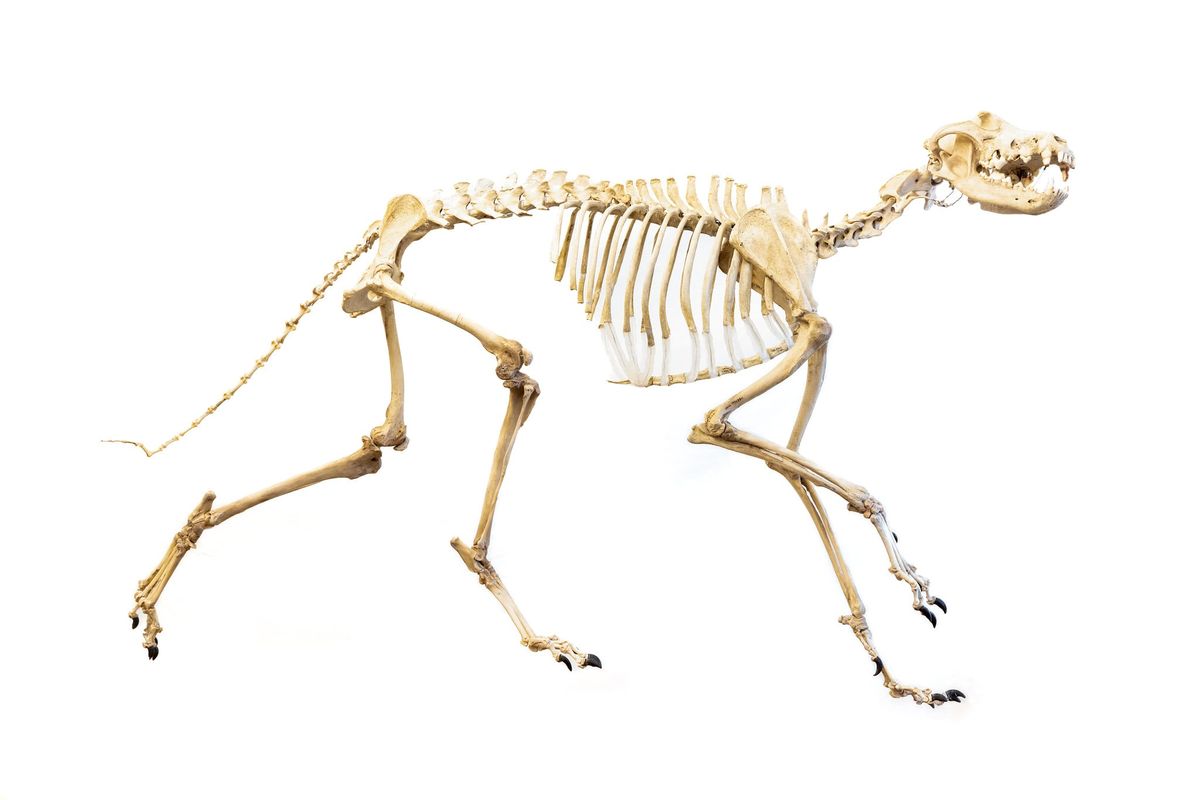
Life’s misfortunes are often written on a body’s bones.
The fall from a wall that cracked a construction worker’s skull. That whitewater canoe trip when your friend’s finger was smashed between the gunnel and a boulder. The tyrannosaurus tooth lodged in a duck-billed dinosaur’s snout.
For a male black-coated wolf that lived in Yellowstone National Park the list of injuries revealed by his skeleton was extensive.
The tip of his tail was cocked at an odd angle after being broken; there were injuries to his skull, possibly from being kicked while attempting to bring down prey; teeth were broken or completely knocked out; trauma to the pelvis may have occurred when he was young; a missing toe and two fused toes were speculated to be from an infection; and in the end all of his bones were brittle with old age.
Broken ribs from the wolf’s final fight with another pack proved fatal and never had a chance to heal.
“There was a lot of history from looking at those bones, just looking at the trauma that had healed over his life that made it a really fascinating wolf to look at,” Lee Post said.
The Boneman
With a title like the Boneman, even if self-proclaimed, Post lays claim to a unique craft.
The Homer, Alaska, resident has become notorious in some circles for his ability to reconstruct animal skeletons for museum displays as well as educational tools.
Given his location, he mostly focuses on marine mammals, but he recently branched out into crocodiles, snakes and reptiles. He’s also written several self-help books to teach his unusual craft to others.
In 2022, Post brought his skills to the small Yellowstone National Park gateway community of Gardiner for a job he initially underestimated.
He had been lured there two years earlier by a pitch from Miriam Watson, curator of the Yellowstone National Park Heritage and Research Center. She was looking for someone to reassemble the skeleton of a male wolf named 302M that had died in 2009 and was kept in a freezer while awaiting his next adventure.
The wolf’s number refers to the order in which Yellowstone’s wild canines are collared. An M is attached to males and an F to females. So 302M was the 302nd male wolf captured and fitted with a collar since wolves were first reintroduced into Yellowstone in 1995.
A bone puzzle
“Skeleton articulation, or ‘bone building’ as Lee calls it, is the process of converting a dead animal into a completely cleaned and articulated skeleton (like the skeletons you see in museums),” Yellowstone Forever noted on its website.
The official fundraising and educational partner for the park, Yellowstone Forever funded 302M’s skeleton project.
As part of the Heritage Center curator’s request for a bid, photos were sent of 302M’s remains to Post. The first photograph alarmed him.
“It looked like they were cremains that had been run through a lawnmower,” he recalled in a phone interview.
Luckily the photo – the first of what was supposed to be a series, the rest of which didn’t arrive in his email – showed 302M’s stomach contents, not his actual skeleton.
Although the stomach contents did not have to be reconstructed, the project proved much more challenging than Post initially conceived.
What he estimated to be an 80-hour work week turned into 160 hours with several people stepping up to help finish in five long days.
Famed wolf adds to pressure
At first Post believed he would be working on a “recently killed normal wolf.” Instead, he would learn that 302M was well-known to park biologists and wolf watchers, had been featured in a book and two films and was such a philanderer that he earned the nickname Casanova.
The wolf was also long-lived, surviving the park’s extreme winter cold and snow for nine years while hunting large, dangerous animals like elk and bison.
Yet as is often the case in Yellowstone, 302M was killed during a fight with another wolf pack – the leading cause of death for wolves in the park. At the time he was the alpha of the Blacktail Deer Plateau pack.
Beefing up bones
The struggles of 302M’s life unfolded after his skeleton was meticulously cleaned by Sue Ware, who at the time worked as a paleopathologist (scholar of ancient diseases) and osteologist (scholar of bones) for the Denver Museum of Nature and Science.
“The pathological changes in a skeleton let us take a retrospective look at some of the major life events for a wolf,” she wrote in an article for the Wolf Project in 2010.
Certainly, that was the case for 302M.
In addition to the injuries, however, the wolf’s bones had become so porous that drilling to install wires to hold the skeleton together had to be postponed until the pores could be beefed up with glue.
“Because of these conditions, because of how famous this wolf was, because of a lot of things, it was like I way missed how long this was going to take to put together,” Post said.
Over the course of his Boneman career, Post has assembled skeletons as small as mice and bats and as large as a 55-foot sperm whale. Although his focus has been on large marine mammals, he said a sea turtle may have been the strangest.
“There’s just a lot of bizarreities that a turtle has because the shell is actually the ribs,” he explained.
When not reconstructing skeletons, Post is helping to manage a local bookstore.
Posed at a fast gait
In the end, thanks to the contributions of several assistants, wolf 302M was posed as if walking at a fast gait, his head slightly raised and aimed to the right as if catching the scent of prey for one last hunt.
“We didn’t want to have a standard biology classroom mount where it’s four feet on the ground just standing there like it’s been frozen in fright,” Post said. “We wanted something that looked a little more natural, had a little more movement.”
That seems fitting for a wolf that was known for often moving through the territory of other packs, sometimes sneakily breeding with their females, before returning to his Leopold pack’s homeland in Yellowstone’s Northern Range.
The wolf’s history also lives on in another way. In its 2016 annual report the Wolf Project noted 302M’s genome had been sequenced providing insights to the animal’s “divergent ancestry,” as well as those of his descendants. That information led to a study on the gene for black coat color.
“The sequencing of 302M, a legacy wolf of the YNP population, will place genetic research in YNP in the limelight and exemplify its cutting-edge nature to the public,” the Wolf Project reported in 2016.
“Wolf #302M’s extraordinary life provided us with a magnitude of insight into the lives of Yellowstone wolves,” wrote Wolf Project biologist Kira Cassidy in her eulogy to the big canine. “Every time #302M was observed hunting prey, howling to other wolves, chasing coyotes, or feeding his pups, it was documented and filed in the Wolf Project office. In so many ways, his life has spoken volumes.”
The reconstructed skeleton of 302M is on display at the Yellowstone Heritage and Research Center, Monday through Friday from 9 a.m. to 4 p.m., where it continues to educate visitors about one animal’s tenacity while living in the nation’s rare remaining vestiges of truly wild country.
Gardiner-based artist George Bumann, who helped rebuild 302M’s skeleton, also plans a life-sized bronze sculpture of the wolf in yet another tribute to the survivor and his resilience.