
No snow is needed for these sled dogs who took on annual dryland race at Riverside State Park
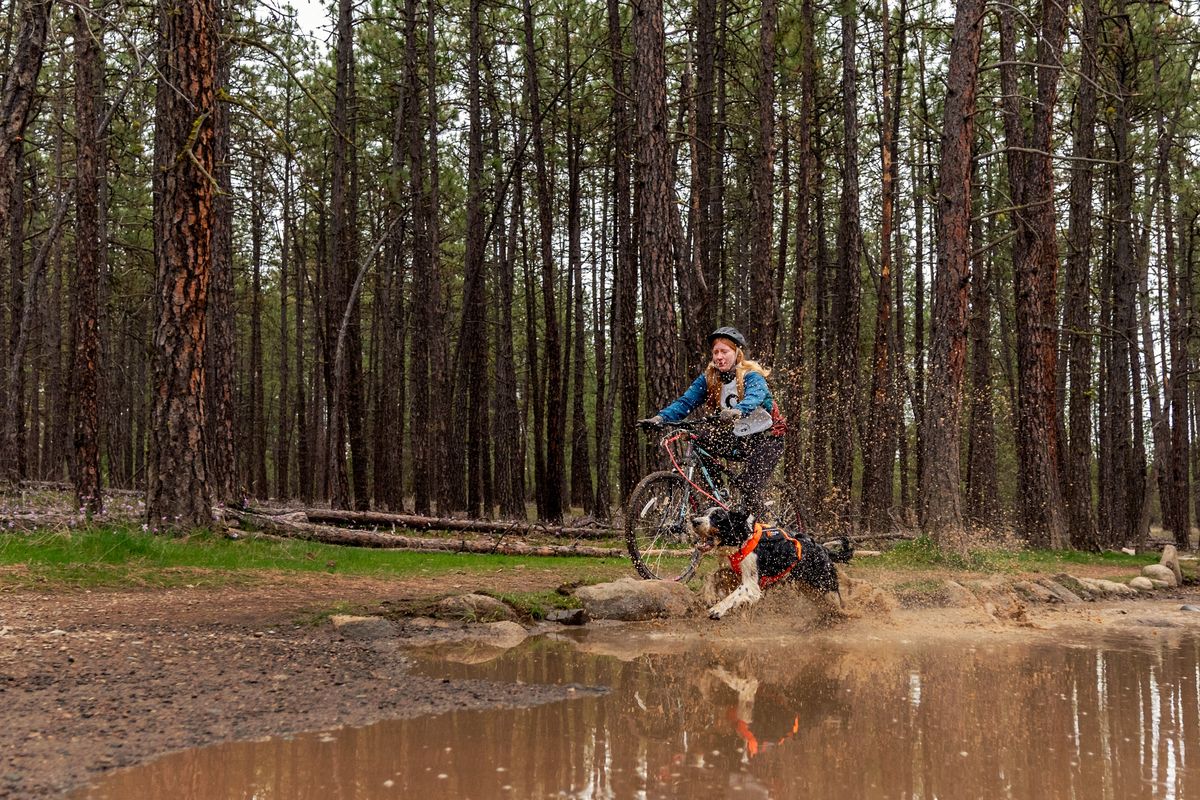
Before dogsled racing was ever on her radar, Mikki Douglass spent her winters skiing around her rural property near Cle Elum, Washington, leisurely towed by her Labrador on a leash.
Douglass is a thrill-seeking, motocross national champion and mountain bike racer; her dog is a retired search and rescue worker. The pair on the slopes were a perfect fit.
Still, she was hesitant when her neighbor suggested she train the Lab in skijoring, a niche in dogsledding where the dog pulls a human racer on a set of skis.
The Lab was on the smaller side. “That’s not fair to her,” Douglass remembered thinking.
“She goes, ‘Oh, she’ll love it,’ ” Douglass said. “So she fit her in a harness, and the rest is history. I got addicted to it.”
Douglass and her pup went on to race in skijoring, building their bond with each other and stoking Douglass’ passion for the sport. In the years since, Douglass has become absorbed in dogsled racing of all kinds, traveling in her truck and camper to race her dogs across the country. Last year, she earned several world championship titles for racing in Wisconsin against athletes from 30-some countries.
Though she started with her beloved Lab, Douglass now races with Eurohounds, a large yet spindly breed designed for dogsled racing, crossbred from Alaska huskies, English pointers and German shorthair pointers.
She has 16 of the dogs in total, a relatively small kennel for dogsled racers.
On Saturday and Sunday, Douglass and nine of her dogs came to Spokane for a dryland race. The Inland Empire Sled Dog Association hosted its inaugural Spokane Spring Sprint dogsled race on the trail systems at Riverside State Park. The race was the first in a three-race series called “Winter in Name Only” sponsored by the Northwest Sled Dog Association.
Nineteen human racers took the course, riding on scooters , bikes and sleds towed by teams of excitable dogs of various breeds.
It’s the 13th year the association, which itself is 60 years old, has hosted the race at Riverside, though it’s typically in the fall. The group hosts runs across Washington and Idaho, said association President Zach Wolf, who opted to host a spring race in what has been a slow year, he said.
“We didn’t get our snow this year that we normally have, so our winter season was kind of cut short with so many races being cut off,” Wolf said. “We decided to start this ‘Winter in Name Only’ series for the spring and get teams out, get them some mileage, let them have at least a couple more races this season.”
The race was open to dogsledders of all sorts. Some took on the 9-mile “mid-distance,” where eight dogs pull their human on a standing, chariotlike sled with three wheels. Shorter options cover 2 miles and involve fewer dogs: Racers can either run alongside their dog, called canicross, or ride just about any rig towed by their dogs. Popular vessels include scooters, bikes or standing carts.
For Wolf, who races with a team of Siberian huskies, the sport is a lot of fun for him and his dogs, he said, but it also gives them an outlet to blow off some steam and do what they were bred for.
“A lot of people think that running your dog in a harness and making your dog pull you or pull a cart or pull a sled is wrong, and we try to educate people,” Wolf said. “The dogs that we have out here doing this, they were bred for this. They want a job; they want to get out and work.”
Many high-energy “rambunctious” dogs, like Siberian huskies, lack an appropriate outlet for their energy if they’re cooped up inside all day, Wolf said.
Enter dogsledding: fit for any dog and any human, Wolf said. It’s especially fulfilling for him to run his Siberian huskies and honor their pedigree of pulling sleds across vast tundra.
“It’s getting back to the root of what the animals were bred for,” Wolf said.
Wolf said some of his dogs can be traced ancestrally to sled dog Togo, who ran on one of the teams in one of the most famous stories in dogsledding history: the 1925 serum run to Nome, Alaska.
Much of the international and historic attention from the event surrounds the Siberian husky Balto, who led a team in the final stretch of the over 674 -mile relay to deliver lifesaving medicine to the secluded town of Nome.
While about 20 mushers and dozens of dogs partook in the five-day effort to deliver the serum, it was musher Leonhard Seppala and lead dog Togo who many credit to traversing the longest and most dangerous stretches of the journey.
Wolf is proud to honor this heritage in his own dogs, though the stakes are much lower in his case.
“It was a lot of keeping that drive in the breed and the furthering of our breed,” Wolf said. “A lot of people think of Siberians as these big, fat, fluffy dogs that just prance around and are really noisy. We like getting them out and building on those foundations that the breed was famous for.”
Wolf has passed on his passion for dog racing along his own lineage; his son Kyler Wolf, 12, has been running with dogs for years. His rig of choice is a small four-wheeler with its engine removed. One of his huskies can be attached to the front of the vehicle to pull him along.
“I just like hanging out with the dogs, hanging out on the trail, they love it,” he said.
The elder Wolf said dogsled racing is waning in popularity. In years past, his fall race would see as many as 60 entrants while they now rarely crack 20. He’d like to see more people take to the trails with their dogs, and encouraged any dog parent of any breed to look into the sport.
As an introduction to the sport, Wolf and Douglass offer Alpine Outfitters “pull clinics” ahead of races. Experienced racers teach beginners how to set up their own rig and appropriately harness their dog.
“That’s where we come in, with teaching the proper techniques, the proper equipment to use, how to do it, how to give your dog that job that they were bred to do,” Wolf said.
The next “Winter in Name Only” race and pull clinic is the last weekend of April in Cle Elum.