
New book by WSU history professor ‘Chosen Land’ examines Christianity’s deep influence on American identity
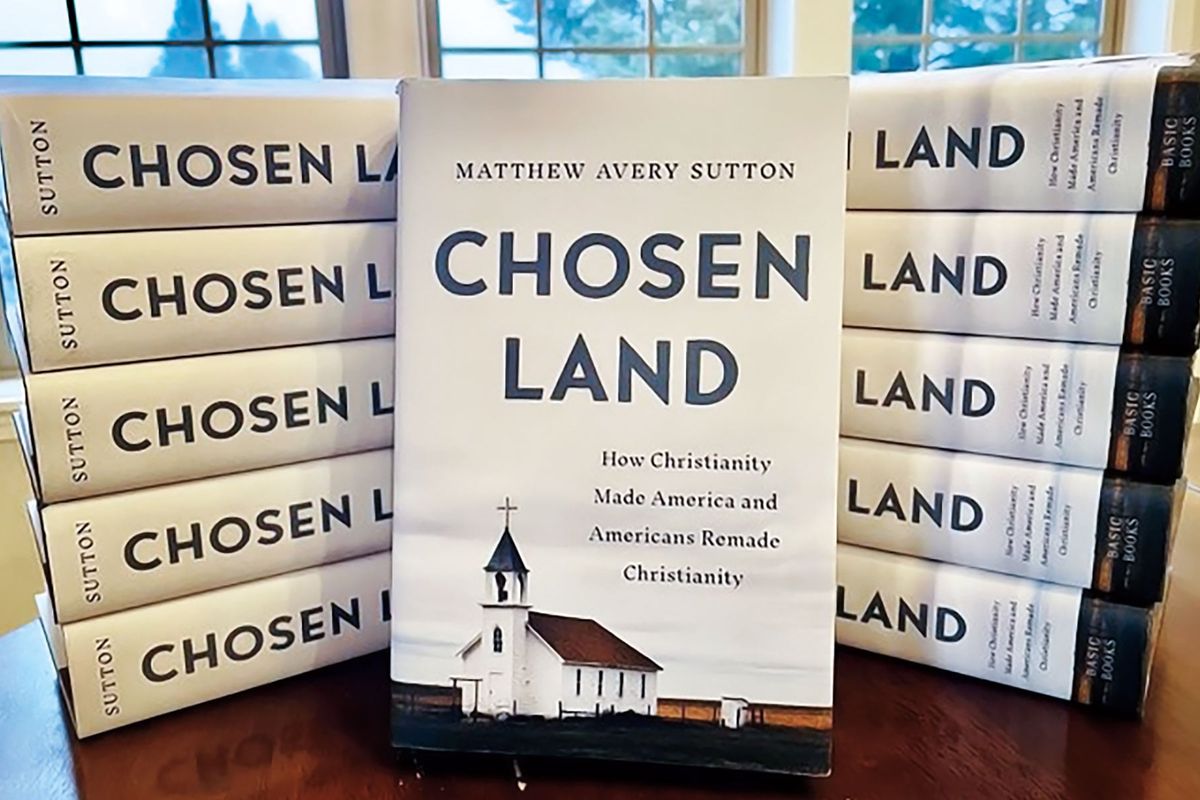
America is mostly a Christian nation but it’s complicated, argues Matthew Avery Sutton in his new book, “Chosen Land: How Christianity Made America and Americans Remade Christianity.”
The book claims to be a 500-year historic survey of Christianity in America just in time for the nation’s 250th anniversary, which marks the signing of the Declaration of Independence.
“I started off with the question … ‘Why are Americans more Christian than our peer nations?’ ” Sutton said, adding that his goal was to explain historically why that matters. “The book was my effort to go back into the archives, go back into the sources and try to figure out what it is that’s unique or distinctive about the United States and its history that has led us to today.”
With 20 years of professional work at the intersection of religion and politics, Sutton chairs Washington State University’s history department.
Prior to “Chosen Land,” he has written five other history books that focus on specific areas of American Christianity, including “American Apocalypse: A History of Modern Evangelicalism.”
To the source
As a historian, Sutton shows his work. Each of the book’s 31 chapters includes a curated list of works alongside footnotes, so readers can trace the scholarship behind his arguments.
“To tackle a book like this, I was essentially doing two things. One was building on (an) entire generation of scholarship – folks who are much more specialized in certain eras to try to figure out how they understood the particular periods they were studying and then combine that with archival research,” Sutton said.
Fellow historian Seth Dowland, who is a professor of religion at Pacific Lutheran University in Parkland, Washington, identifies Sutton’s book as an “incredibly ambitious” and “massive survey” of generations of American religious historians.
“What I think Sutton is attempting to do is … to try to synthesize it into an accessible narrative of American Christianity and using Christian activism as the sort of throughline,” Dowland said.
That thread challenges familiar narratives – about the Constitution’s secular roots, the First Amendment’s intent and the role marginalized communities have played in reshaping American Christianity from within.
American Christianity’s origins up to the present
Beginning with Native Americans and how they viewed religion as part of their culture, Sutton exposes the “vibrant and diverse” place 15th-century America was before “the Christian invasion began.”
From there, he moves on through early Spanish conquests and missions work and writes about how Christopher Columbus believed God had chosen him as part of fulfilling the Bible’s prophecies of the last days.
He explains how Spanish soldiers often justified beating and killing Indigenous men and raping Indigenous women, while at the same time some Franciscan monks complained these acts “‘brought discredit on our teaching.’”
The book concludes with President Donald Trump’s second presidency and how he began “not just as a politician, but a self-anointed messiah.”
Referencing Trump’s assassination attempt in his inaugural address, Sutton shows how Trump used Christian language to show his survival was divine intervention.
“ ‘Just a few months ago … an assassin’s bullet ripped through my ear. But I felt then, and believe even more now … I was saved by God to make America great again,’ ” Sutton quotes Trump saying.
Rebranding American Christianity
In between these two historical worlds of past and present, Sutton shows how Christians in America rebranded and redefined Christianity to gain followers and influence over the centuries, since America’s founding documents prohibited federally-sponsored churches.
Each Protestant denomination competed for followers like companies would compete for buyers in the free market.
He also asserts that the First Amendment has been rebranded into a mythos of coming from high-minded secularism, instead of what he defines as the “crass pragmatism” of the founders.
“The goal was to ensure that the major competing Protestant denominations (Baptists, Methodists, Presbyterians, etc.) could get along to ensure the survival of the American experiment, rather than to keep religion out of government entirely,” he said.
Christian nationalism is as old as America itself
Sutton also spends some time in his book on defining Christian nationalism and pointing out that it has shaped the whole of American history. Rather than defining it as “good” or “bad,” he identifies it as “productive” versus “problematic.”
“Christian nationalism has influenced activists across the political and religious spectrum, Black and White, left and right, for centuries,” Sutton writes. “Americans have never really separated church from state, nor have they truly championed the free exercise of religion. Christian activists from Frederick Douglass to Jerry Falwell used the Bible to try to impose their values and beliefs on the nation.”
Dowland believes “Chosen Land” is also more than a book on Christian nationalism. It’s about broadening that focus to see Christian nationalism in more contexts than the “MAGA-wing of evangelicalism.”
“The (real) story is whose vision of Christianity is going to triumph in American life as opposed to Christian nationalism being a sort of descriptor of a bad variety of Christianity that wants to violate the separation of church and state,” Dowland said.
But then the argument against Christian nationalism needs to be “not we shouldn’t have religion in our politics,” argues Sutton.
“I don’t think that’s fair to people of faith to ask them to put their faith on a shelf,” he said.
However, he does think it’s fair to ask Christians, and by inference, other people of faith, if applying their religion is “in the best service of the country” and all citizens in a pluralistic understanding.
Will Christianity shape America’s future?
Joan Braune, a Gonzaga University faculty member and researcher of fascist and Christian nationalist movements, agrees that Christians should advocate for their values on the basis of faith.
However, she said, “It is important that this happens within the context of a secular state.”
“As long as this project is framed as a ‘Christian’ endeavor on the part of the state, it would remain one in which non-Christians have a secondary status, are seen as outside the norm of what is means to be American, are in some way suspect and have a worldview that is secondary in the formation of laws,” Braune said.
This would include a state run by progressive Christians, too, she added.
Sutton concludes “Chosen Land” by asking another question: “Does the recent rise of a new form of Christian nationalism mark the dawn of a new theocracy – or Christian nationalism’s last desperate grasp?”
He writes, “As we search for answers, one truth remains: the conviction that the United States is God’s chosen land – and Americans his chosen people – has shaped our nation from the beginning. It continues to shape it now. But will it shape our future?”