
The Community School is ‘going with the flow’ as it renames high school
The Community School has a new name, though you probably wouldn’t know it passing by the option high school off Monroe Street.
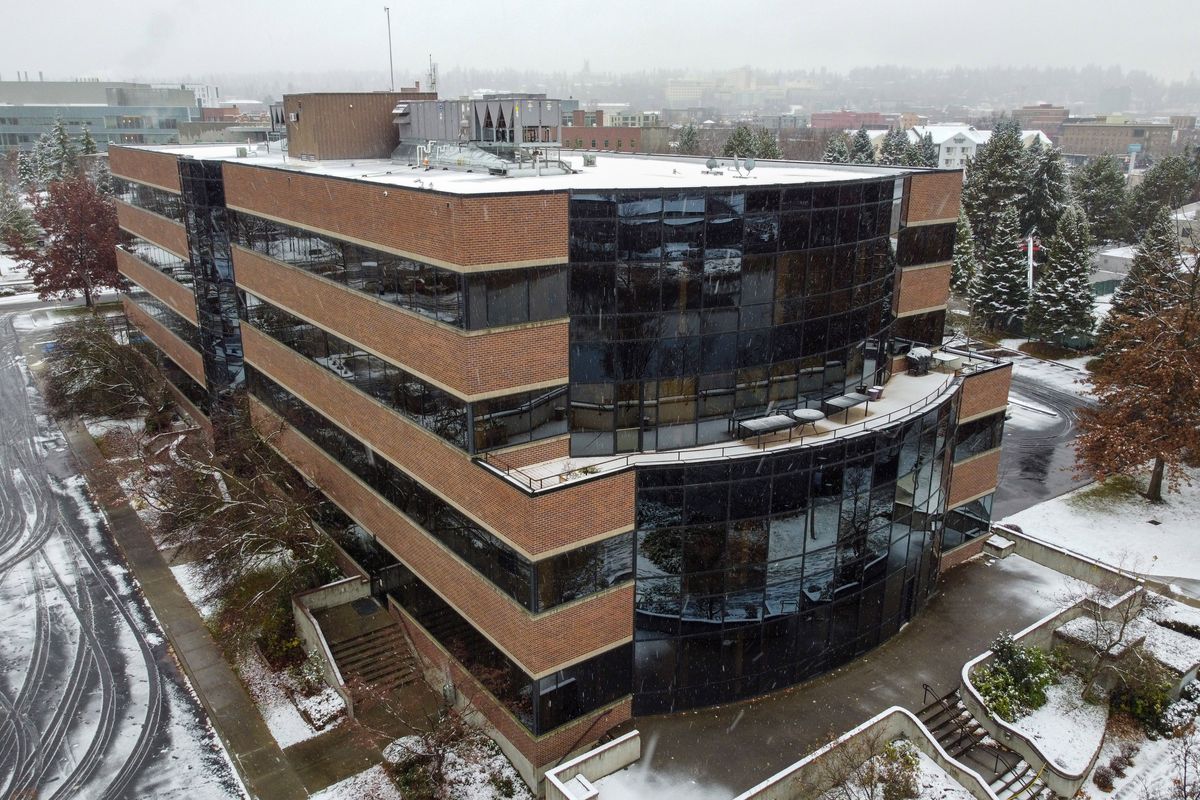
It’ll be a couple of years until the school visibly adopts its new identity, but the Spokane Public Schools board on Wednesday approved rebranding the Community School to Riverpoint High School. The new moniker is meant to reflect a new future for the 12-year-old school, which will be relocating to the district’s recent property acquisition at 501 N. Riverpoint Blvd. That move will happen sometime in 2028, Superintendent Adam Swinyard said.
The new name gives the school a “chance to really solidify our brand, our identity, and this opportunity with the new facility,” Principal Cindy McMahon said. “Lots of things are changing right now.”
After some discussion, the board unanimously supported the new name to match the building and adjacent street, each also called “Riverpoint.” The board selected the name from a list of five drafted by school leaders, students and staff at the school. Suggested names surrounded combinations of the words “Riverpoint,” “Community” and “High School.”
The school was the district’s first project-based high school, dubbed the Community School to reflect its curriculum that brings industry professionals, nonprofit partners and university educators to students. An option school, it enrolls around 150 high schoolers in an old elementary school at 1025 W. Spofford Ave.
Dropping the word “community” from the school name was a “struggle,” McMahon said, conflicted between “hanging on to the legacy of what it was,” and what could be a “real fresh identity” in a new space.
McMahon said surveys from her school were “overwhelmingly” supportive of adding some sort of “river” in the title, given its geographic location.
Asher Nelson, an 11th-grader at the newly dubbed Riverpoint, told the board he would be satisfied with any of the suggestions.
“I’m open to whatever happens, going with the flow,” he told the board.
The board did just that.
“You said, ‘Go with the flow,’ ” board member Nikki Otero Lockwood said. “That, to me, says ‘Riverpoint.’ ”
District leaders also plan to move the central administrative staff from the downtown building to the Riverpoint address in the University District. The district purchased the property from Spokane Colleges Foundation in 2025 for $12.4 million, intending to sell or lease up to seven properties in a consolidation and cost-savings effort.
The Riverpoint Building, which will soon house the school and administrative offices, is the lone remainder of a failed 1980s-era commercial development project undertaken by Glacier Park, the real estate division of railroad company Burlington Northern.
After Expo ’74 prompted the removal of several railroads, Burlington Northern set its sights on a commercial development in the 51-acre triangle. Undeveloped, it was previously used as a dumping ground for railroad waste, said Steve Corker, who Glacier Park hired for public relations services on their planned development back in the day. Corker, now 84, also served on Spokane City Council from 2000-03 and 2007-11.
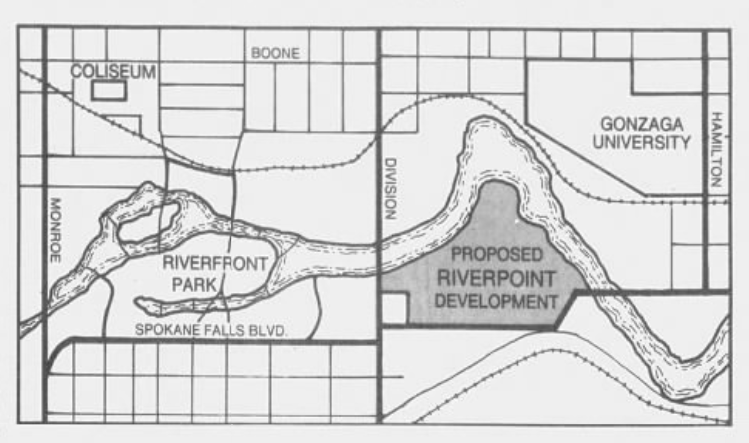
The “futuristic” development, as The Spokesman-Review described it, intended to offer as many as 15 office buildings, plus parking, a high-rise residential building and even a hotel in an estimated $500 million package, Corker told The Spokesman-Review in 1984.
Still in early stages and without the approval of Burlington Northern and governmental powers that be, Corker at the time said the ambitious development “could have twice the economic impact of Expo ’74,” according to Spokesman-Review archives.
That’s not quite how it panned out. Glacier Peak built the lone Riverpoint Building, and within a year of Corker doing PR for the company, he learned Burlington Northern was abandoning its efforts and liquidating its real estate division.
“That was kind of the seed project that was going to kick it off, there were very expensive plans laid out,” Corker recalled in a phone call Wednesday. “Then when Glacier Park found out that because of financial problems in Burlington Northern, they needed capital to deal with their issues, all of a sudden they got the notice that it was for sale.”
Corker said at the time, the downtown business owners, including the Cowles family, were adamantly against commercial expansion past Division street, viewing the project as a “threat,” he said.
“Quite frankly, I think a commercial development of that size at that time would have caused serious problems for the downtown business community,” he said.
Eventually, higher education institutions took up residence in the area and it became the U-District we know today. While the development was a far cry from rivaling the economic buzz of the world’s fair, its legacy is present with the renaming of the high school.
Leaders from Glacier Park chose “Riverpoint” for the name of the project, Corker said, and the name is still associated with the building. Later, the road going through the area was also named “Riverpoint Boulevard.”
“If you look at the geography, there’s an abutment that runs south to north and a bend in the Spokane River and there’s a point there at the river,” Corker said. “That’s how they came up with the name, it was a physical description of that particular area.”
Despite his involvement with the project, Corker said he’s happy with how the space is used now as a hub for education.
Though the board stripped the word “Community” from the title of the school, their emphasis on including outside professionals and academics in students’ education won’t change, McMahon said. If anything, it will be easier for the school to access higher education professionals while nestled in the University District.
“It’s Riverpoint High School in the University District, connected to all those university entities, it gives a different vibe,” McMahon said. “We still will always be a community-based school. It’s in our mission – a community-based school that is empowering agents of change.”