
Indigenous sculptor Greyshoes brings ‘sounds, colors, rhythms, meaning and spiritual nature’ to Marmot Art Space
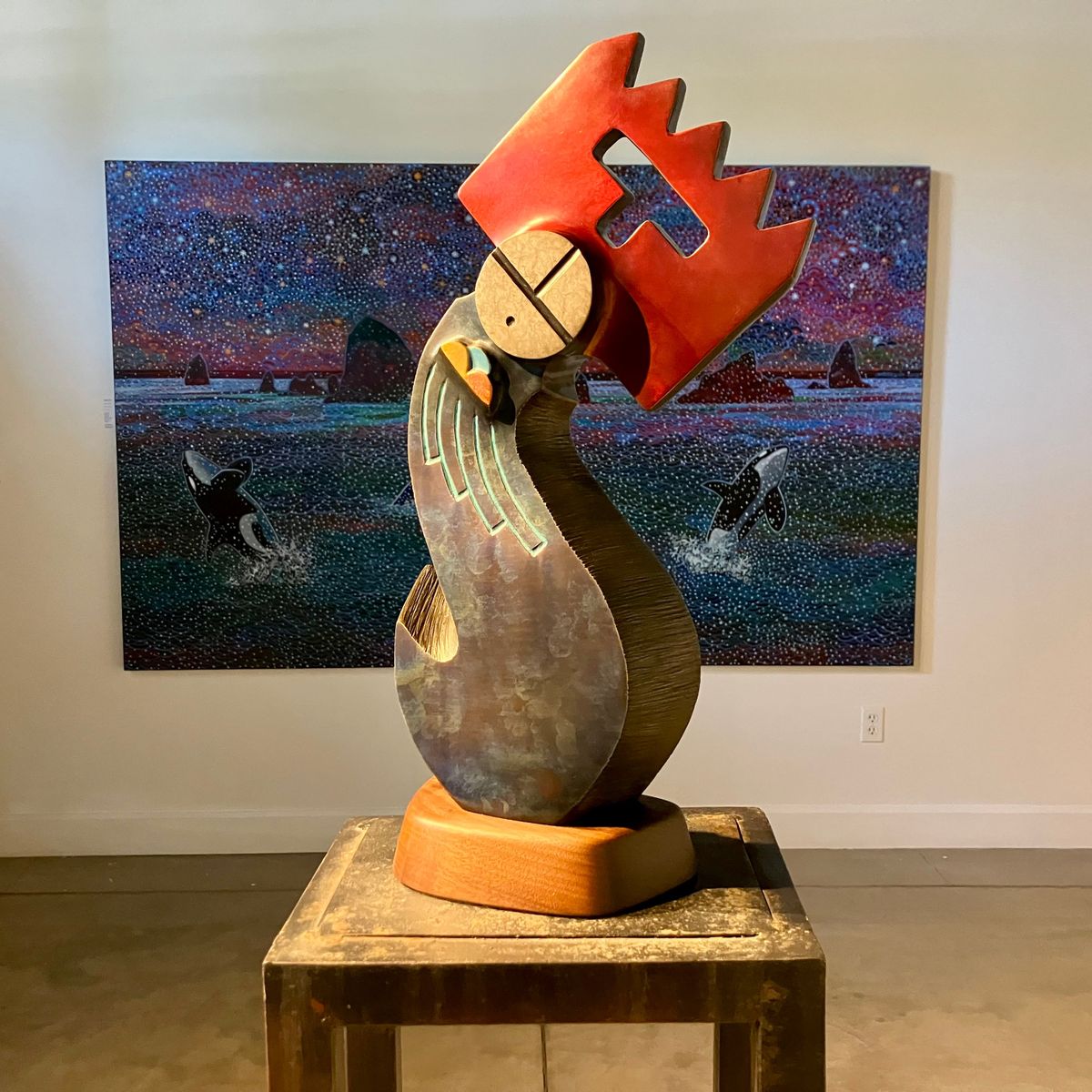
The first piece stone sculptor Upton “Greyshoes” Ethelbah Jr. carved came with an element of “I told you so.”
A longtime friend of Hopi sculptor Evelyn Fredericks, Ethelbah had said time and time again that he felt stone sculpting was something he could do. After he said that for, as he estimates, the 100th time, Fredericks gave him a piece of Utah alabaster, let him borrow a few of her tools and said, “Shut up and do it.”
So he did, carving Drum on Kiva Steps, which features a native drum inspired by one his uncle owned sat on top the steps leading into a ceremonial building called a kiva.
Ethelbah (Santa Clara Pueblo and White Mountain Apache) practiced with various techniques while creating the piece, including keeping some parts smooth while giving texture to other parts by tapping those areas with a mallet and nail.
After it was complete, Fredericks was impressed by what Ethelbah had accomplished. Their friendship, he said, always involved her being the artist and him being the visitor, but now they were on a more even level.
Wanting to continue his stone sculpting education, Ethelbah enrolled in classes at the Poeh Cultural Center in Santa Fe.
Though he showed his natural talent with Drum on Kiva Steps, the second piece Ethelbah made didn’t have the same triumphant outcome. At least not initially.
While working on a piece of Indiana limestone in class, Ethelbah hit the work-in-progress at the wrong place with the wrong amount of pressure at the wrong angle and the piece broke into two.
From that experience, Ethelbah would learn he had three options. The first was to keep working on the initial idea with what remained. The second was to take what remained but make something different. The third involved setting the broken pieces aside, shedding a tear, then beginning a new project.
Ethelbah chose the second option and used what remained to create an abstract piece called Phantasia, which is now at Marmot Art Space. Ethelbah will be showing his work at the Kendall Yards gallery during the month of June.
Being in sculpting class felt natural for Ethelbah, who though surrounded by art growing up, including Native American paintings and Navajo rugs, and his father, who made a hobby of carving wood, said he wasn’t an artistic child.
He liked seeing how his fellow students chose to express themselves through the piece of stone they chose. Some used Indiana or Texas limestone while others chose Colorado or Utah alabaster. Some “real brave souls” chose marble, which Ethelbah said is difficult to work with.
He wasn’t afraid of using the power tools required to sculpt stone, from the biggest angle grinders to the smallest Dremel tools, and he didn’t mind donning a respirator mask and getting covered in dust from head to toe.
A former football player, he liked the physicality of it, wrestling each piece of stone into the right position.
“It’s a lot of macho stuff, but also finesse at the same time …” he said. “We’re all very strong and artistic and committed to expressing ourselves with stone and tools and polish and sandpaper and hammers and chisels.”
After finishing classes at the Poeh Cultural Center, Ethelbah retired from his work at the Santa Fe Indian School, the same school where his parents met, and began working full time as an artist.
Ethelbah’s work can be found in galleries in Sante Fe, Albuquerque, Phoenix, Sedona and here in Spokane at Marmot Art Space. “Greyshoes – Southwest Sculptures” marks his first full exhibition in town.
When carving, Ethelbah is inspired by elements from his heritage, primarily the “sounds, colors, rhythms, meaning and spiritual nature” of Santa Clara Pueblo corn dancers. His father’s people, the White Mountain Apache, call them crown dancers.
Ethelbah manages to bring life and movement to these stone sculptures, carving the curves in such a way that it really looks like the clothing of the dancer is moving with each step.
He also carves a lot of stylized bears, including one he’s bringing to Marmot Art Space that has a heartline, which represents life energy.
Nearly 30 years after his first stone sculpting class, Ethelbah, now 83, thinks the number of stone sculptors working is growing, but at a slow rate. When he began showing at the Sante Fe Indian Market in 1999, he estimates there were maybe six or eight artists in their 40s and 50s with one or two closer to 30 years old.
Now, if there are one thousand artists at a market, he estimates up to 12 would be stone carvers, while noting that other carvers work with clay, wax or wood.
Ethelbah chalks it up to the nature of the medium, which is labor intensive and deals with tools that can be risky. It goes back to the physicality of the medium, which requires moving heavy stones from one location to another, adjusting the orientation as needed, rolling the stone over when you need to cut the other side.
For the really big pieces, Ethelbah has a hydraulic lift to get the stones out of his truck and into the right place for carving.
Stone carving isn’t something one can do at their kitchen table, but it is something everyone can do, with a little education to get started. Ethelbah said he is often asked what advice he has for people who have recently or will soon retire and are interested in pursuing art, and he always tells them to start taking art classes in a variety of mediums until they find the one they enjoy the most.
“Don’t go to the art store and buy a bunch of stuff,” he said. “You don’t know what you’re buying, you don’t know what you’re doing. You try to make something and you’re a total disaster. You throw your stuff in the trash can. What do you say? You say ‘I don’t have any talent.’ It’s not about that at all.
“Classes allow you to learn from an instructor who shows you how to use your tools, your medium in the environment that you need to be successful, all the aspects of being an artist in that particular medium. It’s going to cost you a few bucks but it’s more productive that way.”