
Small studio a big draw
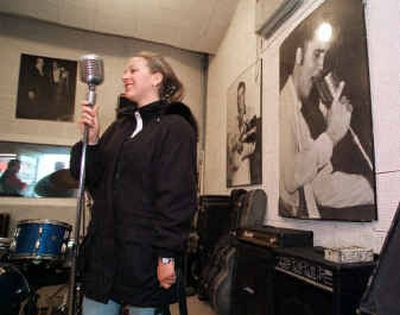
MEMPHIS, Tenn. — Michael Hallsworth stepped up to the big black X on the floor (right where Elvis stood), grabbed the microphone (the one Elvis used) and broke into “It’s Now or Never.”
Hallsworth and his wife, Rita, came from Nottingham, England, to stand on this piece of hallowed ground for Elvis Presley fans: Sun Studio, where the King of Rock ‘n’ Roll began his ascent to fame.
Holding the microphone and its floor stand at an angle, Hallsworth cut about as good an Elvis pose as one could expect from a retired house painter in red shorts and plaid shirt.
And he looked just fine to his wife, who videotaped everything.
“Oh, it’s brilliant,” she said. “This is a wonderful holiday.”
The studio — all 20 feet by 35 feet of it — wasn’t much to look at in Elvis’ day and still isn’t. But it draws some 125,000 tourists annually, and it’s also at the center of a yearlong celebration of local rock ‘n’ roll history.
A party was held here on July 5, 50 years to the day after Presley came to Sun Studio to make his first commercial recording, “That’s All Right.”
More festivities are planned for “Elvis Week,” which begins Saturday. The annual affair is organized by managers of Presley’s estate to coincide with the anniversary of his death on Aug. 16, 1977.
The highlight of the anniversary week, which includes fan club meetings and parties, is a candlelight procession past Presley’s grave, located in a small garden beside his house. It runs through the night of the 15th and often attracts upward of 10,000 participants.
The studio, across the street from a garage and next door to a radiator service, was opened by Sam Phillips, who recorded dozens of pioneers in blues, rhythm and blues and rock ‘n’ roll. He formed Sun Records in 1953, and the studio — officially named the Memphis Recording Service — has carried that name ever since.
Following “That’s All Right,” Jerry Lee Lewis, Carl Perkins, Johnny Cash and Roy Orbison also made their first recordings at Sun.
Phillips gave up the studio lease in 1959, and Sun was largely ignored after he left. It sat empty for more than two decades and housed a few small businesses, including a barbershop, but none for very long.
But by 1987, Sun was becoming a tourist attraction — although on a much smaller scale than Graceland, Presley’s Memphis home, which opened to tourists in 1982 and now draws more than a half-million visitors a year.
Other attractions for music-loving visitors to Memphis include the Gibson Guitar Factory, the Smithsonian Rock’n’Soul Museum, the Stax Museum of American Soul Music, and legendary Beale Street, the music district where B.B. King’s Blues Club is located.
While Graceland is resplendent in Elvis flash and excess, Sun Studio is a more modest affair. It was named a national historic landmark last year, but it could use some fresh paint and a few cosmetic repairs.
Sun Studio Entertainment Corp. now owns the studio as well as the adjoining two-story building that housed a restaurant and rooming house. The restaurant, with its original tile floor, 1950s-style booths and jukebox, is a souvenir shop.
In the museum, tour guides give a brief history of the studio going back to the pre-Elvis days when Phillips recorded a group of singing prison inmates called The Prisonaires and a cowboy band named Doug Poindexter & the Starlite Wranglers.
Moved along in groups of two dozen or more, visitors are then squeezed into the studio, which still has the original acoustic tiles and light fixtures put in by Phillips.
The studio floor is marked with Xs in the spots where Presley, guitarist Scotty Moore and bassist Bill Black stood while recording “That’s All Right.” A stand-up microphone used during at least some of the recording sessions is at Elvis’ spot.
Sun manager John Schorr said visitors are often surprised at the studio’s small size, but he said that played a role in producing the “Sun sound.”
“A lot of it had to do with that small space they were recording in and the different acoustic baffles that Sam Phillips put in,” Schorr said. “That’s the whole lure of it, that this little room had so many music legends come through it.”
Besides tourists, Sun still draws musicians, too. It’s a working studio, for the unknown and well-known alike.
“We’ve had Bonnie Raitt, Marty Stuart, Paul Simon, Ringo Starr,” said tour guide Aaron Covington. “But, you know, other people can come in, too.”
Bands producing their own CDs can rent the studio for $75 an hour, with an engineer included, and tourists can make karaoke-style recordings at $30 a pop.
Dean Wilson, 23, and Freya Walkley, 19, of Cambridge, England, stopped off to visit Graceland and Sun while on a trip across the United States.
At Sun, they recorded their own version of Presley’s “In The Ghetto.”
“We can sing to it when we’re driving around sometimes,” Wilson said.