
Amtrak Travel Guide: The ins and outs of riding the rails
My first time riding Amtrak, I journeyed from Spokane to Seattle to see a concert. I usually rode the bus across the state, but decided to change things up for no other reason than I had the extra time to spare.
I remember having to leave early in the morning, around 3 a.m., and immediately falling asleep. After waking up a few hours later, I remember taking in the landscape as the Empire Builder made its way through Ephrata, Wenatchee, Leavenworth, Everett, Edmonds and finally to Seattle.
I wouldn’t say I was hooked at that point, just that I enjoyed the new adventure.
The ride that really got me was a trip from Seattle to Los Angeles on the Coast Starlight. I was traveling to California to see my grandparents during the pandemic and, with travel being so cheap at the time, I booked myself a roomette, a private two-person room, for extra social distancing.
Watching endless bodies of water turn into lush forests, golden fields and, finally, the beaches of Southern California reminded me of the cross-country moves I took growing up as an Army brat and how much I still had to see of this country. I knew pretty quickly into that trip that I’d hop on a train again soon.
About a year later, I took a big leap and booked a Rail Pass, which allows the purchaser to ride 10 segments (Stop A to B is one segment, Stop B to C is another segment, etc.) over the course of 30 days. The pass was on sale from $500 to $300, so I couldn’t say no.
I took some time booking a trip that would take me all the way to the East Coast, down south, where my sister Angelina and her family lived at the time, back to the West Coast, through middle America, back to the West Coast again and finally home to Spokane.
I’ve traveled overseas quite a bit but was somehow more nervous about this trip. Being away from home for so long was one thing, and having to navigate a still new-ish-to-me mode of transportation felt a little intimidating.
But I set off and didn’t look back until the train pulled into the Spokane train station a month later. On that trip, I traveled more than 11,500 miles, or halfway around the world, as my grandpa put it, and visited 11 cities, nine art museums and two national parks.
I took a surf lesson in Los Angeles, ate beignets in New Orleans, saw my first Broadway show in New York and an improv murder mystery show at Second City in Chicago, visited Coney Island, saw my first snow of the season while visiting Rocky Mountain National Park and so much more.
I also had countless conversations on the train with passengers and Amtrak employees who I still follow on social media as they continue their travels.
In a word, it was incredible.
Since then, I’ve taken shorter though no less incredible trips on Amtrak, many of which I’ve written articles about. In total, I’ve spent just over three weeks on the train, racking up the memories as I criss-cross the country.
As with all of my other train-related stories, this story is not sponsored by Amtrak. I just really do love riding the train that much. Having finished writing about my most recent trip, I thought a “how to” article might be helpful to anyone who’s ever thought “I should take the train some day.”
To begin, of course, you have to figure out where you’re going. As per the Amtrak website, Amtrak has “21,000 route miles in 46 states, the District of Columbia and three Canadian provinces. Amtrak operates more than 300 trains each day – at speeds up to 150 mph – to more than 500 destinations.”
Amtrak offers a Trip Planning Map on their website that is helpful in visualizing your options.
Ticket prices depend on the length of the trip and discount eligibilities, such as seniors, children, active duty military personnel and their family, military veterans, students and passengers with disabilities. Amtrak also offers discounts for groups of 15 or more, Rail Passenger Association members and federal government employees traveling for work.
You can also go all in and purchase the Rail Pass, which goes on sale once or twice a year. Amtrak also offers a multiride pass that’s great for commuters, and a California rail pass which acts as a hop on/hop off train in the state.
Amtrak offers a variety of accessible travel services for those who need accessible space on the train, are traveling with a service animal or have dietary requirements.
Passengers can choose to travel in coach class, which features wide seats that recline and have what I, as a short person, consider a lot of legroom, but a taller person might disagree. Either way, it’s more than on an airplane.
There are no middle seats, and each seat has a tray and reading light. There are electrical outlets at each seat, and a restroom located in each coach car.
With the Rail Pass, passengers have to travel in coach so I became very familiar with the section over the course of my monthlong trip.
Passengers who book a business class seat will have even more legroom plus a complimentary nonalcoholic beverage. First-class seating is available on Acela trains that run in the Northeast. First-class passengers get priority boarding, complimentary food and beverage services, premium amenities and access to station lounges in Boston, New York, Philadelphia and Washington, D.C.
For those looking for a private accommodation, there are roomettes, which feature two seats that can be converted into bunk beds. Roomette passengers have access to a bathroom and shower in their car.
There are also bedrooms, which are twice as big as roomettes and include a private sink, restroom and shower; bedroom suites, which combine two adjoining bedrooms; family bedrooms, which have enough space for two adults and two children; and accessible bedrooms for those who need space for a wheelchair or other mobility aid.
All private room accommodations feature a dedicated attendant who sets up the beds when needed and can help book your dining car reservations. The rooms include towels, linens and pillows.
My only private accommodation experience comes from roomettes. While they definitely put you in close quarters with the person you’re traveling with, I find there to be enough space for people and any luggage.
Each passenger can bring one personal item and two carry-ons on board. Travelers can also check up to four bags, two for free and two more at $20 per bag.
Private room accommodations include meals in the dining car. Passengers traveling in coach can purchase meals for between $20 and $45.
Breakfast options in the dining car include French toast, a three-egg omelet and a breakfast quesadilla. For lunch, passengers can order, among other choices, a grilled chicken Caesar salad, an Angus burger, and, for the vegetarians and vegans, a Beyond burger or vegan chili bowl.
There is a children’s menu featuring grilled cheese, white cheddar macaroni and cheese, or a hot dog.
For dinner, passengers can choose an appetizer (pearl tempura shrimp or mixed green salad with baby brie), an entree (steak, roasted chicken breast, salmon or pasta primavera) and dessert (cheesecake or chocolate cake).
The pasta is the only vegetarian option for dinner, so it’s my go-to. At times I’ve had perfect pasta and at others there was still a little crunch . Oh, and choose the chocolate cake for dessert. Trust me.
Those traveling solo or as a pair will be sat with another couple during meals. Like with off-train dining, it’s standard to tip the dining car attendants, either per meal or as a whole toward the end of the trip. Tips for private accommodation attendants are also common.
For a lighter option, all passengers can purchase food in the cafe, which is located on the bottom floor of the observation car, usually in the middle of the train. At the cafe, breakfast options include oatmeal, muffins, bagels and breakfast sandwiches. For lunch, there are sandwiches, salads and hot selections like cheeseburgers, vegan burgers, grilled cheese sandwiches and Cup Noodles.
The cafe also offers snacks like cheese and cracker trays, popcorn, candy bars, chips and pretzels. There is a variety of nonalcoholic beverages, as well as wine, beer, hard seltzers, spirits and cocktails.
Passengers can also bring their own food on board. For my Rail Pass trip, I would stop by a grocery store in whatever city I was in, grab food and a bag of ice and store everything in a small cooler. It was a bit of a hassle to lug the cooler from my hostel to the train station, but it saved me money on buying food on board.
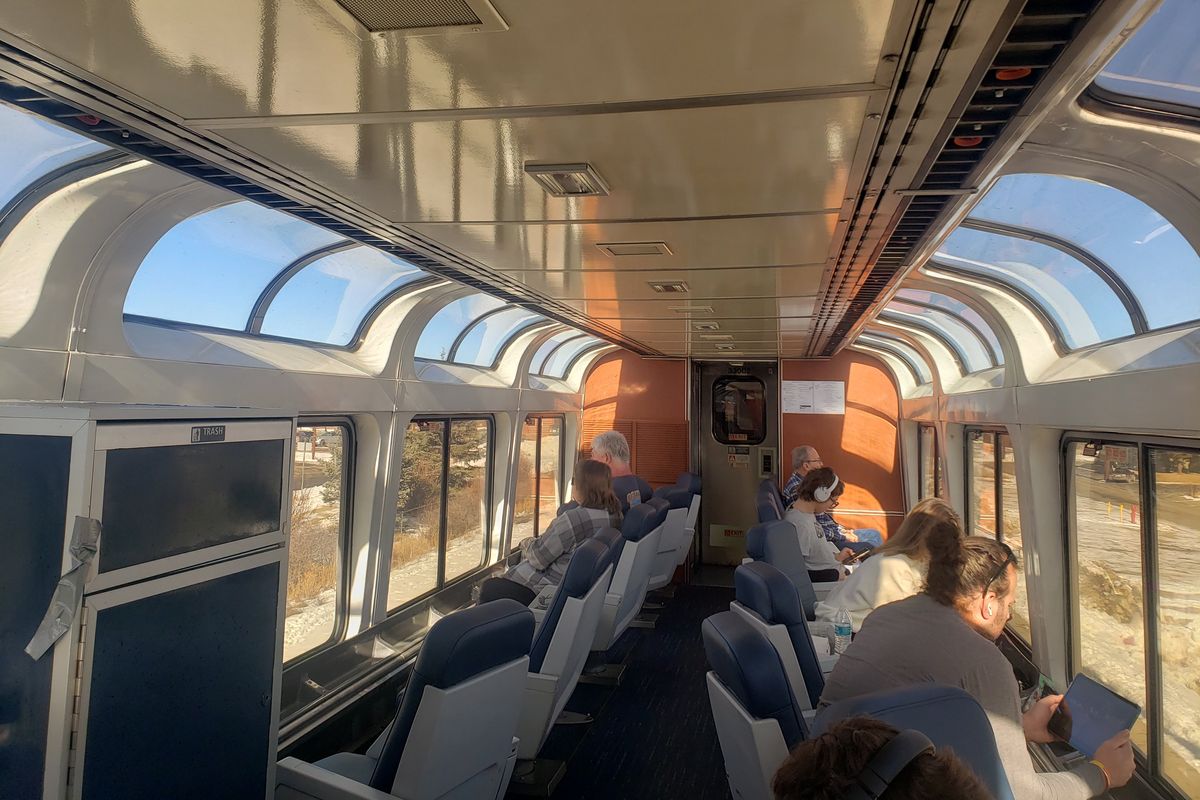
On the way back to your seat from the cafe car, I encourage you to spend a little time in the observation car. Seats are positioned facing the windows, so there are no seatmates unintentionally blocking your view while you try to see out the window.
On some routes, park rangers will be on board for a short stretch, sharing information about the landscape the train is passing and animals that call that area home.
In the observation car, the dining car or at your own seat, prepare to make friends. The fun part of riding Amtrak is that many on board are marking a special occasion. I’ve met people on the train celebrating graduations, retirements and everything in between.
Sometimes the conversations don’t go much deeper than “Where did you get on? Where are you getting off? What do you plan to do when you’re there?” But other times, you really click with a seatmate and have conversations that stick with you long after you’ve gotten off the train.
Routes include at least a few fresh air stops, aka smoke breaks. From my experience, they tend to last between five and 20 minutes.
Even if you only have a few moments off board, I advise you to take all the fresh air stops you can. It feels good to stretch your legs after hours on board, and it gives you a sneak peek at small towns around the country.
While on board, especially at night when you can’t enjoy the landscape, I suggest having a book or two in your carry-on. Wi-Fi can be spotty, so download books or movies before your trip, and don’t forget to pack headphones, especially if you plan to stay in the quiet car. I’d also suggest an eye mask, ear plugs and a travel blanket and pillow for coach passengers.
Amtrak may not be the most time-efficient means of travel, but I do think it’s the most special. On board, the journey is just as important as the destination.
In 2025, 1,438,363 total passengers boarded or alighted in Washington state on one of three routes: Amtrak Cascades, the Coast Starlight and the Empire Builder. Will you be one of those 1 million travelers this year?