
Bush backs intelligence post
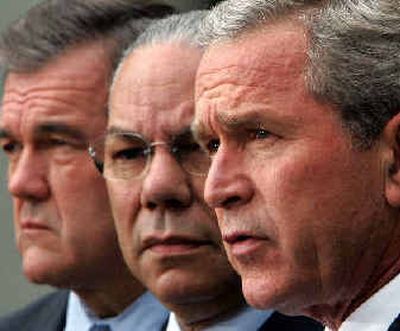
WASHINGTON – Warning that “we are a nation in danger,” President Bush called Monday for the appointment of a national intelligence director as part of a sweeping overhaul of the United States’ intelligence infrastructure.
Bush embraced virtually all key recommendations made by the bipartisan Sept. 11 anti-terrorism commission and urged Congress to quickly approve legislation to make them happen, although he would substantially modify the recommended powers for the new intelligence director.
Democratic presidential candidate John Kerry said Bush should have acted sooner and criticized him for failing to call a special session of Congress to take action.
The national intelligence director would oversee an intelligence network that spans 15 government agencies from the CIA to the Energy Department. The director would serve as the chief presidential adviser on intelligence matters, with a specific mandate to ensure that conflicting views are fairly presented to the president.
But Bush rejected the commission’s call to make the intelligence director a Cabinet-level position inside the White House. He also balked at the commission’s recommendation to give the director authority over intelligence budgets at the CIA and other government agencies, a reservation that would limit the new director’s power.
Both commission co-chairmen had strongly endorsed giving the broader powers to the new director during testimony Friday before Congress.
Bush also endorsed the commission’s recommendation for a counterterrorism center to coordinate the collection and use of intelligence. Echoing another commission recommendation, he urged Congress to streamline its oversight of intelligence agencies by reducing the number of committees with jurisdiction over intelligence.
The presidential call to action came 11 days after the Sept. 11 commission released its report and a day after federal officials warned of possible terrorist attacks on financial institutions in Washington, New York and New Jersey. The commission proposed the changes after investigating security lapses before the 2001 attacks.
Bush agreed with the commission that the nation is safer but still not safe from the possibility of another devastating terrorist attack.
“The work of securing this vast nation is not done,” Bush said. “All the institutions of our government must be fully prepared for a struggle that will last into the future.”
Kerry, who’s given a blanket endorsement to the commission’s recommendations, urged Bush to summon lawmakers back to Washington from their summer break to carry out the overhaul. He also noted Bush’s call for change came nearly three years after the Sept. 11 attacks.
“The president seems to have no sense of urgency to make America as safe as it needs to be,” Kerry said. “The time to act is now, not later.”
Kerry endorsed the commission’s recommendations virtually upon their release. Bush and Republican leaders of Congress initially said they needed time to study them, but as it became clear that Americans wanted action fast, they agreed.
Bush and his advisers said they’ve already made many changes to improve the collection and use of intelligence related to global terrorism. At the top of their list is the new Homeland Security Agency, which Bush initially opposed.
White House officials said a special congressional session is unnecessary because the House of Representatives and Senate can’t act until the overhaul plans emerge from congressional committees. The relevant committees intend to work through the August recess.
Republican congressional leaders say they want to take a “deliberative approach” to the proposals and have set an Oct. 1 deadline for committee action.
“We are not going to reconvene unless we have some legislation to vote on,” said John Feehery, a spokesman for House Speaker Dennis Hastert, R-Ill.
Although Bush embraced the thrust of the Sept. 11 panel’s recommendations, his reservations on the scope of the new director’s powers could prove controversial.
The president said he favors a director who would work outside the White House, without Cabinet rank and with only advisory power on budgets. The changes would reduce the director’s clout but make the position less susceptible to White House influence. Bush would appoint the director with Senate approval.
“I will hire the person, and I can fire the person,” Bush said. “That’s how you have accountability in government. I don’t think that the office ought to be in the White House, however. I think it ought to be a stand-alone group.”
Critics said Bush’s proposal would deprive the position of the clout needed to force change at agencies with a long history of mistrust and rivalry.
The commission’s co-chairmen – Lee Hamilton and Thomas Kean – insisted Friday that the intelligence director have authority to set budgets, hire and fire personnel across agencies, and set operational strategy for counterterrorism efforts abroad and at home. They also stressed that the director should be a part of the Oval Office team.
Without such broad powers, they said the director wouldn’t be effective.
“If you’ve got him stuck out here somewhere in center field, he’s not going to have the authority. He has to have the authority that comes with the presidency of the United States,” Hamilton said.
At least three of the agency heads who joined Bush at his Rose Garden announcement Monday – Defense Secretary Donald Rumsfeld, Homeland Security Secretary Tom Ridge and acting CIA director John McLaughlin – have expressed reservations about a national intelligence director.
“It’s the illusion of change but not the real change that is needed,” said Flynt Leverett, a former CIA official, speaking of Bush’s position.