
Get the right fit
I
N A LITTLE OVER a week, your nagging mom will have the force of law behind her.
Come Aug. 11, it’ll be illegal to ride a bike, skateboard or skates within Spokane city limits without a helmet. The law applies to everyone, not just kids.
But there’s more to being safe than simply wearing your helmet; it’s got to fit properly, too.
“The fitting is huge,” says Dr. Kim Thorburn, chief health office for the Spokane Regional Health District. “The idea is that this is going to be an additional layer of protection if you hit that vulnerable thing, your head, against a nonmovable hard surface.”
A recent national survey found that fewer than half of all kids observed on bikes, skates, skateboards or scooters wore helmets. And of those, more than a third wore their helmets improperly, according to the survey conducted by the National Safe Kids Campaign.
If a helmet’s so loose that it exposes part of your head when you fall, “you might as well not be wearing one,” says Andy Friedlander, outreach coordinator for Spokane’s REI sporting goods store.
Helmets have been shown to reduce the risk of head injury by as much as 85 percent. One study found that children whose helmets fit poorly were at twice the risk of injury in a crash compared to those with properly fitting helmets, according to the Safe Kids Campaign.
Plus, kids who wore their helmets tilted back on their heads — one of the most common mistakes — were at a 50 percent greater risk of head injury than those who wore their helmets centered on their heads, the study found.
So, how can you tell if your helmet fits properly?
First, it’s important to measure your head, Friedlander says. Helmets come in different sizes, and knowing your head circumference will help you choose the right one.
At REI and other sporting-goods stores, they’ll measure your head for you.
If you decide to measure yourself, you should hold the tape measure about an inch above your eyebrows. That’s the same spot your helmet should sit on your head.
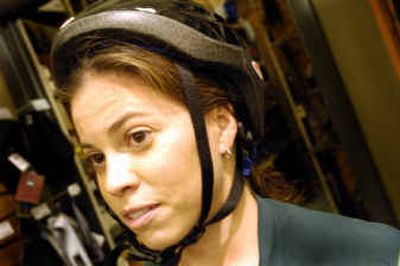
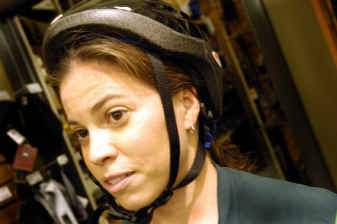
Many helmets come with an adjustable strap on the back, called a head lock. When the helmet is level, the lock should fit snugly against the back of your head.
The chin straps should go around your ears.
“The most important part is underneath your chin,” Friedlander says.
You should still be able to open your mouth when the chin strap is locked. But you should feel pressure under your chin when your jaw opens.
Many helmets come with extra padding that can be stuck inside, providing a snug fit on heads of different shapes and sizes.
Once adjusted, the helmet shouldn’t move more than an inch in any direction.
For Patricia Flint, the importance of wearing a bike helmet hit close to home last August and forced her into action.
Flint’s niece, Alex Goehring-Kane, was struck by a car while riding her bike at Loon Lake. She almost always wore her bike helmet, but she didn’t have it on that day. The then-14-year-old smashed through the car’s windshield and suffered broken vertebrae and a traumatic brain injury.
She was in a medically induced coma for three weeks, Flint says. But she lived.
“She’s very, very lucky,” says Flint, who lives in Spokane. “We should’ve had a funeral.”
After watching her young niece lay in a hospital bed, Flint decided to join Spokane’s Safe Kids Coalition to lobby in support of the helmet ordinance.
“No one ever leaves their house thinking, ‘Hmm, I think I’m going to get a traumatic brain injury today,’” Flint says. “Probably most of the people who are so resistant (to the helmet law) have never sat in the spot I was in, watching their loved one in a coma for three weeks.”
When buying a helmet, you should make sure that it’s been approved by the Consumer Product Safety Commission (just about all helmets sold in this country are).
You don’t need to buy a helmet that’s specific to skateboarding; a bike helmet will do, Friedlander says.
In anticipation of the new law, REI has stocked a wall of helmets in its downtown Spokane store, ranging from about $20 to $140. And some discount retailers have helmets for around $10. So, what do you get for all of that extra money?
The least-expensive helmet has all of the necessary safety features.
“The main differences are airflow and weight,” Friedlander says.
A top-of-the-line model is about half as heavy as a cheaper one and it’s got more holes in it to allow air to pass over and through.
Helmets should be replaced anytime you crash; they are only good for one accident.
You should also look into getting a new helmet if you notice many dings or dents in the foam. A helmet older than five years should also be replaced because the foam starts to break down.
The health-care community has been supportive of the new helmet law, Thorburn says. Bikes are associated with more childhood injuries than any other consumer product except cars, according to the Safe Kids Campaign.
“There’s a real excitement because there’s an understanding of the toll of injuries,” Thorburn says.
But Thorburn says she’s also heard plenty of grumbling about forcing everybody to wear helmets.
“There’s still concern that we’re regulating adult behavior,” she says. “Our response is, “Adults’ heads aren’t any stronger than kids’ heads.’”
Christopher Anderson/The Spokesman-Review