
Pundits’ paradise
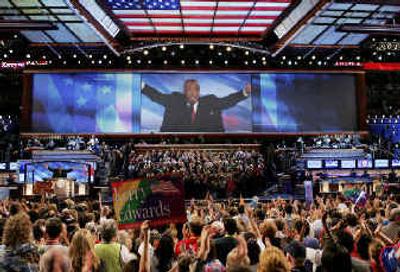
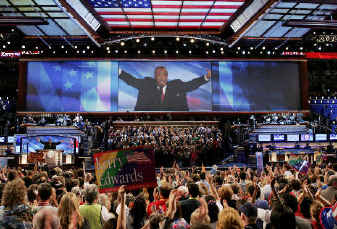
Some TV viewers might not be aware that former President Carter, Al Gore and Al Sharpton all spoke at last week’s Democratic convention.
They certainly heard from Bill O’Reilly, Wolf Blitzer and Chris Matthews, though.
It was a pundits’ convention for the cable news channels, which were on the air many more hours than the big broadcasters. To some, CNN, Fox News Channel and MSNBC provided a necessary filter for a staged event. Others believe they simply talked too much amongst themselves.
Asked about TV coverage of the convention, Democratic presidential nominee John Kerry told USA Today: “The talking heads keep talking, and you can’t hear anything.”
“The notion that the (broadcast) networks have offered that they don’t have to cover the convention because you can watch it on cable is actually not true,” said Tom Rosenstiel, director of the Project for Excellence in Journalism, a media research group. “If you want to watch the convention, you have to watch PBS, C-SPAN or ABC’s digital channel.”
The people on the podium were least visible on Fox News Channel.
While CNN and MSNBC carried Gore’s 15-minute speech in its entirety, Fox looked in for one minute. CNN and MSNBC listened to Carter for 16 minutes, while Fox telecast five minutes live, somewhere in the middle of his speech.
Fox had about five minutes of Sen. Edward Kennedy’s nearly half-hour speech live on the air and three minutes of Sharpton’s, while the others carried most or all of them.
During the beginning of Sharpton’s speech, Fox carried a taped O’Reilly interview with ABC’s Peter Jennings. After providing a taste of Sharpton, O’Reilly cut away to talk to two print journalists about his own interview with filmmaker Michael Moore the previous night.
On the convention’s first night, the camera trained on O’Reilly in Fox’s Fleet Center skybooth while Maryland Sen. Barbara Mikulski spoke behind him to the convention. (None of the networks carried her speech.)
“Somebody’s out there screaming about something,” O’Reilly said. “I don’t know what it is, and it really doesn’t matter at this point.”
After some critics questioned Fox’s short attention span for Gore and Carter, O’Reilly — ringleader of the “no spin zone” — explained the next night that his mission was to provide viewers with perspective rather than propaganda.
“The newspaper pinheads claim because we aren’t broadcasting the speeches, we’re not fair,” he said. “That, of course, (is) a bunch of baloney.”
It’s a defiant stance for a cable channel in the cross hairs of liberal political groups this summer and the subject of a documentary, “Outfoxed: Rupert Murdoch’s War on Journalism,” that claims Fox shows a pattern of support for the Republican agenda.
With conventions nothing more than extended political commercials, Fox’s news judgment is a necessary service, said Brent Bozell, founder of the conservative media watchdog, the Media Research Center. He said he hopes the network does the same at the GOP convention.
“I have no problem with any network saying, ‘We’re not going to focus on the fluff that they give us. We’re going to analyze this,’ ” Bozell said.
But the notion that conventions are nothing more than infomercials is wrong, Rosenstiel said.
“They are staged events,” he said. “There’s not really a sense that something unexpected is going to happen. But there is still news going on. The conventions are still events where the public will change their minds.”
The convention was the first chance most Americans had to see Kerry present his case for an extended period, he said. All of the networks — including ABC, CBS and NBC — carried Kerry’s speech in full.
“In this age of 30-second commercials and eight-second sound bites, that’s very significant,” Rosenstiel said.
All of the networks likely will defend their approaches based on ratings. The broadcast ratings were down, so network executives can point to that as proof they didn’t underestimate the public’s interest. Cable ratings, on the other hand, were way up.
“Who’s responsible, then, for letting the public see this?” Rosenstiel asked. “Is no one responsible? PBS does it because they think it’s the right thing to do journalistically. C-SPAN is doing it because it’s what they do — they train cameras on events.
”(But) none of the people who have access to our homes over the public airwaves feel an obligation to allow us to see the convention.”