
Spiritual self-defense
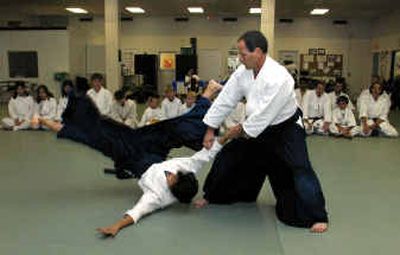

MIAMI — Sitting in front of a makeshift altar decorated simply with fresh flowers and Japanese script, Sensei Peter Bernath peacefully commands the wiggly legs and giggly voices throughout the room.
“You’re gonna learn meditation, and you’re gonna like it. And if any of you try to leave, I’m gonna break your legs,” he called out to his class cheerfully.
But there was no breaking of limbs that day as the 20 children in the room laughed and complied. Even though Bernath, 53, of Hollywood, Fla., is one of the highest-ranking aikido instructors in the United States and can knock men twice his size off their feet, he prefers more passive means of domination.
“When you get really good, you don’t need strength at all. People just sense something about you,” Bernath said.
It’s just one of many lessons Bernath imparts through his travels around the globe as a top martial-arts teacher.
Last month, he taught self-defense to crowds in Barcelona. In a few weeks, he will be reviewing spiritual techniques in New York with Aikido’s top sensei, Yoshimitsu Yamada. And in late 2004, he will be explaining the history of aikido to groups in Switzerland.
Aikido is a noncompetitive Japanese art of self-defense that redirects the attacker’s advances by shifting positions or using body weight. It calls the techniques “spiritual” self-defense, because it doesn’t use the kicking, jabbing, yelling, or choking techniques of other martial arts like judo or karate.
For Bernath it’s not just a sport. It’s a way of life.
“It’s really about enlightenment. You have to make your body and mind work together till it becomes like an instinct. Once you become sensitized to that, the more you are in tune with nature.”
Since turning to aikido, Bernath aims for what he calls an Asian-inspired “simplistic life.”
But decades ago, the Zen master was a rowdy college kid who dreamed of fame, models and instant recognition from the doormen at trendy Studio 54 in Manhattan.
In 1970, he saw the poster that changed his life — an aikido advertisement featuring a small Japanese woman flipping a large man over her shoulder.
“I just thought it was so cool and peaceful-looking,” he said.
Bernath soon signed up for aikido classes and has spent most of his time since in a dojo, Japanese for an aikido instruction center. He is one of only 40 instructors in the United States to have reached the level of a sixth-degree black belt, according to the United States Aikido Federation. He has his own dojo in the Holiday Park Activity Center in Fort Lauderdale, Fla.
“Peter is one of the best senseis teachers in the federation,” said Susan McKenzie Wolk, general secretary of the federation. “You have to be a very good teacher to attract enough students so that you can make a living doing this.”
The federation sent Bernath to Florida to open the center in the late ‘80s.
“Back then, nobody knew what aikido was. None of us at that time thought we could earn a living from it. We were like, ‘We aren’t Japanese, we can’t do this,’.” Bernath said.
Today the dojo is one of the largest in South Florida, with more than 140 students.
Alex Hatfield, 14, makes the two-hour round trip from Palm Beach Gardens, Fla., about three times a week to study with Bernath.
“He pays a lot of attention to me, helping me out,” Hatfield said. “He has a really high status and I get well-known, too, just by training here with him.”
“You can mention Peter’s name anywhere in the world of aikido and they will know him,” said Gene Nelson, 39, a student since 1992. “We are very fortunate to have him down here.”