
Charting a new course
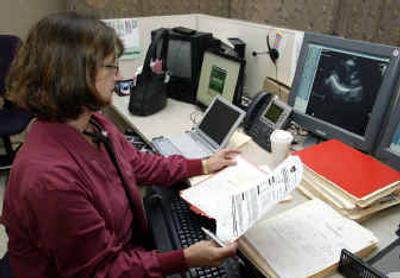
INDIANAPOLIS — With no patient chart in sight, Dr. Sheila Gamache strides into Thom Kolby’s hospital room to check on him a day after the 54-year-old arrived ashen-faced and perilously close to death with a clogged artery starving his heart of oxygen.
Rather than flipping through a clipboard thick with pages of notations and test results, Gamache gets up to speed on Kolby’s condition simply by logging onto a wireless notepad she carries on her daily rounds at the Indiana Heart Hospital.
Like a handful of others nationwide, the Indianapolis hospital has traded its once scattered medical charts, file folders, X-rays and other documents for a unified electronic records system accessible with a few keystrokes.
Federal officials who are trying to convince more hospital executives to go “paperless” say electronic records can make hospitals more efficient, reduce medical errors and lower health-care costs.
The costs of the transition can be high, and many physicians are also unwilling to trade the ease of jotting down paperbound notations of their patients’ statuses for a system that requires them to type the same information into a computer.
But concerns aside, digital records are a leap ahead for records system rooted in cumbersome 19th century filing systems.
After the checkup, Gamache sits down at a computer outside Kolby’s room — one of 650 spread across the 88-bed hospital — to enter notes and order changes in his blood-thinning medication.
And all of it without the typical paper trail filled with scrawled physician handwriting.
Nearly all hospitals do have electronic billing, but adoption of electronic health records has been slow. Just 13 percent of hospitals and 28 percent of physicians’ practices had some level of electronic health record systems in 2002, according to HHS.
Yet the change appears to carry great benefits.
According to a recent analysis by the Institute of Medicine, the routine use of electronic records could help reduce the tens of thousands of deaths and injuries caused by medical mistakes every year.
Brailer said paperless systems also cut administrative costs by eliminating the need to produce, maintain and store enormous numbers of paper files. Although it takes doctors longer to enter their patient observations on a computer instead of writing them down, he said digital records save time in the long term.