
Artist’s creations reflect his respect for subjects
DON’T BUY A DUCK DECOY off a store shelf without talking to Frank Werner first.
The retired U.S. Marine in St. Maries is a duck psychologist, although he bills himself as an artist and boat builder. He knows how mallards land on water and what attracts them. He knows redhead ducks save spaces in their floating formation for other ducks and that wigeons are thugs. He knows canvasbacks, like all ducks, don’t check details on floating ducks before they join the flock.
Frank understands ducks, which is why his hand-carved and painted decoys are so effective.
“There’s something dishonorable about not honoring ducks with good decoys,” he says.
His decoys reflect his respect for the birds he hunts. That’s why the Idaho Commission on the Arts considers Frank’s duck decoys art and why Gov. Dirk Kempthorne just named Frank a recipient of a 2004 Governor’s Award in the Arts.
“It’s cool stuff,” says Steve Gibbs, studying Frank’s photo of his decoys mixed with real birds in the utility boat he built. Steve runs Coeur d’Alene’s Art Spirit Gallery. “He made it into an art form.”
Frank didn’t carve his first decoy with art in mind.
“I wanted to fill my stewpot,” he says, grinning under his impressive handlebar mustache. “I wanted to be a more effective hunter.”
He discovered ducks during his 20 years in the military. Frank had plugged sewer rats and pigeons as a kid in Brooklyn, N.Y. and eventually graduated to hunting deer. During his time in the Marines, Frank took woodworking classes and built a boat so he could fish after work.
His company commander saw potential for duck-hunting in Frank’s boat. Frank joined him in a duck-hunt and was hooked. Frank had worked as a game warden for U.S. Fish and Game and knew his duck varieties. Like most hunters, he looked for decoys to attract ducks. He wasn’t satisfied with what he found, so Frank carved his own.
He’d learned to make wooden patterns in high school and improved his wood-crafting skills in the military. Frank had built a 12-foot long stereo shelf with built-in speakers before he constructed his utility boat. Carving a duck decoy didn’t intimidate him.
Frank studied light woods and found 14 he’d use. His favorite is Idaho white pine. He learned to hollow out the body of his decoys until less than a quarter inch was left, then coat the inside with epoxy and Kevlar to make it bullet proof. He soaked his decoys in linseed oil for 20 hours and let them sit for up to six months. Then, he painted on the repetitive patterns that cover most ducks and balanced the decoys so they floated level.
Frank retired from the Marines in 1974 and landed with his wife, Carol, and three sons in Moscow. The University of Idaho offered classes in wood technology, so Frank signed up to gain a better understanding of his budding craft. He kept journal-like notes, and the exercise of writing led him to ponder the art behind decoys.
Research introduced him to the “art ducko” world—hand-crafted, decorative, nonfunctional ducks. Art duckos were duck look-alikes with every feather and color variation. Frank carved a few. The finished products were beautiful, but they didn’t satisfy him.
“They felt phony,” he says. “They were for the shelf and never used. I wanted something functional.”
By then, the artist inside him was demanding attention. Frank wanted to create effective decoys that allowed him to express his artistic side.
“Art enables me to realize my own identity,” he says. “Duck hunting is very ceremonial to me, especially when I was taking my boys with me.”
Research and talks with other duck hunters taught Frank that decoys don’t need extreme details. He began designing decoys to attract ducks but with abstract features to satisfy his creativity. His goal was to attract ducks to land in a position that would allow him a clean shot. To accomplish that, he needed the right decoys positioned in just the right way.
Occasionally, he crafted duck statues for Carol–sleek black walnut ducks or oiled tan mahogany ducks with their heads turned toward their tails and bills tucked into their back feathers.
In 1976, a woman out hunting saw Frank’s mallard decoy and wanted to buy it. He’d never considered selling his work. He threw out a pricetag of $60. She pulled out three twenties. The experience motivated him to sell at art fairs, but he found most shoppers there looking in the $20 range. Frank shifted to demonstrations. He showed his style at a national governors’ conference in Boise in 1984. The Idaho Commission on the Arts recommended him for various arts events.
“I learned show business. I enjoyed it and I was under no pressure to discuss price,” Frank says.
He also began writing for “Wild Fowl Carving” magazine.
To allow him to pursue his art and demonstrations, Frank created Werner Marine Enterprises, a venture he calls “nom de biz.” The business covers everything he likes to do – constructing duck boats and the things that go in them.
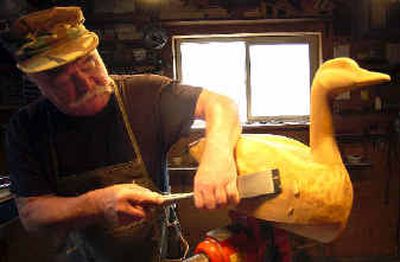
He works behind his home–Frank and Carol moved to St. Maries in 2001–out of a metal shop big enough to hold six cars. He keeps his concrete floor spotless and his wood neatly categorized in cubby holes. A honker–large Canada goose–is taking shape in his carving room. Frank has chiseled slowly on the decoy for years, mostly to demonstrate his craft. Ducks and birds in various stages of development fill eight shelves in the room.
He’s a master photographer and fills magazines with photos of his work at different stages. His photos show readers the positions of his hands and tools while he works, among other things. Frank not only has won awards for his decoys. His photos have won awards in juried shows.
Fellow artists nominated Frank for the governor’s award. The awards are going to 16 artists, but only four are in Frank’s category – excellence in the arts.
“They’re like the Nobel Prize for Idaho,” says Maria Estrada, an Idaho Commission on the Arts office manager who has helped with the awards since 1992.
Frank believes the display of his decoys shifted them from useful craft to art. He fits them into frames divided into grids so they resemble a quilt. The price of his decoys is now $350 to $700. Frank sells dozens a year to individual hunters and duck clubs.
He’s exhibited his work throughout the Northwest, in New Mexico, Wyoming and Mexico. He loves when people drop by his studio. It’s a chance to entertain, teach, examine the nature of art.
“The governor’s award validates the idea that quality is very much culture specific,” Frank says, pushing back a camouflage cap covering the quarter inch of hair on his head. “I can create art and still fill the stewpot.”