
Directly from herd to hamburger
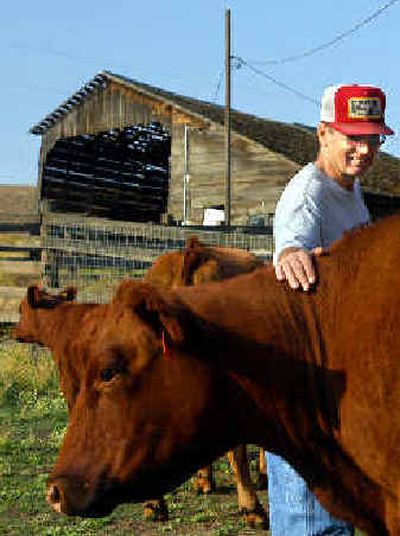
MAYVIEW, Wash. – If you stand on the rim of the gorge with your back to the Snake River, it’s easy to see the russet coats of Roger Koller’s cattle as they graze through the crispy remains of a wheat field.
Koller is a third-generation Washington wheat farmer who started raising cattle for his family and to provide his sons with livestock for 4-H and junior livestock competitions. But what started as an educational effort for his boys has turned into a small business called Cabernet Beef.
Nearly 300 miles to the west live 20 families in Seattle and Portland who have promised to buy these animals on the hoof to circumvent the standard supermarket beef available in the city.
For some, it’s a matter of not being afraid of their burgers.
For others, it’s the peace of mind that comes with knowing the source of their steak was treated humanely. And for still others, it’s a question of quality.
People are looking for more control over the production of their meat. Recognizing that, grocery stores such as Safeway and Rosauers have added organic and “natural” beef.
At Huckleberry’s Natural Market in Spokane, “The awareness level, the interest and customer sales are up dramatically,” said Don Whittaker, merchandiser for the store.
The Organic Trade Association predicts demand for specialty beef will rise 30 percent a year for the next four years. And a few farmers, like Koller, are more and more dealing directly with consumers.
“It began with word of mouth as people started to eat the meat and like it,” Koller said. “Then it just started snowballing. It’s growing every year.”
The discovery of a cow infected with bovine spongiform encephalopathy in Washington last winter only served to further the demand. Though it has happened in rare occurrences, the fatal brain-wasting disease known also as mad cow disease can be transmitted to humans, where it manifests as a variant of Creutzfeldt-Jakob disease.
The news of BSE in a Washington dairy cow rattled the beef industry nationwide, cut off lucrative export markets and focused a questioning light on government oversight of the industry.
In the wake, a number of Washington’s small-scale ranchers found or expanded their niche of catering directly to consumers and bypassing feedlots, the USDA, major processors, big meat packers and the concerns about mad cow.
Grass-roots sales
Koller, a Pomeroy,Wash.-area farmer, knows the personalities among the herd of 50 cows and walks easily among them as they graze. He lifts his cap and scratches his head as he explains the care and attention, the feeding of grass and then grain, and the humane final moments for the animals, who aren’t confined in crowded feedlots and are trucked just a short distance to be slaughtered.
After slaughter, the beef is hung and aged for several weeks before being cut and wrapped.
Koller and Seattle architect Al Bryant, a former college roommate, have recognized that many people care about the source and quality of the beef they buy and will obtain a freezer large enough for 250 to 500 pounds of meat. Koller said the price of his beef is competitive with supermarket prices and much better when it comes to top-quality choice cuts.
Koller and Bryant met at Washington State University in 1970. They lived together in the Farm House fraternity, but after school they headed in very different directions. Bryant now has his own firm in Seattle. Koller, after earning a master’s degree in international relations, returned to farm with his parents and his brother, Randy.
While commiserating over an unsavory Apple Cup loss in the late 1990s, Koller and Bryant started talking about using their east-west tie and their mutual affinity for good, aged beef to go into business together. Koller would raise the cattle, and Bryant would find urbanites to buy them.
“I talked to clients and people in my office,” Bryant said. “I gave them some hamburger.”
He carried pictures of the small herd. He grilled at company events. He set out to educate his friends by filling their stomachs with the tasty beef and their minds with information about flavor, cuts and quality.
“I’m a true believer in understanding where our food comes from,” Bryant said. “That’s not just meat, it’s fruit and vegetables from our grocery store. I see this is a way to educate people. They want to be much more attuned.”
Bryant’s friend Bill Allen, a Seattle-based graphic artist, has been buying their beef almost since they started. Allen said he likes that there are controls over how and where the animal was raised.
“It’s pretty simple,” Allen said. “I do it because it’s good beef, and the price is right. It’s probably the only meat I buy.”
Worried consumers
This year, Koller and Bryant have already promised to sell 10½ of their Red Angus/Limousin crosses, up several head from last year. The steers are raised by Koller’s sons, Nolan and Wyatt, who show them at livestock shows and the county fair. When they’re sold, the money goes into the boys’ college savings.
While Koller raises the cattle for his sons and the families who want the beef, other farmers, like Charlie Card in Prosser, Wash., see it as a way to make a living. “We’re just a small operation, with about 30 pair,” Card said.
The rancher’s customers buy his steers on the hoof. Then a butcher comes and slaughters the animal at the farm. “You’re not loading them into a doggone truck and beating them around,” Card said.
Card’s customers load coolers into their cars and drive to his ranch from Seattle and Spokane to pick up the meat. “They make a day of it,” he said. “They come on a Saturday and stop at a winery on the way to get a few bottles of wine.”
Surveys performed this year by the Harvard School of Public Health and the Consumers Union both showed that a large percentage of the population was concerned about the source and testing of their meat.
In the Consumers Union survey, more than 90 percent of participants said they would pay 10 cents more a pound for testing of cattle to ensure they are free of mad cow disease. One-third said they would cut back or stop eating beef as a result of the mad cow discovery.
Beef producers are recognizing consumers’ concerns and have been working toward addressing them, said Leo McDonnell, a Montana rancher and founding member and president of R-Calf. The organization started as a nonprofit foundation in 1998 and today has more than 10,000 rancher and cattlemen members.
“They’re producers who want to get involved in some positive changes in our industry,” McDonnell said.
R-Calf has been pushing for required country-of-origin labeling on beef. The group is also advocating for increased testing to show their animals are free of diseases like mad cow.
“Ranchers are becoming marketing people that they never were before,” Bryant said. “People today, I think they want to know a little bit more about the food they eat. What’s healthy, what’s not, what’s good for the environment. It seems like they’re asking more questions.”