
Monumental spire
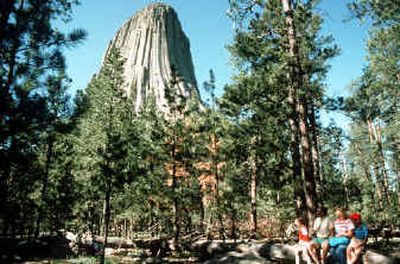
It stands all alone in northeastern Wyoming, a colossal spire of rock unlike any other.
Indians of the region call it “Bear Lodge” and still regard it as a sacred place. Other Americans know it as the Devils Tower.
Whatever its name, there’s no denying its imposing presence. This 867-foot cylinder of rock, rearing up from the softly rolling land of the western Black Hills, is as unmistakable a landmark as a lighthouse seen from the sea.
Up close, this fluted shaft is no less impressive. Tapered vanes of naked stone soar majestically toward the tower’s crown. Piles of jumbled boulders — fallen debris from eons of erosion — lie helter skelter at its base. Ponderosa pines ring the tower, some of them more than 150 feet high but still dwarfed in the presence of this geological oddity.
So striking is Devils Tower that President Theodore Roosevelt, sight unseen, made it the nation’s first National Monument in 1906. Today, more than 400,000 visit the monument annually, and several thousand actually climb it.
The ascent is close to vertical and requires experience in rock-climbing techniques (five climbers have lost their lives in the attempt), but a successful outing confers a lifetime of bragging.
“It’s acrobatic, it’s intense, and it gives you a sense of accomplishment,” said Chuck Lindsay, a climbing ranger who guides others up the tower an average of four times a week. Despite his many ascents, he said, “it hasn’t lost its thrill.”
There are more than 200 established climbing routes, Lindsay said, including the remains of a 250-foot-long ladder left there by the first climbers, Williams Rogers and Willard Ripley. More than 1,000 spectators drove their buckboards from miles away to see the pair make that ascent on July 4, 1893, and plant a giant replica of Old Glory on its summit.
The real boom in tower-climbing, though, got its impetus in 1937 when the first ascent was made without the aid of the ladder. A year later, Jack Durrance mapped out the “Durrance Route,” which remains today the most popular path to the summit.
Durrance made news again at Devils Tower in 1941 when a professional parachutist named George Hopkins successfully landed atop the tower, but was stranded there when the 1,000-foot-long rope he planned to use to descend from it fell off the summit.
His predicament made national news, relegating the World Series to secondary play. Goodyear offered the services of a blimp; the Navy suggested it could bring in a yet-untested helicopter. A local pilot dropped food, water and blankets to the stranded chutist while the National Park Service mulled over the problem. In the end, the service called on Durrance, who put together a rescue team that brought Hopkins down after he had spent six days on the summit.
While climbing impels some visitors here, most are content simply to gaze at the monumental tower and to walk the 1.3-mile-long paved trail that girdles it.
Skirting the boulder field, the trail takes visitors through a thin forest of ponderosa pines and aspens broken here and there with constantly shifting views of the tower. On its sunny side, the mostly hexagonal columns of rock are sharply delineated; on the shady side, the rock takes on more of a monotone color. On all sides, one can see tiny figures of climbers inching their way upward.
Geologists say that Devils Tower was formed by the intrusion of magma into the region’s sedimentary rock. Some believe it is a volcanic plug, but there is no evidence of volcanic activity anywhere in the region.
In any case, the softer sedimentary rock surrounding the tower’s harder igneous variety eroded over perhaps 60 million years, exposing the tower. Its stone, by the way, is called “phonolite porphyry,” a relatively rare material nearly as dense as granite that is found only here and in Africa and perhaps France. It gets the “phono” part of its name because it rings when hit with a geologic pick, Lindsay said.
To Northern Plains tribes, the site is sacred. As visitors walk around its base, they often come upon prayer cloths tied onto tree branches by Native Americans.
The legend heard most frequently relates that a group of girls being chased by a huge bear jumped atop a large rock and prayed to the spirits to save them. The rock thereupon grew larger and larger, rising into the sky, and as the bear attempted to get at the girls his claws scraped the edges of the rock, creating the grooves we see today.
(A legend of another sort came into being just 25 years ago when the movie “Close Encounters of the Third Kind” was released. Its climactic scenes were shot at the tower, imbuing it with an otherworldly aura that exists to this day in the minds of many.)
The tribes object to the name Devils Tower, which they consider offensive, and have petitioned to restore the original Indian name, Bear Lodge. Many tribes also want all climbing banned; in a compromise, a voluntary no-climbing plan has been put into effect for the month of June each year.