
Taking the plunge
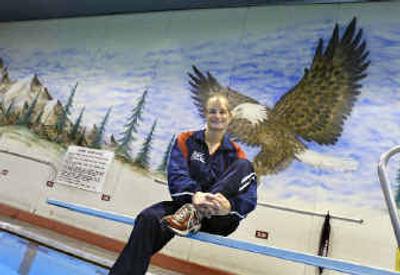
Jeni McNeal is a heretic, plain and simple. She doesn’t come off like one, particularly. She has the petite, yet sinewy build of a gymnast, which she was in her high school days at Central Valley. She speaks in earnest, even tones, like the assistant professor of physical education she is, about what nowadays would seem to be the taken-for-granted trinity of elite-level athletic preparation – strength training, power training, flexibility.
It was only when she got into diving that she discovered she was a heretic.
But because she is – and because the people who drive the sport in this country have finally opted for vision instead of wishin’ – the members and mother hens of the U.S. Olympic diving team are hopeful of bringing home as many as five medals from the Games which begin Saturday in Athens.
And, frankly, they’d better.
“There is some pressure, yes,” McNeal said in a conversation in her office at Eastern Washington University. “No number has been given to us, but it’s been made clear to us that we need to get diving in this country back to a place where it’s competitive on the international scene.
“We need to make a good showing in the Olympic arena.”
If American divers do make a big splash in Athens – or, rather, if they make no splash at all after performing their impossible midair contortions – few will know the irony that a significant contribution to the cause happened to come from a school which abandoned its swimming and diving program more than 20 years ago.
An EWU graduate in 1993 and a faculty member the past four years, McNeal took her master’s and Ph.D. in physiology at the University of Utah. It was there she got involved working with our national gymnastics program, and also happened to do some experimental work in strength training for young divers.
Two years ago, the U.S. Olympic Committee threw some money at USA Diving to fund a central training center in The Woodlands, Texas, near Houston, with the intention of stirring the sport out of its post-Louganis funk. Though Laura Wilkinson did win gold in women’s platform in Sydney in 2000, it was the lone U.S. medal in eight events that year; in 1996, America managed a couple of bronzes.
All the national team-level divers were invited to move to Texas, take advantage of concentrated coaching, physical assessments and assistance, shrinks, trainers, therapists – and a lordly $700-a-month living stipend – in search of Olympic gold and glory.
Six accepted.
One of those eventually left.
All together now – Houston, we have a problem.
“It’s a controversial thing inside the sport of diving,” said McNeal, who was solicited to direct the divers’ physical preparations for the 2004 Games. “It’s based on an old Eastern bloc model, for one thing, and that makes people nervous. People were offended, almost, that they were being asked to leave their homes and their coaches, come to a new coach and a new system and most were not willing to do that.
“Diving has never had a system like this before.”
For the last two years, then, just five divers have availed themselves of this brave new training world. In the U.S. Olympic Trials in June, all five made the team. Troy Dumais and Justin Wilcox were 1-2 in men’s 3-meter springboard. Dumais and brother Justin won the 3-meter synchronized and were second in platform synchronized. Wilkinson won women’s platform and Kimiko Soldati won women’s 3-meter springboard.
All together now – Houston, we have a solution. Or at least the makings of one.
“It’s hard to argue with the results,” said McNeal.
And it’s hard to argue with the notion that the changes McNeal has demanded in the way of physical preparation has been central to the success.
“To a certain degree, divers historically believe that to get better, you just need to dive more,” she said. “Obviously, it’s a very technical sport, but the rest of the world has moved away from that and we were getting left behind. There’s a certain amount of resistance to strength training and I really had to get the work ethic going. You simply can’t get the strength you need to do the bigger skills without outside training.”
In essence, McNeal’s group – coached by longtime USA diving guru Ken Armstrong – had to be herded into the weight room, generally four days a week. They were put through alien regimens – doing repetitive heavy squats and following them immediately with flips or jumps. They were outfitted with weight vests to supplement their dryland training, a McNeal innovation she believes has not been tried by any other nation’s divers.
And they did it right up to the eve of competitions, possibly the highest heresy of all.
“They come from a swimming model and think they have to ‘taper’ four to six weeks before a meet,” McNeal said. “In gymnastics, we would never think like that – we’d do strength training up to the day before competition. I had to gain their trust that they could go into a competition being tired and still perform at their best ability. When they saw they could, that was a big confidence boost.”
Rebellion segued into compromise which morphed into compliance. But it took time. McNeal’s duties at EWU limited her visits to Houston to six to eight times a year, usually for three to five days at a time. Much of her direction was done via the Internet, on which she checked the divers’ daily training logs, adjusted schedules and communicated with other professionals assigned to The Woodlands project.
And it took results.
“Some of them have been able to add a whole extra somersault or twist they didn’t have before, and that’s huge,” McNeal said. “All the divers are doing skills now their best competitors are doing, and they weren’t two years ago.
“Justin Wilcock is a good example. He wasn’t on the national team a year ago and hadn’t had any international experience and he’s made the team as a real longshot. He’s just blossomed in the last six months into a consistent, elegant diver.”
Still, the medal count remains problematic. At last February’s World Cup in Athens, for instance, only Wilkinson mounted the medal stand, collecting another platform gold, and other Grand Prix results have been spotty. The usual suspects – China, Australia, Russia – are expected to dominate again. But McNeal is so convinced of her group’s progress that she’s paying her own way to Athens in hopes of taking part in a celebration.
So what about the skepticism in the diving community?
“Well, it’s still there, but I think it’s more hopefully skeptical,” she said. “There are still coaches with kids who are national team members who feel they should be funded and still be able to train on their own, but the bottom line is we need to have people training the same way, on the same page.”
And less of a need for instant gratification.
“I have a big problem with the (USOC) only being interested in the last two years going into a Games,” McNeal said. “They are hesitant to fund things that begin further out. In both diving and gymnastics, you have to get the athletes at a much younger age. By the time this group got to me, they already had their bad habits – significant bad habits – and you can’t get them trained out. We really need to reach kids four to six years out and get them on the same program.”
Sounds pretty dangerous. You don’t know what something like that might lead to.
And who would want that hanging around their neck?