
Let the debate begin

SEATTLE — The Hall of Fame voter of the near future will have some crucial re-assessing to do.
With Harold Baines on the ballot for 2007, and Edgar Martinez two years later, voters must do some deep thinking on the whole designated-hitter concept. And with closers becoming ever more important, their role, too, must be critically evaluated.
Some magical, ironclad numbers of the past, like 500 home runs, might have to be raised in this era of offense run amok. And in light of five-man rotations, other numerical touchstones, like 300 wins, might have to be revised downward.
With the Martinez Hall of Fame debate already starting to rage, here is a snapshot of where active players stand in regards to Cooperstown.
First ballot, no questions asked
Barry Bonds, Giants. Steroids allegations aside, he is making a strong case as the greatest player of all time. He could be headed for his second batting title and seventh Most Valuable Player award, and Hank Aaron’s all-time home run record is his for the taking.
Roger Clemens, Astros. Clemens may have delayed his induction by unretiring, but he has added to an already rock-solid case by pitching well enough to start the All-Star Game.
Greg Maddux, Cubs. His 300th win removed all doubt remaining, but Maddux had already locked up a spot in Cooperstown. His numbers in relation to his peers are astounding.
Randy Johnson, Diamondbacks. OK, M’s fans might have a tiny question about 1998, but Johnson has erased all doubts by winning five Cy Young Awards (one fewer than Clemens), pitching the D-Backs to the World Series title, and amassing one of the best winning percentages in history.
Sammy Sosa, Cubs. For four years, from 1998 through 2001, he averaged 60 homers, and he’ll be in the 600s before he’s through.
Rickey Henderson. Hopefully, no team will give him a courtesy appearance in September, so his clock can finally start ticking.
Heading to first ballot, barring disaster
Alex Rodriguez, Yankees. Unless he goes Griffey, A-Rod will have one of the most impressive Hall of Fame resumes in history.
A few quibbles, but close to a lock
Ken Griffey Jr., Reds. Some people might penalize him for his career fade, but he did cross the 500-homer threshold. Voters shouldn’t forget he was the game’s premier player for a decade.
Rafael Palmeiro, Orioles. He kind of sneaked up on us, but his numerical portfolio makes an impeccable case. Palmeiro is at 542 homers and counting, and needs fewer than 125 hits for 3,000.
Pedro Martinez, Red Sox. He doesn’t have overwhelming lifetime numbers, but Martinez had a stretch of dominance that rivals Sandy Koufax. And he’s still one of the game’s elite pitchers.
Mike Piazza, Mets. Maybe the greatest-hitting catcher of all-time.
Ivan Rodriguez, Tigers. Not just a career .306 hitter, but widely regarded as the best-throwing catcher of his generation. Some have questioned his defensive commitment, but his role in leading Florida to a title and reviving Detroit has silenced critics.
Tom Glavine, Mets. He can end all doubt by winning 300 games (he’s at 259), but Glavine has been a consistent winner since 1991, with two Cy Youngs and five 20-win seasons.
Headed on a Cooperstown path
Albert Pujols, Cardinals. He has started his career with three tremendous seasons, and is on the way to a fourth.
Scott Rolen, Cardinals. The second coming of Mike Schmidt.
Manny Ramirez, Red Sox. Kind of a space cadet, but take another look at those offensive numbers.
Vladimir Guerrero, Angels. Now that he’s out of Montreal, we’re seeing how great he really is.
Nomar Garciaparra, Cubs. A .323 career average, two batting titles but health is now a concern.
Derek Jeter, Yankees. Some of his secondary numbers aren’t the greatest, but he’s on a path toward 3,000 hits, and widely regarded as the heart and soul of great Yankees’ teams.
Get ready for a debate
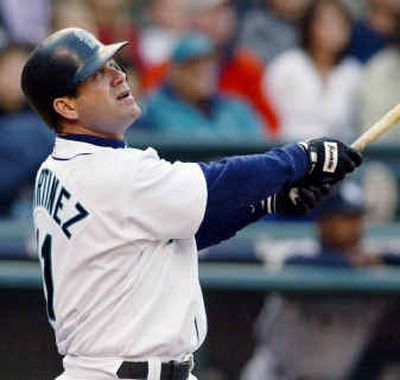
Edgar Martinez, Mariners. Voters will penalize him for being a DH, and for not amassing drop-dead career numbers.
Ichiro, Mariners. Just how much credit should be given to his Japanese record, including seven batting titles?
Frank Thomas, White Sox. If future voters learn to worship OPS (on-base plus slugging percentage), the Big Hurt is in.
Roberto Alomar, White Sox. Undergoing a late career slump, but still may get to 3,000 hits.
Mariano Rivera, Yankees; Trevor Hoffman, Padres. Voters have never given much respect to closers, even the elite. Check back in a few years on Eric Gagne.
Todd Helton, Rockies. His numbers are out of this world but how do you weigh Coors Field?
Fred McGriff. Not quite 500 homers, and not quite a Hall of Famer, in the estimation of many.
Omar Vizquel, Cleveland. He’ll have to get in on the Ozzie Smith card, and he’s making a pretty good case - nine Gold Gloves, and the highest career fielding percentage of any shortstop in history (.982, to Ozzie’s .978).
Barry Larkin, Reds. He’s a better player than a few shortstops in the Hall of Fame, but doesn’t seem to have a strong Cooperstown buzz.
John Smoltz, Braves. He still has a way to go to get the Dennis Eckersley treatment.
Larry Walker, Cardinals. Three batting titles, but Bill Madlock had four. If only Walker had stayed healthy.
Juan Gonzales, Royals; Jeff Bagwell, Astros; Gary Sheffield, Yankees; Jim Thome, Phillies; Carlos Delgado, Blue Jays; Jason Giambi, Yankees. For space purposes, we’ll lump all these players together, which admittedly is not fair. All are going to end up with close to 500 homers, lots and lots of runs batted in and sparkling OPSs. The next five years will determine which ones stand out.