
Look out for fun
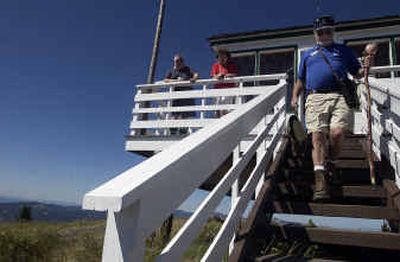

KELLOGG PEAK – Mountain bluebirds blend with a cloudless sky, but Naomi Barth spots them as she scans the Cabinet Mountains, then the Selkirks, Mt. Spokane and Frost Peak.
Her eyes are sharp from practice. Barth spotted fires from Little Guard lookout tower up the Coeur d’Alene River for two summers, in 1972 and 1990. She stood on a wooden stool protected with insulators in the middle of the building while lightning cracked the night sky all around her and thunder rocked her elevated abode with an intensity she’d never experienced 4,000 feet below in town.
“You can see the lightning when it hits the ground from up here,” she says, climbing the dozen wooden stairs that lead into the Kellogg Peak lookout tower. “It always seemed to come at night and we’d have to look out every 20 minutes. Adrenaline helped.”
Barth volunteers now in the Kellogg Peak tower, an hour above Kellogg by gondola and chairlifts. The tower, like most, is no longer in use to spot fires. It’s a lookout replica for people to visit and learn. New technology has replaced lookouts. Towers that remain are obsolete and rented out like campsites. About one old and neglected tower disappears each week somewhere in the nation.
Kellogg Peak’s original tower was demolished in 1950 after 16 years of use. Few people even remembered it until Phil Ruff, a retired U.S. Forest Service forester in Kellogg, suggested Silver Mountain build a replica of the lookout. Silver Mountain was looking for activities to attract people in the summer to its ski hills. Kellogg Peak, at an elevation of 6,297 feet, is its highest point.
Silver Mountain sat on the idea for a few years, even though Ruff repeated his request annually. Work finally started in 1997. A Forest Service archaeologist found the 1929 plans for the Kellogg Peak lookout. The plan was simple so the materials could be pre-cut and the agency could erect the buildings quickly. Silver Mountain followed the plan minus the original root cellar.
The lookout tower began its new life on the same site as its predecessor. It even shares the original four concrete piers poured in 1934. The root cellar was no longer necessary because the tower is accessible by road and chairlift. No roads reached the first tower. Supplies were hiked in monthly and stored.
Windows make up most of the 14- by 14-foot wood building. Fire lookouts needed to see for miles in every direction. The roof rises to a peak where one propane-powered light bulb used to give off enough light to enable the firewatcher to plot details on a fire finder without muddying the darkness outside.
A fire finder rises from a stand in the middle of the room, like navigation charts on a ship. A sheet of plastic covers a round, detailed map on which fire watchers marked storms with a grease pencil. Fire watchers packed in water, cooked on woodstoves and used an outhouse.
Ruff volunteered to work at the lookout and answer visitors’ questions as soon as it was ready for occupancy.
“It’s too much fun to let someone else do it,” he says, grinning.
He’d retired from the Forest Service in 1992 after 34 years managing recreation and trails. In 1956, he staffed a lookout for three weeks. When the national Forest Fire Lookout Association organized in 1990 to preserve lookouts and educate the public about their use, Ruff joined.
“They’re the history of the Northwest,” he says.
He talked fellow Forest Service retiree Rick Barth and his wife, Naomi, into volunteering at the lookout. They all had lookout experience as fire watchers and plenty of stories to share. They all could identify the peak’s lavender Alpine asters and bell-like harebells, mountain bluebirds and red-tailed hawks, sub-Alpine pines and fuzzy bear grass. They all had worked fire finders and knew the mountains in every direction.
“This place brings back years of memories,” Naomi says, leaning against the wood railing of the deck that surrounds the tower. She teaches at Silver Hills Elementary in Wallace now. “Volunteering here keeps alive what we did.”
She spotted her first fire on Bloom Peak in 1972. It was contained quickly, but not before her heart began pounding wildly. The Barths and Ruff mostly remember the northern lights playing across a night sky lighted only by stars. They remember squirrels scarred by birds that tried to snatch them and ruby-throated hummingbirds dancing by their windows.
Ruff and Rick Barth filled in for a few weeks as fire watchers, but Naomi lived two summers for two months at a time in the lookouts. She remembers washing windows constantly. A clear view was top priority. She remembers the plastic bag shower Rick tried to rig for her over a rocky ledge. Before she could use it, the shower relaxed in the sun’s heat and slid over the ledge. She remembers watching campfires by the Coeur d’Alene River and talking to other fire watchers by radio for company.
A smattering of lookouts are available to rent through the Forest Service, but Kellogg Peak is the only one in North Idaho equipped with the fire finders and former fire watchers to help visitors experience the past. The tower is open Wednesdays through Sundays through Labor Day, 10 a.m. to 6 p.m. The round-trip gondola ride costs $13 for adults and $9 for seniors and children.
“Why do we do this?” Rick Barth says. “It’s 90 degrees down there and it’s never above 70 here.”