
Teachers get crash course on tech
Televisions in the classroom are so 2001.
The old-fashioned pull-down screens for movies and slide shows are back in vogue. New digital projectors can beam student papers onto a wall for everyone to see. And this winter, some teachers in the Spokane Public Schools will be able to enhance their lessons with short video feeds from a media library. Imagine a history lecture jazzed up with a 90-second clip of the Berlin Wall falling or a science class with a three-dimensional animation to illustrate a quantum physics theory.
This year, a new wave of technology is being installed in Spokane Public Schools classrooms.
In March 2003, voters approved a capital bond measure that included $20 million for technology upgrades and improvements.
Since the bond was passed, 1,600 new computers have been installed in the schools. Another 950 computers were upgraded with more memory.
As part of the technology upgrade, a number of schools are buying the new digital projectors.
A 27-inch television screen simply isn’t large enough for students, said Ken Brown, Spokane Public Schools’ executive director of technology and information services.
New digital projectors can produce images so large that even students in the back of a room can see everything clearly, Brown said.
“That makes it possible for everyone to be engaged in the classroom regardless of where you are in the classroom,” he said.
Lower costs helped make the upgrades possible.
Last year, the projectors were being sold for $3,500. “Now you can buy them for $900 to $1,400,” Brown said.
In preparation for the new computers and other teaching tools such as the projectors, about 80 grade-school teachers were offered two training sessions during their summer break. The first session began the week after school let out. The second session started Monday and will continue until Thursday afternoon.
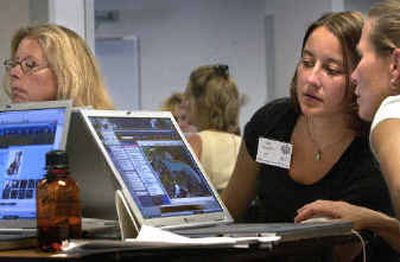
Barb Miller, a teacher at Bemiss Elementary School, sat back in her chair Monday afternoon with her new laptop balanced on her legs. All 42 elementary teachers who came for the training session received a laptop to use as long as they work in the school district.
Teachers at Miller’s table were excited by the prospect of compiling report cards and preparing lessons at home. The laptops enable them to work on materials at home and then easily display the information onto a classroom wall.
Miller, who has taught at Bemiss for seven years, said she knows the computers will help her students.
“Computers engage all kids,” she said.
Bemiss historically has had high rates of students who qualify for reduced-price lunches. About one-fifth of the students speak English as a second language. Some students don’t know how to type very well. Or if they do use a computer, they hit the “Enter” key after each line as if they were working on a typewriter, Miller said.
But once they get their hands on a computer and receive some training, they learn fast, she said.
“They’re smart kids,” Miller said. “They’re survivors.”
And once the digital projectors are installed, so many more tools will open up to teachers, said Mark Slater, a 13-year teacher at Linwood Elementary School.
He has dabbled with a projector that allowed him to display student homework, which tends to capture student attention. He also could display an assignment from a previous year to show how to do a good job or to illustrate what mistakes to avoid. Basically, he can teach students by showing the work of their peers.
“If we grade papers at home, we learn. If we grade papers in the class, everyone learns,” Slater said. “Now students can walk up with their papers and explain their work.”
Slater recently used a digital camera to take a daily picture of a growing plant in the classroom to help students identify growth stages.
The new tools really transform the classroom into a dynamic visual and hands-on learning environment, said Rod Burke, a teacher at Wilson Elementary School.
“It’s more you’re a facilitator than a dispenser of education,” Burke said. “If I tell kids how to do it, they won’t remember,” Burke said.
Get students involved, and they won’t forget, he said.