
Thorpe stays cool in the pool
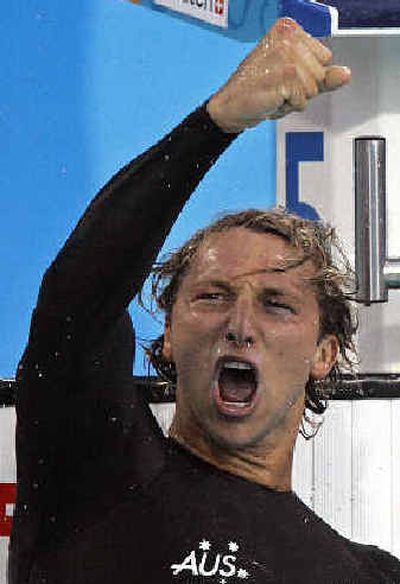
ATHENS — In the noisy minutes before Monday night’s 200-meter freestyle final, Michael Phelps and Pieter van den Hoogenband shimmied and shook like greyhounds just in from the rain.
All around a jammed Olympic Aquatic Centre, colorful packs of flag-waving fans — drawn there by the star-appeal of an event one American news agency termed “the race of the millennium” and by Phelps’ ballyhooed gold-medal quest — hummed with anticipation.
Meanwhile, the race’s third superstar, angular Australian Ian Thorpe, sat quietly in a poolside chair, his rhythmically bouncing left leg the only visible expression of the pent-up energy he was ready to unleash.
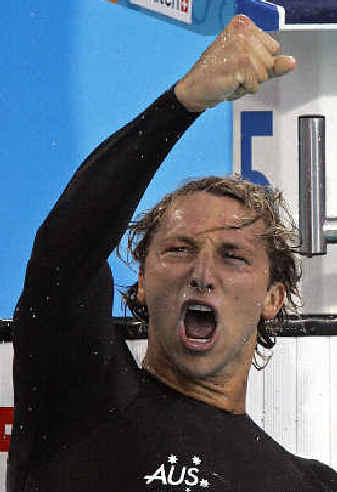
The explosion came in the last 50 yards of the race when Thorpe burst past van den Hoogenband, the defending Olympic champion, to defeat him and a hard-charging Phelps. It was Thorpe’s second gold medal at these Games and an Australian-record fifth overall.
Thorpe’s impressive victory, in an Olympic-record 1:44.71, probably had as many implications for Phelps as for him. While it solidified the reputation of the 21-year-old “Thorpedo” as perhaps the greatest middle-distance swimmer in history, it shattered Phelps’ golden ambition of winning seven or eight races and raised questions about the wisdom of attempting an Olympic schedule packed with eight finals and numerous heats.
“I don’t know who else has gone before,” the taciturn Thorpe said when asked about his accomplishment, “I’m just pleased with that race.”
The three V-shaped poster boys sped to the wall of the hotly anticipated event with a great water-churning rush, finishing within three-fifths of a second of each other.
“I gave my best,” said van den Hoogenband, “but Thorpe was better. He is the man in this distance.”
The Dutchman took the silver, while Phelps, the Maryland teenager who had hoped to at least match Mark Spitz’s 1972 record of seven gold medals, settled for his second bronze medal in three events. He also has a gold.
“I swam the fastest race I could swim,” said Phelps, who admitted that “a little bit of pressure” had been lifted from his shoulders. “And he swam the fastest race he could swim.”
“That shows that what Mark Spitz did was one of the greatest achievements ever in swimming,” said Phelps, who admitted to being “emotionally drained” after his eighth race in three days of Olympic competition.
He suggested he celebrated so hard after winning a gold medal in the 400-meter individual medley two days ago that he might have been emotionally spent.
Still, he swam a personal-best 1:45.32 and came within a lengthy arm of the world’s best.
“To get the chance to swim in the fastest 200 in (Olympic) history,” said Phelps, “and to be the third fastest person in the world, ‘Wow!’ “
Asked if he had any regrets about setting such a lofty goal, Phelps said he did not.
“I had an opportunity to try to do something he (Spitz) did,” he said, “but I didn’t. I still did something no one else has ever done, and that’s qualify in five individual events at the Olympic swimming trials.”
The 200-meter showdown created the kind of atmosphere usually reserved for a World Cup match. There were chants of “U-S-A” and “Aussie-Aussie-Aussie.” An enormous section of orange-shirted van den Hoogenband supporters filled one section of the grandstands. Hand-held Australian flags snapped in the breeze.
“One of my big goals is I want to bring more attention to swimming in the United States,” said Phelps. “We have so many other professional sports for people to focus on.”
Every eye at the pool was on the three men when they leapt into the water at the start. Van den Hoogenband, the purest sprinter of the three, went immediately to the front.
He went the first 50 in 24.44 and, with Thorpe on his shoulder and Phelps third, finished 100 meters in 50.42. Van den Hoogenband’s lead over Thorpe was just .20 seconds when he reached 150 yards. And it was on that final turn when Thorpe exploded and kicked past him.
The winner traveled the final 50 in 26.79 to break the 1:45 mark for the first time in two years.
Both Phelps and Thorpe are young enough to make a Beijing rematch in 2008 a real and tantalizing proposition, particularly if Phelps were to narrow his unprecedented range and concentrate on Thorpe’s specialty.