
Consumer prices show rare decline
WASHINGTON — After months of being buffeted by higher energy costs, consumer prices posted a rare decline in July while output at U.S. factories and construction of new homes and apartments rebounded from their June swoon.
Analysts said the trio of government reports released Tuesday gave hope that the economy is already emerging from what Federal Reserve Chairman Alan Greenspan termed a “soft patch” in early summer.
“The picture painted by today’s numbers is very positive,” said Mark Zandi, chief economist at Economy.com. “The economy is not stalling out.”
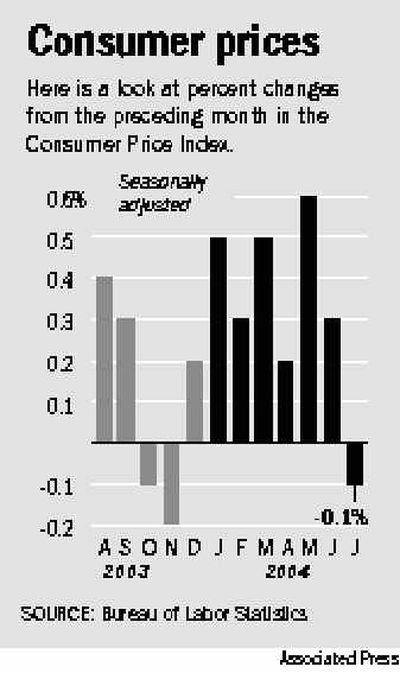
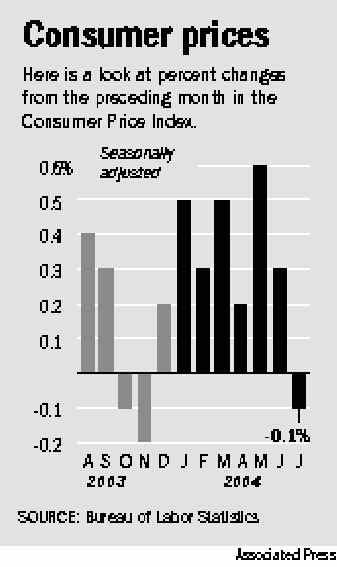
The Labor Department reported that its closely watched Consumer Price Index fell by 0.1 percent in July, the first decrease since last November, as gasoline prices, which had posted sharp increases in May and June, retreated by 4.2 percent last month.
Meanwhile, industrial production rose by a healthy 0.4 percent in July, after having fallen by 0.5 percent in June, while construction of new homes and apartments rose a better-than-expected 8.3 percent in July, erasing a 7.7 percent decline the previous month.
The setbacks in June were part of a pattern of weak economic data that helped drag down overall economic growth as measured by the gross domestic product to just 3 percent from April to June, sharply below the 4.5 percent GDP growth rate in the first three months of the year.
The Bush administration, which is counting on a strong economy to bolster President Bush’s re-election chances, has insisted that the recent slowdown, which included a disappointing increase of just 32,000 payroll jobs last month, was only temporary.
While many private economists agree with that assessment, they noted that job growth in August — the next-to-last employment report released before the Nov. 2 election — will very likely be depressed by Hurricane Charley, which struck during the survey week for August employment.
“We think it is unlikely that the economy will stall out although there are dangers, such as higher oil prices,” said Michael Carliner, an economist with the National Association of Home Builders.
While oil prices hit a record high of $46.58 per barrel in trading last Friday over concerns about supply disruptions, prices have retreated a bit this week.
The 0.4 percent increase in industrial output last month reflected a big gain of 1.2 percent in mining, a category that covers oil production, and 0.6 percent rise in production at U.S. manufacturing companies, which more than erased a 0.2 percent drop in manufacturing output in June.
Jerry Jasinowski, president of the National Association of Manufacturers, said that the July increase showed that the previous month’s decline “was a temporary breather in an otherwise strong growth curve.”
With last month’s increase, U.S. factories operated at 76.3 percent of capacity, the highest operating rate in more than three years.