
Lessons in survival
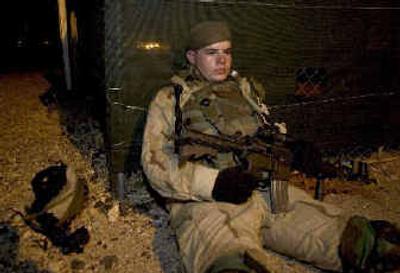
FORT BLISS, Texas – BooBoo could barely walk, stepping gingerly to favor his right foot, which stuck out sideways like a penguin’s.
His painful limp was the most visible marker of the strains that came with six hours of night patrol in 60-degree temperatures in a hostile desert. But the truth was, by 4:30 in the morning, all nine guys in Second Squad were hurting, not just Pfc. Buddrius, a Blanchard, Idaho, soldier who’s nicknamed BooBoo.
Two had been “killed” by friendly fire in the Wednesday night training exercise. They had fallen while walking on uneven ground in the dark. And then there was the “OC,” Observer and Controller, a no-nonsense sergeant from a different unit who walked the night with them to see how they handled surprises.
Oh boy, the OC was going to give it to them good during the discussion – known as a hot wash – of the just-completed patrol. So even though they were weary and two debriefings were the only thing keeping them from a hot shower and a bunk, the National Guard soldiers from North Idaho lingered as they shucked out of body armor and Kevlar helmets and the surprising amount of big and little things that can be tucked, clipped, snapped, taped or Velcroed to the human body. They heaved walruslike sighs of relief as they became, in some cases, instantly 100 pounds lighter.
The nine soldiers were pale with exhaustion, eyes pinched as they filed into the portable classroom, their slumping shoulders a far cry from when they stepped into the night six hours earlier with an almost jaunty air, weapons pointing off into the darkness, heads swiveling, hand signals passed up and down the column.
The night breeze carried the thick, sweet smells of sage and mint, as well as fouler, sulphur-tinged odors. Ears became tuned to snaps and thuds. Eyes strained to make sense of a darkness that had so much backlighting from the surrounding lights of El Paso that night-vision goggles were largely a drawback instead of a help.
Things began to go bad when the OC blew an air horn to signal mortar rounds coming out of the dark. The nine soldiers dove for cover, only there was no cover on the road.
A shouted command from the squad leader, Staff Sgt. Tom Irby, to run toward vegetation at 9 o’clock was misheard, with some soldiers running toward 12 o’clock and others not moving at all.
A few miles later sniper fire came from a fenced compound up on a dark knoll.
Second Squad formed a battle line and the four-man firing teams – alpha and bravo – began leapfrogging each other in the dark, snaking past sage and cactus, their M-16s and M-4s throwing out muzzle flashes as they poured blanks into the night.
Two guys, including Holloway the “saw gunner” (in human terms, he’s James, just turned 20 and is from Hayden, but everybody in the squad just yells “Holloway!”) cut too close in front of one of the firing teams and was shot by another soldier in the squad.
The “saw” – a fully-automatic machine gun and the heftiest firepower carried by the squad – rested with Holloway for a short spell of confusion. When somebody finally grabbed it, they didn’t take the backpack with 600 rounds of ammo.
Both these decisions were discussed at the hot wash.
These soldiers from Idaho are going to Iraq soon, and they are being drilled and drilled in the art of staying alive.
Second Squad’s firing teams were too close to each other, they didn’t move on the sniper position fast enough and allowed the shooter to get away. They wasted ammunition shooting into darkness at nothing at all.
“I went through 300 rounds,” one of the squad members said as they cleaned weapons Thursday afternoon.
“So you were shooting at shadows,” another squad member said, running cleaning pads through the barrel of his rifle.
No, no, the first guy insisted, another soldier was directing the fire. This drew a laugh from the four guys sitting around their bunks amid broken-down gun parts and cleaning tools. “He can’t see in the daytime,” they all crowed.
The humor was testimony to the ability of worn-out humans to rebound from pain and doubt.
Heads were hanging just hours earlier during the hot wash.
Make these sorts of mistakes in Iraq – lack of talking with each other, not reacting fast enough to gunfire – and you are not coming back, they were told.
“We are a team here. We have to talk to each other because if we don’t, we can die,” squad leader Irby told his soldiers. “I don’t want to write a letter” to a grieving family, he said.
The night patrol took Second Squad along roads, cross-country under the wheeling stars, and into two Iraqi villages constructed on the grounds of Fort Bliss and staffed by civilians who hector and scold the patrols in Spanish.
The military is doing whatever it can to make the 116th Armored Cavalry – Idaho citizen soldiers who include police officers and bank managers and mechanics and teachers – prepared for a year as combat soldiers.
The 116th’s combat engineers, who are largely based at armories in Post Falls and Bonners Ferry, are starting from scratch to learn combat infantry techniques.
“I knew somebody was going to die last night. I didn’t think it was going to be me,” Holloway, the saw gunner, said.
The saw is, of course, a military acronym – Squad Automatic Weapon – and “sometimes other saw gunners and me like to joke that we are going to saw people down, but you saw the truth of it last night, firing four- and five-round bursts,” Holloway said.
As part of the reality training, the soldier who killed Holloway on a sloping sandy lane near a fence line, “is going to have to write a letter to my mom.
“We talked this morning,” Holloway said. He was angry, refusing to shut up and play dead during the night patrol. But they talked it out, he and the other guy. “He’s not going to be ‘flagging’ people with the muzzle of his M-16,” Holloway said.
And as long as they all learn something, Holloway said, they all just might stay alive.
“I am firmly convinced with the training we are getting here and the training we already had, we are all going to walk off the plane on our own two feet coming home,” he said. “Maybe that’s optimistic, but that’s what I believe.”
The six-hour, six- or seven-mile night patrol was “our first-ever squad mission,” said Irby, the staff sergeant.
On Monday, the 116th moved into a new training cycle that brought them to the heart of Fort Bliss, which is surrounded on three sides by the growing cities of El Paso, Texas, and Juarez, Mexico.
Still, the Idaho guardsmen live behind razor wire – the base, El Paso are all Iraq. A muzzein’s recorded song, calling the faithful to prayer at the mosque, is played over loudspeakers five times a day, just as it would in Iraq.
Soldiers are denied alcohol in barracks and even on days off from training. In Iraq, the military is trying to show respect for Islamic culture, in part by keeping soldiers away from booze.
The 37-year-old Irby, a mechanic who has a wife and six kids in Coeur d’Alene, said morale among his guys remains good, even though they face burnout from being pressed constantly during the last six weeks of combat training.
Lessons learned the hard way, lessons that come with bruises and scratches and limping will be the lessons that sink in, he hopes.
“My motivation is to get these guys back alive.”
COMING SATURDAY: Life in camp at Fort Bliss, from fiddle music to old movies and a lot of roommates.