
Water polo harder than you think
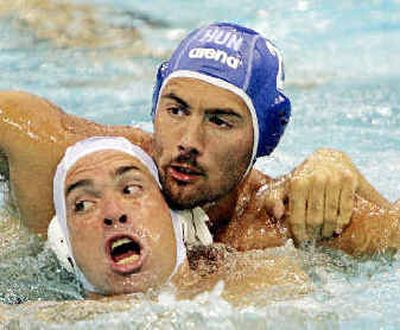
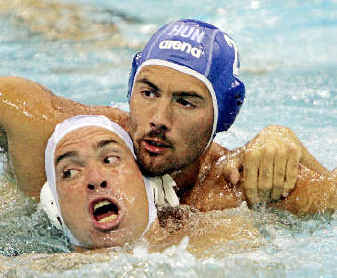
ATHENS — What to make of a sport in which you move the ball with your face, you practically have to decapitate somebody to get called for a foul and part of the strategy is to goad an opponent into fouling you so your team goes a man up for 20 seconds?
Welcome to water polo, which may be the toughest and dirtiest game at the Olympics.
An underwater viewing area provides a look at the literal underside of this sport, and it shows much more than one can see from the surface. There’s pushing, there’s grabbing, there’s kicking and pinching. And apparently it all goes unnoticed because the officials, who are standing out of the water alongside the pool, can’t really see it.
“You’re generally only going to see fouls on stuff that happens above the water,” said Wolf Wigo, the captain of the U.S. men’s water polo team, who recently suffered a burst eardrum when he took a knee in the ear – during training. “Underwater, I wouldn’t say it’s ‘anything goes,’ but it can get pretty rough.”
Last Sunday, U.S. coach Ratko Rudic was ripping the team from Kazakhstan for playing too rough, saying two of his players got hurt in the game and that the Olympics should not permit countries like that to play.
Overly dramatic? Maybe. But Rudic is like that.
“He’s one of a kind,” Wigo said of his coach. “He dominates the scene. We’re glad he’s on our side.”
Rudic was a water polo gold medalist as a player with Yugoslavia and a gold medal-winning coach at three consecutive Olympics (once with Italy, twice with Yugoslavia) from 1984 to 1992. Having not medaled in water polo since 1988, the United States, which plays Russia today in an attempt to move onto the medal round, hired Rudic in 2001 to revamp its program.
He did by implementing a physical training program he cheerfully calls “The Suffering,” in which players train for as many as 10 hours a day. The point is that whatever skill deficit they encounter in competition can be made up for with conditioning.
One of the key strategies is to create a power play (similar to hockey) by forcing the other team to foul and be “excluded” from the pool for 20 seconds.
A partial list of reasons for exclusion:
“Splashing in the face of an opponent intentionally.
“Holding, sinking or pulling back an opponent not holding the ball. (But if you’re holding the ball, you’re mostly fair game.)
“Attempting to play the ball before it has left the hand of the thrower.
“Using foul language.