
Cheney splits on marriage amendment
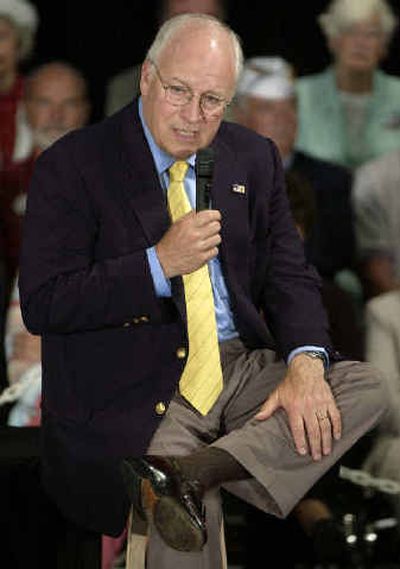
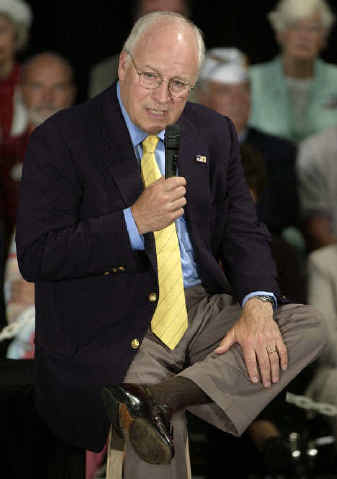
DAVENPORT, Iowa – Vice President Dick Cheney, whose oldest daughter is a lesbian, said Tuesday he believed that decisions about same-sex marriages should be left to the states, contending that “freedom means freedom for everyone.”
Despite his personal view, he added, President Bush is his boss, and Bush favors an amendment to the U.S. Constitution banning such marriages. “The president makes policy for the administration,” Cheney said.
His comments came in response to a question during an invitation-only town hall meeting in Davenport, a city both presidential campaigns have focused on in their competition to win Iowa. Cheney’s remarks were his first this year on the gay marriage issue while campaigning.
Religious conservatives, a key part of the Republican coalition, strongly support a federal ban on same-sex marriage. But recent Senate debate on the issue showed that it is a divisive subject among GOP lawmakers. And Cheney’s view represents a rare break by him from the party’s conservative base.
“Lynne and I have a gay daughter, so it’s an issue that our family is very familiar with,” Cheney said Tuesday. “With respect to the question of relationships, my general view is that freedom means freedom for everyone. People … ought to be free to enter into any kind of relationship they want to.
“The question that comes up with respect to the issue of marriage is what kind of official sanction or approval is going to be granted by government… . Historically, that’s been a relationship that has been handled by the states. The states have made that basic fundamental decision in terms of defining what constitutes a marriage,” he said.
His audience included his lesbian daughter, Mary, a campaign staff member.
Cheney took a similar position in the 2000 campaign, when he said that “people should be free to enter into any kind of relationship they want to enter into. It’s really no one else’s business in terms of trying to regulate or prohibit behavior in that regard.”
On Tuesday, the vice president said he could understand why Bush pushed for the proposed constitutional amendment to prohibit same-sex marriages after the Massachusetts Supreme Judicial Court made such unions legal in that state.
“I think his perception was that the courts, in effect, were beginning to change, without allowing the people to be involved,” Cheney said. “The courts … were making the judgment for the entire country.”
Asked later about the difference between Bush’s and Cheney’s positions on the constitutional amendment, Anne Womack, a spokeswoman for the vice president, responded: “The vice president respects the president’s right to make that decision.”
In July, the Senate easily shelved the amendment. Only 48 senators voted to halt a filibuster against the amendment, far short of the 60 votes needed to cut off debate.
Cheney played no public role in debate on the proposal. But his comments Tuesday prompted criticism from Tony Perkins, president of the conservative Family Research Council, which supports the traditional definition of marriage. In a statement, he wondered “why the vice president is allowed to depart from this position when the top of the ticket is unified on all other issues.”
“I find it hard to believe the vice president would stray from the administration’s position on defense policy or tax policy,” he said. “For many pro-family voters, protecting traditional marriage ranks ahead of the economy and job creation as a campaign issue.”
Cheryl Jacques, president of the Human Rights Campaign, a gay and lesbian advocacy organization, said Cheney’s position illustrates that same-sex marriage “is a personal issue that affects hard-working, taxpaying Americans.”