
Holiday cuisine
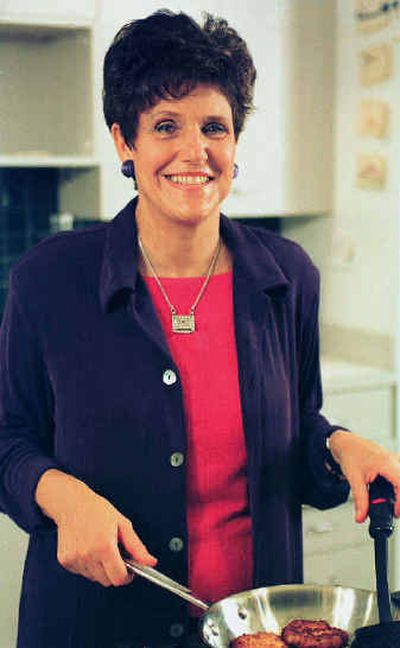
When growing up, cookbook author Joan Nathan would go each year to her Aunt Lisl’s house during Hanukkah to make butter cookies decorated with blue-colored sugar.
Now Nathan has made Aunt Lisl’s prized recipe – and hundreds of others – available to a new generation of Jewish cooks as they prepare holiday meals with their friends and families.
Nathan, 61, the grande dame of the Jewish culinary world, educated Jewish epicures 25 years ago with her book “The Jewish Holiday Kitchen.” This year, just in time for Hanukkah (which begins Tuesday), Nathan has updated her classic recipes in “Joan Nathan’s Jewish Holiday Cookbook” (Schocken Books, 544 pages, $29.95).
It’s sure to be on many a kitchen counter as the smells of potato pancakes, jelly doughnuts and beef brisket fill the air.
The book offers examples of Jewish cuisine from Morocco, Argentina and Egypt in addition to Eastern Europe. It also illustrates the latest trends in Jewish food, including a proliferation of readily available kosher and traditional ingredients and a renewed desire for tradition and family gatherings around the table.
“Families aren’t together enough,” says Nathan. “What’s so beautiful about Judaism is that at least on Friday night and on holidays, it’s a reason to have a family meal, it’s a reason to be together.”
Nathan’s eight books, which brim with stories, personalities and traditional Jewish tales in addition to recipes, have established her as much as a food anthropologist as a cookbook author.
She says that in a world where “everything melds together,” Jews who are disengaged from their religion, or simply uneducated about traditional Jewish foods, recognize something in her books.
“It’s sort of a way of saying, ‘This is my family,’ ” she said.
Nathan, a mother of three who never attended culinary school and began her career working for Jerusalem Mayor Teddy Kollek, said she is humbled by the many fans who describe their dog-eared copies of her books as “their Jewish cooking bible.”
But she stresses that the importance of her work is more than simply providing good recipes. It’s about preserving time-honored techniques and foods while updating them to be palatable to today’s health- and flavor-conscious cooks.
In recent decades, Jewish cuisine was in danger of becoming “bubbe cuisine, grandmother cuisine,” says Jayne Cohen, author of “The Gefilte Variations: 200 Inspired Recreations of Classics from the Jewish Kitchen” (Scribner, 2000), which she is revising for rerelease.
But Nathan led the way, Cohen says, to preserving the stories and traditions of Jewish food while also introducing new variations on themes, as well as geographically diverse sources of Jewish foods.
“Jewish food is layered food,” says Nathan, who has traveled extensively in Israel and written about Israeli cuisine. “It clearly started in ancient Israel and has wandered through time.”
Nathan’s own travels have taken her into the kitchens of home cooks and professional chefs alike, where she gathered stories as well as ingredients to communicate a larger message about Jewish life and cuisine.
One thing that Nathan encounters frequently in her travels is young people whose parents or grandparents have died, taking their family-famous recipes with them. That’s where she comes in.
“People are in desperate need of something today,” she said, “People who didn’t save family recipes regret it.”
In addition to their target audience, Nathan’s books have found a niche among non-Jews who are intrigued by the promise of good, time-tested food.
“Jewish culture and Jewish food are not marginalized anymore, so people don’t have that insular feeling about it,” says Cohen, who points to the popularity of klezmer music and Kabbalah spirituality as evidence of the mainstreaming of Jewish culture.
Interfaith families are also drawn to Jewish foods as a way to explore the Jewish heritage of part of the family, and simply enjoy good food together. Nathan says food and family are a natural pair.
“You don’t have to do it all alone,” she says. “You can involve your family. Cooking or sitting at the table is time when you can talk.”