
Project helps class deal with cancer
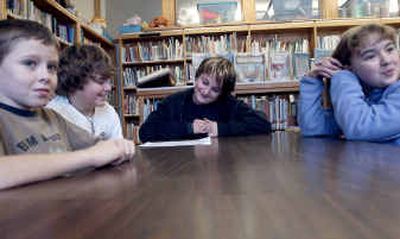
JENNY BROOKS, 11, is no stranger to cancer. She and classmate Sam Fortis, 11, throw around terms such as CAT scan as comfortably as they talk about juggling in their fifth-grade class at Coeur d’Alene’s Sorensen Elementary.
“I want kids to know it’s not their fault,” Jenny says, her brown eyes pools of seriousness. “I always thought it was my fault my great-grandmother Ruth got cancer, but I never knew her.”
Sam isn’t sure, but he believes his grandparents and an aunt died from cancer.
“I want people to know it’s not just a sickness. It’s a deadly virus that they have to be sure to stay away from,” he says.
If their grasp of cancer is a tad shaky, it won’t be by March. They’re helping their fifth-grade teacher, David Groth, write a book about a fifth-grade class in which the favorite parent volunteer has terminal cancer.
“We’re writing a chapter book and we’re going to get it published,” Jenny says with confidence.
David started the book six years ago. His wife, Jane, died from breast cancer in 1994. In 1997, a monthlong writing workshop for teachers, the Northwest Inland Writing Project through the University of Idaho, convinced David that he could write about the experience.
“It wasn’t a ‘Love Story,’ ” David says, referring to the 1970 Erich Segal book.
He had all the elements of a good story. David is passionate about juggling and introduces the skill to his classes every year. He views juggling as a metaphor for life.
“There’s laughter and silliness but it brings confidence and good things come of it,” he says. “It’s a quest for people.”
He saw a parallel between juggling and cancer and knew he could tie the two together for a funny yet heart-wrenching tale. He wrote scenes randomly and fervently at first, but as the first fires of inspiration cooled, his writing time waned.
“I wasn’t ready to write a book then,” he says. “There was a lot I didn’t know.”
The project dragged along. He read scenes every year to his classes to model writing and for honest feedback. He’d just read a few scenes to this year’s class when Jane’s cousin, Mark Pearson, visited him from California. Mark challenged David to produce a finished manuscript by Labor Day.
“I love a challenge, but where am I going to find the time?” David says.
Still, he accepted the challenge. A light went on in his head the next day.
“I’ll write it with my class,” he says. “We’ll talk about cancer at a level fifth-graders can deal with, knowing cancer is going to be a part of every fifth-grader’s life.”
He pitched the idea to his class the next week. They could write a book about a fifth-grade class writing a book. The story, he told them, was about a class learning to juggle over one school year. One student’s mother is a favorite classroom volunteer. She has a great sense of humor and connects easily with the kids.
“One of Jane’s best qualities was her sense of humor. She was zany, unpredictable,” David says.
Early in the school year, the mother is diagnosed with cancer. She’s frank about it in the classroom and starts honest conversations about cancer. She tells the kids she’s mad and depressed at one point, then hopeful because not everyone dies from cancer.
The class prepares a juggling show toward the end of the school year and the mother is the sole adult performer. But she grows too sick and can’t participate. Actress Patty Duke fills her role while the mother watches from a wheelchair. The end.
Anna Pearce – Patty Duke – was David’s neighbor a few years ago and agreed to perform in his school production after the original female performer opted out at the last minute. He incorporated that memory into the book.
David’s students embraced the book idea, particularly when he suggested future appearances on “Oprah” and the eventuality of a movie. They studied his scenes and pointed out inconsistencies and where they wanted more detail or information. They wanted their names in the story. And they began writing on their own.
“I have some really fine writers,” he says. “One emulated my style. A good portion of what they write will be used.”
Some students have written scenes on juggling. They’ll reach the cancer story line before Christmas. Jenny keeps a journal of odd things that happen in class to add to the story. David’s suggestion of a 250-page book doesn’t intimidate them.
“I could write a 50-page book, and we have 30 kids in the class,” Sam says. “It’s a really important subject.”
So important that David is entrusting it to the people who view life with a clarity they won’t lose for a few years.
“Cancer is bad but preventable,” Jenny says. “Everyone has to deal with it. You have stuff you have to do that you don’t like, but we all do it.”