
Counterfeiters get close examination
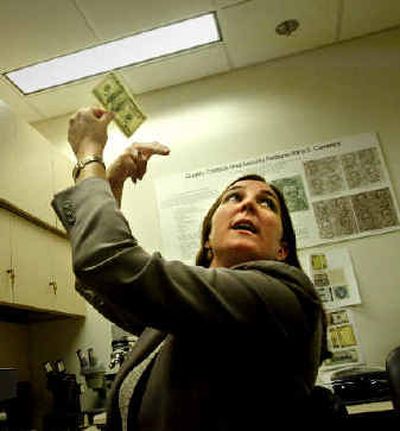

WASHINGTON — Karl Miller hunts for clues in cold cash — counterfeit cash, that is.
Studying a bogus $100 bill, Miller looks for imperfections — a wisp of ink extending outside of a line, blurred scrollwork, a mottled background — that might tie it to another one on record, and help investigators catch the counterfeiters.
“What we are trying to do is compare the image that we see, the details from it, to the details seen on previous images of counterfeit,” said Miller, a counterfeit specialist in the Secret Service’s anti-counterfeiting lab. The Secret Service is the primary federal agency for investigating the counterfeiting of U.S. currency.
A cache of 23,000 uniquely classified counterfeit notes stored in a “specimen vault” helps investigators make a match. That, in turn, helps them decide whether to go after those who made the phony money or those who distributed it.
Using microscopes, hand-held magnifiers and a fleet of sophisticated instruments and equipment, investigators analyze the bogus bills.
“We start with the paper and work our way to determine how they did produce it,” said Lorelei Pagano, a senior counterfeit specialist.
Real bills, for instance, have tiny red and blue fibers embedded throughout. Counterfeiters often try to simulate them by printing tiny red and blue lines on their paper.
Examiners also look for attempts to copy security features, such as watermarks that become visible when held up to light, ink that shifts colors when a bill is tilted and embedded security threads that glow a certain color when exposed to ultraviolet light.
Information about how a counterfeit bill is made also helps examiners evaluate the effectiveness of existing security features.
The lab also studies the security features of foreign currencies, keeps up with new security technologies, conducts anti-counterfeiting training and assesses the effectiveness of possible changes to U.S. currency.
Roughly 60 percent of the $37 million in counterfeit notes passed off as genuine in the United States are printed overseas, mostly in Columbia, the Secret Service says. Officials suspect the counterfeiting may be related to the drug trade.
Most bogus U.S. notes made overseas are done through traditional printing processes, such as offset printing, while most of those produced in the United States are done digitally, Secret Service officials say.
In general, a traditionally printed counterfeit note tends to look better than a digital one, although quality can run the gamut for each type of printing process.
Counterfeiters in the United States who use traditional printing methods are becoming a rarer breed, officials say.
“We monitor ex-counterfeiters,” said Larry Johnson, special agent in charge of the Secret Service’s criminal investigation division. “We like to know where they are. What they are doing. As time has passed, this expertise has kind of gone away because the real printers, the real counterfeiters have died off. At least domestically,” he says.
The number of counterfeit bills these days is small — just a tiny fraction of the $710 billion of genuine U.S. notes circulating worldwide.
Ironically, counterfeits tend to increase after a new note is issued.
The $20 bill — the most copied in this country — was remade in 2003. During the year that ended Sept. 30, about $4.6 million in counterfeit $20 bills were passed off domestically, the Secret Service says. An additional $750,000 in counterfeit $20s were seized before they could be circulated.