
Seattle-area shelters awash in kittens
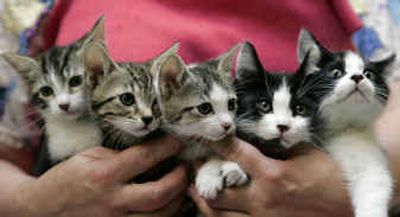
SEATTLE — A warm winter has rained cats and dogs on area animal shelters.
The mild weather has meant more litters and fewer deaths among unwanted animals, cats especially, and some shelters say they’re flooded with kittens.
The Humane Society’s Bellevue shelter has had to bring in a trailer to house some of its 436 felines.
Unweaned kittens who need special care such as bottle feeding are sent to the Mercer Island Eastside Orphans and Waifs, or MEOW, which rarely turns newborns away.
“We’re trying not to panic,” Bonne VeVea, who founded MEOW in 1997, told the Seattle Times. But the operation is struggling to find safe havens for 411 cats and kittens — about 100 more kittens than normal — at its shelter or in foster care.
Veterinarian Brian Huntsman with the Humane Society shelter in Bellevue theorizes that the mild winter may have resulted in some cats going into heat earlier than January, the normal time.
“If we’re starting to get busy now, as the season progresses along, it’s going to get worse,” Huntsman told the Times.
The director of the Seattle Animal Shelter has a darker theory. When there are “freezing spells, there is a certain population that doesn’t make it over the winter,” Don Jordan said.
During milder winters, more of those animals survive.
“We used to have slow seasons over the winter,” Jordan told the Associated Press. “We haven’t seemed to have that in recent years.”
And during kitten-puppy season in spring and summer, “things really start to get out of control,” he said.
Increased neutering has helped reduce the unwanted-pet population, Jordan said, noting that Seattle helped pioneer city-operated spay-neuter clinics in the early 1980s.
The shelter now handles between 5,000 and 10,000 animals a year and euthanizes about 2,500 of them. Too many, he said, but a big improvement over the 25,000 animals handled in 1972, when about 90 percent were killed.
“It’s still a reality that there are too many animals out there. We need to try to get that message out,” Jordan said, adding that “it’s an endless message.”
At MEOW, which moved to Kirk-land in December, the influx has meant extra cleaning time for volunteers. What’s usually a three-hour job — washing out cages and litter boxes — now takes five.
Cleanliness is critical with so many cats in close quarters, VeVea said.
“It’s like a day care,” she said. “They get sneezes and colds — all it takes is one.”
VeVea founded the organization in Mercer Island seven years ago. Shelter space, which includes play rooms as well as stacks of cages, is reserved for felines who need special care.
MEOW still turns away cats daily, but callers are counseled on caring for strays and on spaying and neutering.
“We help people work through logical solutions so (the cats) don’t have to be euthanized,” said VeVea, whose organization has a no-kill policy.