
Gore games
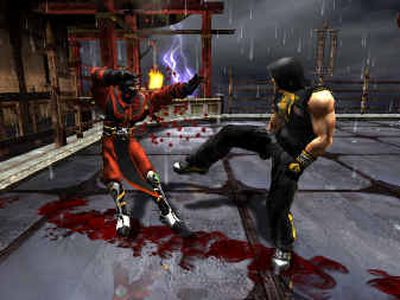

In video games these days, you can strangle someone with a garrote (“Manhunt”), pop off an enemy’s head in a shower of gore with a sniper shot (“Psi-Ops: The Mindgate Conspiracy”) and direct a teenage girl to shotgun a demon dog (“Silent Hill 3”). Not to mention beat up prostitutes, run down pedestrians, bathe in the blood of your enemies and curse like a lobster boat captain who’s stubbed his toe. The video game industry seems to delight in pushing the envelope — and the bounds of good taste — with ever-gorier content. That has put it under renewed attack from legislators and activists who claim some titles must be kept out of kids’ hands, though courts have repeatedly granted games First Amendment protections.
The opponents cite new research that they say suggests strong links between violent games and aggressive behavior. They are disturbed by games’ cultural ubiquity and the always-improving technology that makes virtual gore more realistic than ever.
“Pediatricians and psychologists have been warning us that violent video games are harmful to children,” said Washington State Rep. Mary Lou Dickerson, D-Seattle, who wrote a 2003 law — now being challenged in federal court — banning the sale of some violent games to kids.
“I’m optimistic that the courts will heed their warnings,” she said.
Lawmakers in at least seven states proposed bills during the most recent legislative session that would restrict the sale of games, part of a wave that began when the 1999 Columbine High School shootings sparked an outcry over games and violence. None of the measures that passed has survived legal challenges.
The game industry says legislating ultra-violent games out of the hands of children would deal a severe blow to free speech. Game companies point to the industry-imposed ratings system that gives detailed descriptions of violence in a game and labels some titles as “mature” or “adults only.”
“Does it make any rational sense to you that we’re going to pass a law someplace that says we’re not going to prevent minors from buying (the movies) ‘Passion of the Christ’ or ‘Kill Bill’ or ‘Texas Chainsaw Massacre’ in a local store but you can’t buy (the game) ‘Resident Evil?’ ” said Douglas Lowenstein, president of the Entertainment Software Association.
Game opponents — many of whom admit they don’t play video games — point to new studies that purport to show a stronger link between violent games and aggressive behavior than ever.
“On average, there is a significant tendency for the studies to yield an increase in aggression by those who have played the violent games,” said Craig Anderson, an Iowa State University professor and leading researcher on the effects of media violence.
There is also the inescapable fact that the military uses video games to train its soldiers. In his new book “Generation Kill,” author Evan Wright quotes one U.S. soldier in Iraq as saying an ambush felt just like playing the game.
“It felt like I was living it when I seen the flames coming out of windows, the blown-up car in the street, guys crawling around shooting at us,” the soldier says.
The next 12 months could see a flurry of new scrutiny of violent games, with three controversial franchises due to release sequels.
They include “Doom,” notorious as a favorite of the Columbine killers; “Mortal Kombat,” with its calls for a player to “finish” opponents in myriad gruesome ways; and “Grand Theft Auto,” which exhorted players in its latest version to start a Cuban-Haitian race war.
Among the games’ most vocal critics is Jack Thompson, a Florida lawyer who has tried, so far without success, to argue for acquittal of defendants in violent crime cases in which he believed that games made them do it.
“There’s a culpability here that should be shared by those who are training kids to kill,” Thompson said.
Thompson is part of a $246 million case filed last year that accuses Rockstar Games, Sony Entertainment and other companies of causing two teenage stepbrothers to shoot and kill a motorist, and wound another, in Tennessee last year.
The boys, who pleaded guilty to reckless homicide, reckless endangerment and aggravated assault, told authorities they were inspired by the “Grand Theft Auto” series.
Nationally, proposed legislation by Rep. Joe Baca, D-Calif., would penalize retailers who rent or sell games with violent, sexual or other “harmful” content to minors. A version was killed in 2002 but a revised draft is making its way through the Judiciary Committee, with 43 co-sponsors.
New Zealand, Brazil, Germany and several other nations have outlawed some games. In Britain, the makers of the “Resident Evil” series were made to change the color of blood from red to green, while the creators of “Carmageddon” had to make the people you run over in your car look more like zombies than average pedestrians.
There already are some limits on the availability of violent games to youngsters in the United States.
The National Institute for Media and the Family reports that 79 percent of stores it surveys prohibit selling mature-rated games to kids. Many major chains — including Wal-Mart and Best Buy — will have a carding policy in effect by the end of the year, though the games also are available over the Internet.
“Grand Theft Auto: Vice City,” the best-selling game of 2002, was the only mature-rated game among the top 10 for 2003, at No. 6, according to NPD Fungroup.
“Vice City” trailed the top title, “Madden NFL 2004,” as well as two Pokemon games and “The Legend of Zelda: The Wind Waker,” a Nintendo Co. tale featuring a kid in a green outfit who travels by talking boat and pals around with an excitable fairy named Tingle.
And the most popular computer game of all time is Electronic Arts Inc.’s “The Sims,” in which the player is virtually incapable of committing any act of violence whatsoever.
American McGee, who in 2000 made the last mature-rated game for Electronic Arts, “American McGee’s Alice,” said game publishers try not to get engaged in the debate over whether violent games cause violent behavior.
“They look at how hypocritical our society is when it comes to judging the content or sexuality in the media,” McGee said. “And they look at how these double standards or triple standards are applied to films versus games or music versus games or written fiction versus games, and it’s a silly argument to get involved in.”