
‘Bad’ cholesterol gets new low
Updated government guidelines expected today suggest that people at risk of a heart attack or stroke should lower their “bad” cholesterol levels even more than previously recommended.
The update from the National Cholesterol Education Program (NCEP) recommends more intensive drug treatment to help meet the new goals. Its authors say the new “therapeutic options” could apply to millions of Americans.
NCEP considers patients high-risk if they have coronary heart disease, diabetes or diseased blood vessels to the brain or arms or legs. Individuals also are high-risk if they have at least two risk factors, such as high blood pressure, that raise their heart attack risk to more than 20 percent over the next decade.
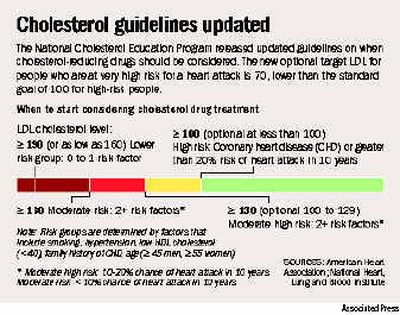
The update, based on a review of five recent studies encompassing more than 50,000 patients, identifies a subset of patients as very high risk and suggests that they reduce their LDL, or “bad” cholesterol, to below 70.
An LDL of “100 certainly yields results, but 70 looks even better,” says co-author Sidney Smith, a University of North Carolina cardiologist. In 2001, NCEP lowered the goal for LDL for high-risk patients to below 100 milligrams per deciliter.
Very high risk includes patients who have had a heart attack or stroke and have multiple risk factors. People who have just had a heart attack or have metabolic syndrome – a combination of risk factors associated with obesity – also are considered to be very high risk.
All high-risk patients whose LDL is 100 or higher could benefit from taking cholesterol-lowering drugs, the update says. In 2001, drugs were recommended for high-risk patients if they had an LDL of 130, and they were optional for an LDL of 100 to 129.
The authors acknowledge that lowering LDL to below 70 will be impossible for some, even if they take more medication and diet and exercise.
“If you start at 170 LDL, you’re not likely to get all the way down the scale,” says NCEP coordinator James Cleeman. But such patients should try to cut LDL 30 percent to 40 percent.
The update suggests a lower LDL goal and drug treatment threshold for moderately high-risk patients who have a 10 percent to 20 percent risk of heart attack in the next decade.
Currently, only about half of candidates for cholesterol-lowering therapy are on it, says lead author Scott Grundy, an internist at the University of Texas Southwestern Medical Center at Dallas.