
Kabbalah
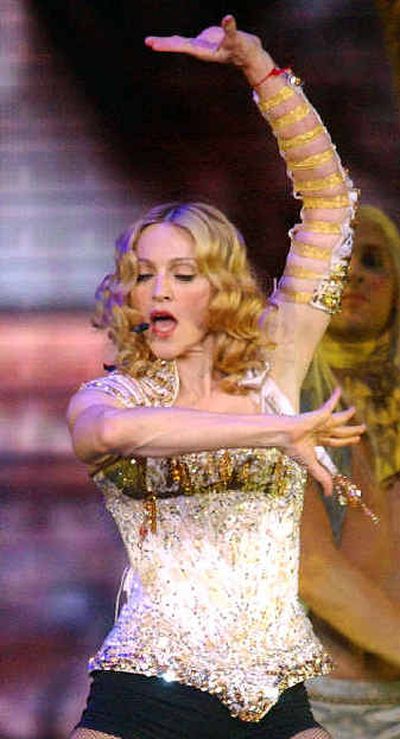
Madonna’s doing it.
Britney’s doing it.
And a host of other celebrities are doing it.
They’re studying Kabbalah.
Delving into the topic of Jewish mysticism brought warnings from scholars: Kabbalah is complex and only for the spiritually mature. But with celebrities like Demi Moore, Roseanne Barr and Gwyneth Paltrow flocking to Kabbalah centers and sporting red-string bracelets as a sign of their newfound interest, the question is a natural: What is Kabbalah?
“There is no simple definition of Kabbalah,” said Elliot Wolfson, professor of Hebrew and Judaic studies at New York University and a leading scholar of Kabbalah. “The word means ‘tradition,’ and from some time in the Middle Ages, the term began to be used to refer to secrets about the divine nature, the cosmos and the human soul or, principally, the soul of the Jew.
“Kabbalah relates both to esoteric wisdom and contemplative practices that facilitate communion, and sometimes even union, of the individual and God,” Wolfson said.
“There are meditative and magical practices, but the main application is to provide a layer of deeper meaning for observing the traditional Jewish commandments,” said Pinchas Giller, professor of Jewish thought at the University of Judaism in Bel Air, Calif.
Traditionally the study of Kabbalah has been reserved for the most learned and pious, not the masses. Jews could not even begin studying it until they were 40 years old.
The ideas and teachings of Kabbalah go back 2,000 years and originally were orally transmitted.
“It became a written tradition in the late 12th century and flourished in the 13th century in Spain,” said professor Hava Tirosh-Samuelson of Arizona State University, who studies the relationship between philosophy and Kabbalah.
“Several Kabbalistic schools developed concurrently, but the most influential one was the school that produced the magnum opus of Kabbalah, Sefer ha-Zohar (The Book of Enlightenment).”
The Zohar can be described as a mystical commentary on many sections of the Torah, or the first five books of the Hebrew Bible. It deals with five theological issues, said Jim Wallis in “The Religion Book”: the nature of God, the creation of the universe, the destiny of humanity, the nature of evil and the meaning of the Bible.
“Torah deals with the physical and with this world,” said Rabbi Mendy Wineberg of Chabad House Center. “It does not generally discuss things that don’t apply to our daily service of God in the here and now.
“Kabbalah, on the other hand, looks at the spiritual reasons and outcomes of our actions.”
So why has it become such a sensation with modern-day celebrities?
“I think that performing artists are attracted to the Kabbalah’s images of struggle, the overcoming of impediments and the underlying instability of present-day existence,” Giller said. “These anxieties are at the root of much traditional Kabbalistic writing.”
Tirosh-Samuelson sees three reasons for Kabbalah’s present popularity:
• It consists of a strong psychological emphasis, since it concerns the pursuit of perfection and the spiritual transformation of the individual.
• It is highly visual and employs the power of the imagination. Practices include a special focus when reciting prayers on colors that correspond to specific potencies of the divine.
• It has much to say about sexuality, both human and divine.
“The combination of the emotional, the imaginative and the sexual makes Kabbalah extremely attractive to artists who are seeking new imagery or who are displeased with the shallowness and emptiness of American consumerist culture,” she said.
But to Wolfson, what is being offered today is, he said, a distorted “pop version that is far more a form of New Age occult astrology and magic than a genuine expression of Kabbalah.”
“The main danger in the popularization of Kabbalah is the belief that it has nothing to do with traditional Judaism or that one does not need to live as a Jew in order to engage in Kabbalah,” Tirosh-Samuelson said. “Kabbalah is an integral part of Judaism and cannot and should not be wrested from its Jewish moorings.”
And, added Rabbi David Fine of Congregation Beth Israel Abraham & Voliner, an Orthodox synagogue: “It is very demanding, and it requires a purity of soul and personality that Madonna just doesn’t have.”
Wolfson thinks Madonna and other celebrities have been misled into treating the repackaged Kabbalah “as if it is a spiritual quick-fix.”
“It is demeaning and does not honor the complexity of the tradition,” he said. “It is like a sixth-grade teacher trying to make Einstein’s theory of general relativity understandable to his or her students.”
But some Jewish scholars don’t see the attention as all bad.
“Every time in Jewish history that outbreaks of Judeaophilia have occurred, the Jews have gratefully accepted a few crumbs of positive attention,” Giller said.
Kabbalah has always been a crossover phenomenon, he added, with kabbalists teaching gentiles in the third, 12th, 16th and 18th centuries.
“So scholars shouldn’t be surprised when it happens again,” Giller said. “People can’t choose their relatives, and scholars can’t dictate the history of their chosen fields.
“However, being nearby during this present-day eruption of interest is good for me. I prefer living traditions.”