
Bridge

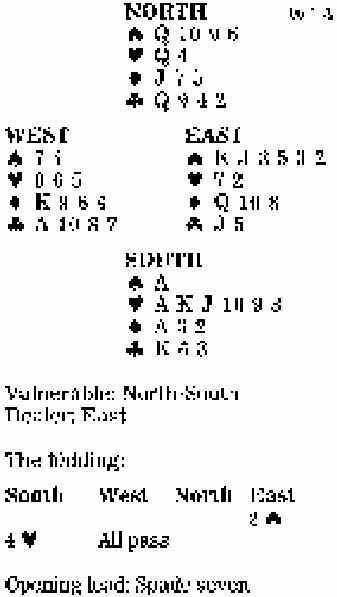
Most of bridge consists of trying to do the best you can — rather than trying to persuade your opponents to do worse than they should. Nonetheless, on occasion, it is enormously satisfying to tempt an opponent into doing something he may regret later.
Today’s four-heart contract is just such an example. On the lead of the spade seven you can see that entries do not permit you to establish a spade to allow a discard for one of your minor-suit losers. You appear to have four top losers, unless you can hold your club losers to just one — apparently impossible as the cards lie.
Still, you must try to exploit the ambiguity of the opening lead. East does not know what the spade layout is, so you must try to trick him into doing some of your dirty work for you. If he can be persuaded to waste a high spade honor unnecessarily, it will allow you to build a trick in that suit.
Accordingly, at trick one cover the spade seven with dummy’s 10 and hope that tempts East into letting go of his jack. If so, you can win and draw two rounds of trump ending in dummy, then lead the spade queen to take a ruffing finesse against the spade king. Now that the spade nine is a winner, you can eventually use the club queen as a delayed entry to dummy to establish a discard for one of your diamond losers.
Bid with the aces
South holds:
| •K J 8 5 3 2 | |
| •7 2 | |
| •Q 10 8 | |
| •J 5 |
| South | West | North | East |
| 1 • | Pass | ||
| 1 • | Pass | 2 • | Pass |
| ? |
Answer: Rebid two spades. Here, although your spade suit is broken, it is right to repeat a six-card suit. You have no reason to assume that a seven-card fit in either hearts or diamonds may work out better than spades. Additionally, your hand may be nearly worthless in hearts, but play quite well opposite even a singleton spade honor.